Your Legs Are Predicting Your Brain's Future
Written and edited by Sarah Bonza, MD, MPH, FAAFP, MSCP, DipABLM, NBC-HWC

What a decade-long study of 324 female twins revealed about muscle, memory, and the years ahead.
There is a study I think about constantly in my clinic, and I want to tell you about it, because it changed how I talk to women about strength training.
In the late 1990s, researchers at King's College London measured the leg power of 324 healthy female twins. The women were between 43 and 73 years old — midlife through early old age. Nothing exotic was done to them. They sat on a machine called a Nottingham Power Rig and pushed, hard, one leg at a time. The machine recorded how much explosive power they produced. The researchers also tested their thinking: memory, learning, processing speed.
Then everyone went home and lived their lives for ten years.
When the women came back a decade later, the researchers tested their cognition again. A subset also had MRI brain scans. And what they found was this: the leg power measured ten years earlier predicted how much cognitive ground each woman had lost — and predicted how much grey matter she had left in her brain [1].
The stronger legs, the better-preserved mind.
Why the twins matter so much
Here is the part that makes this study unusually persuasive, and it is the reason I bring it up so often.
Whenever we find a health association in a population, the honest first question is: what else could explain this? Maybe women with strong legs also had better childhoods, better nutrition, better genes, better education, more money. Maybe the legs are just a marker for a life that was already going well.
Twin studies are built to attack exactly that problem. Identical twins share their DNA and, typically, their early-life environment — the same household, the same food, the same schooling, the same socioeconomic starting line.
So the researchers ran what is called a discordant twin analysis: they looked only at pairs where one sister had meaningfully stronger legs than the other, and asked whether the stronger sister had aged better cognitively.
She had. Within twin pairs, the difference in fitness predicted the difference in cognitive change — and also predicted a difference in lateral ventricle size, a structural marker of brain atrophy [1]. Same genes. Same childhood. Different legs. Different brains.
The effects survived a genuinely aggressive statistical adjustment. The researchers controlled for heart disease, diabetes, blood pressure, fasting glucose, lipids, diet, body habitus, smoking, alcohol, reading IQ, socioeconomic status, and birthweight [1]. Leg power was still standing at the end of it.
And notably: leg power outperformed the other lifestyle factors the researchers tested. Self-reported physical activity — the thing most of us assume is the important variable — showed only a weak independent effect [1]. What predicted the brain was not how much the women said they moved. It was how much force their legs could actually produce.
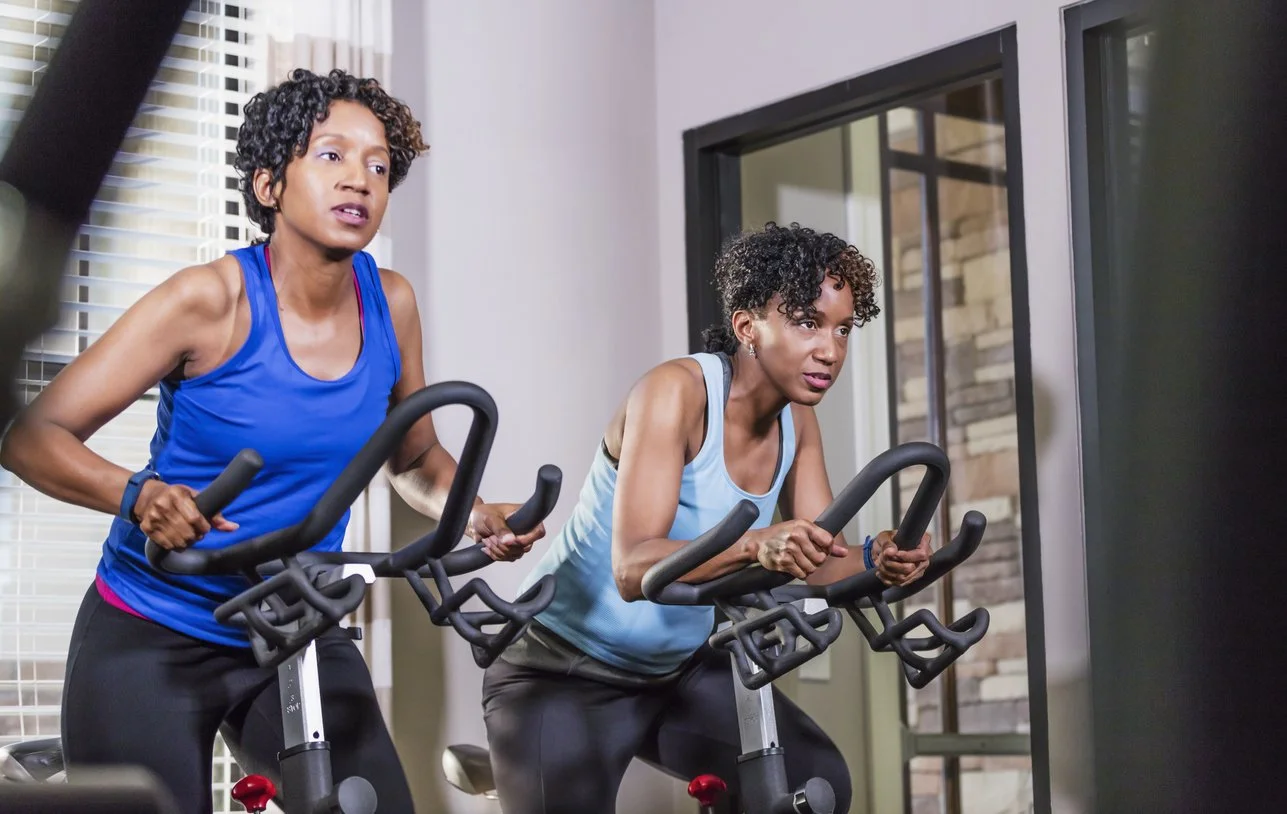
Identical twins share their DNA and, typically, their early-life environment — the same household, the same food, the same schooling, the same socioeconomic starting line.
This is not one strange study
If leg power were the only finding pointing this direction, I would tell you it was interesting and to wait for replication. It isn't.
The largest confirmation comes from the UK Biobank, where researchers tracked 466,788 adults — median age 56.5, and 54.5% of them women — using a simple hand dynamometer to measure grip strength [2].
Over roughly nine years of follow-up, 4,087 participants developed dementia and 1,309 died from it. Compared with the strongest fifth, people in the weakest fifth for grip strength had a 72% higher risk of developing dementia and an 87% higher risk of dying from it — after adjustment for age, sex, ethnicity, deprivation, BMI, multimorbidity, long-standing illness, walking pace, sleep, television time, smoking, and diet [2].
Two more numbers from that paper are worth sitting with.
The first: the authors calculated that roughly 30% of dementia cases and 32% of dementia deaths in that cohort were statistically attributable to low grip strength [2]. That is a population-level figure with big assumptions behind it, and I'll return to those assumptions in a moment. But it is not a small claim.
The second, and the one I find most intuitive: the researchers translated the risk into time. Women and men in the weakest fifth for grip strength experienced the same rate of dementia as people in the strongest fifth who were three years older [2]. Weak muscle, in that dataset, looked like three extra years of brain aging.
And a 2021 systematic review pulled 15 longitudinal cohort studies together. After sensitivity analysis, poorer grip strength was associated with a substantially higher risk of cognitive decline (HR 1.99, 95% CI 1.71–2.32) and of dementia (HR 1.54, 95% CI 1.32–1.79) [3]. The signal held across Alzheimer's and non-Alzheimer's dementia subtypes [3].
Different countries. Different measurement tools. Different decades. Same direction.
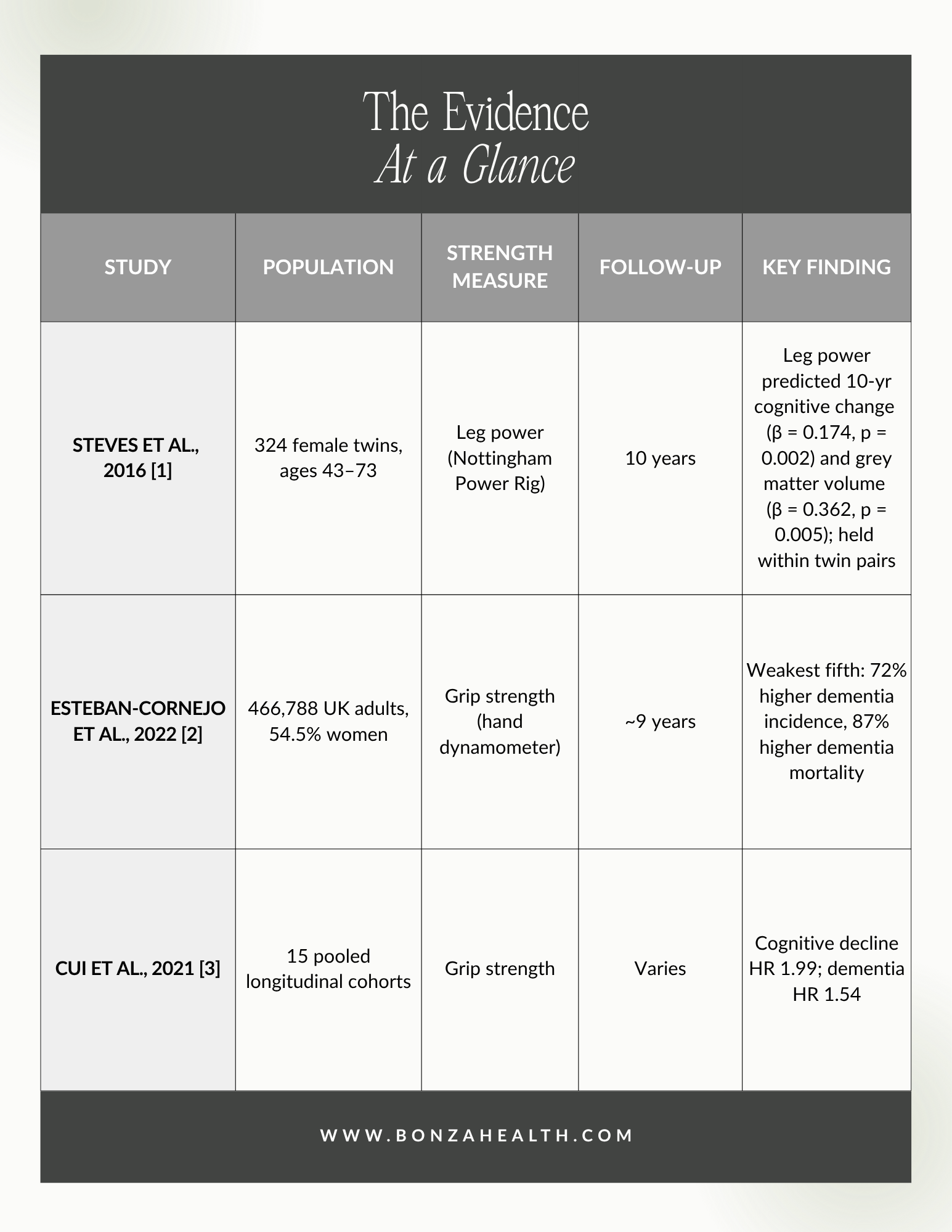
Table 1: The evidence at a glance.
Why would legs have anything to do with the brain?
For most of medical history, we treated skeletal muscle as scaffolding — the thing that moves the skeleton around. That understanding is now obsolete.
Muscle is an endocrine organ. When a muscle fiber contracts, it manufactures and releases signaling proteins into the bloodstream. These are called myokines, and they carry messages to the liver, the bones, fat tissue, blood vessels — and the brain [4].
Several of these appear able to cross the blood-brain barrier, or to act on the cells that line it. Cathepsin B and irisin are the two most studied; both have been shown to stimulate production of brain-derived neurotrophic factor, or BDNF [4], [5]. BDNF is essentially fertilizer for neurons. It supports the birth of new cells in the hippocampus — the memory structure — and it supports synaptic plasticity, which is the physical substrate of learning [4,5].
So the working hypothesis, in plain language: contracting muscle sends chemical messages that help the brain build and maintain itself.
Now, why legs specifically? Because of volume. Your quadriceps, glutes, and hamstrings are the largest muscles you own. If contraction is the signal, the legs are the loudest transmitter you have. A biceps curl sends a whisper. A heavy squat sends a shout.
That is the mechanistic story, and it is biologically plausible and actively researched. It is not yet proven in humans as the explanation for the findings above.

Your quadriceps, glutes, and hamstrings are the largest muscles you own.
Let me be honest with you about what this evidence is not
I am not going to oversell this, because my credibility with you is worth more than a viral headline.
These are observational studies. They show association and prediction. They do not, on their own, establish that building leg strength prevents dementia. It is possible that very early, undetected brain changes cause muscle weakness rather than the other way around — a phenomenon researchers call reverse causation. The Biobank team addressed this by excluding the first two years of follow-up and everyone with dementia at baseline [2], and the twin design in the leg-power study rules out shared genetics and childhood environment [1]. Those are strong defenses. They are not the same as a randomized trial.
The 30% attributable-fraction figure is conditional. It answers the question "if this relationship is causal, how much dementia would be attributable to low strength?" The "if" is doing real work in that sentence.
The twin cohort was not fully representative. Those women were relatively educated, of middling occupational status, and somewhat healthier than the general population [1]. And the study started at age 43, so it tells us about midlife into early old age — not about what happens at 85.
Here is where I land, as a physician: the evidence that strength training preserves function, independence, bone density, metabolic health, and mobility in women is already strong enough to recommend without reservation. The cognitive data is a compelling additional reason to start — not the only one, and not a guarantee.
You do not need certainty to act on something with this much upside and this little downside.
What to actually do
The women in the original study were not powerlifters. They were ordinary women whose legs happened to be capable of producing force. That is a trainable quality at any age.
Four movement patterns cover almost everything that matters for lower-body strength and power.
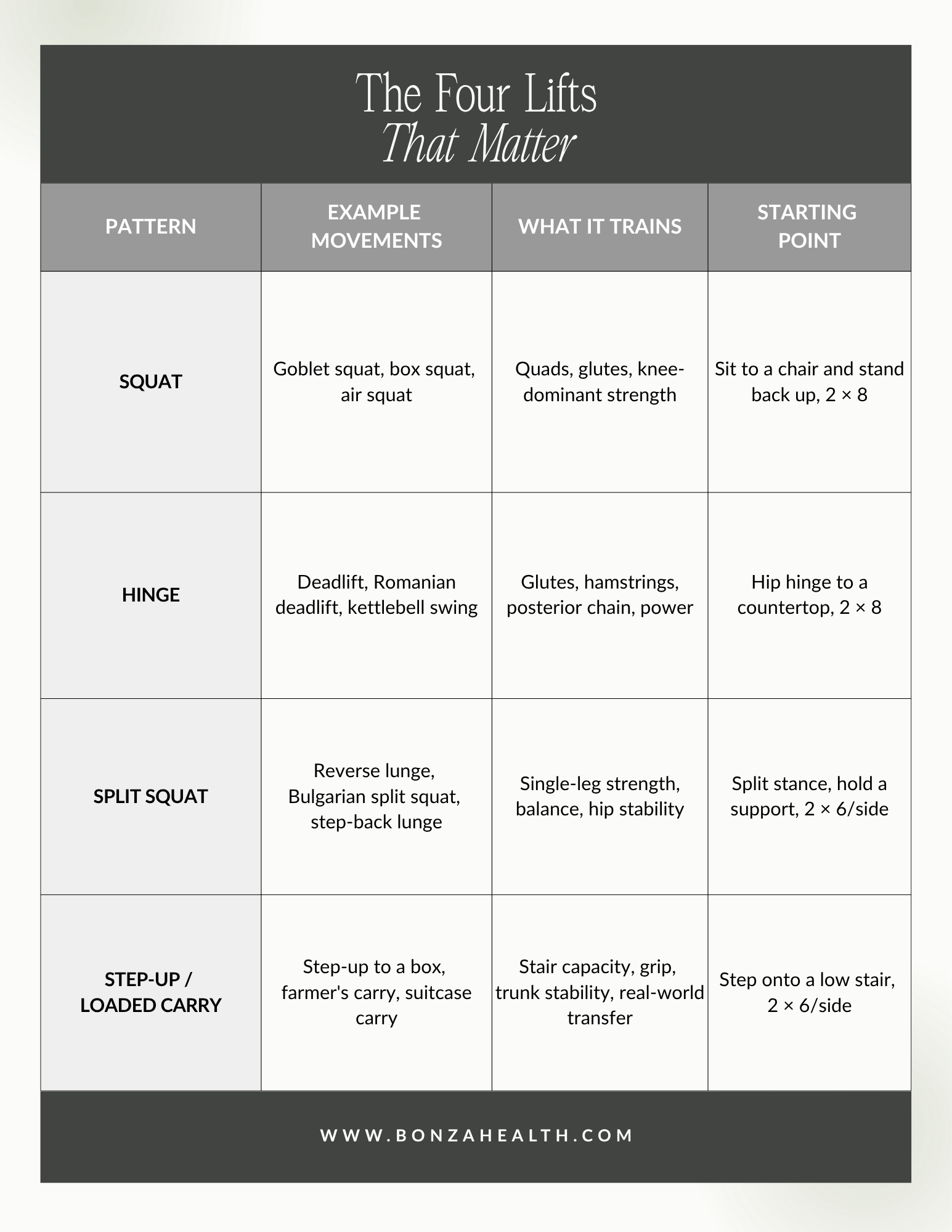
Table 2: The four lifts that matter.
The dose: two to three sessions per week, on non-consecutive days. Five to eight repetitions per set when you're building strength. The last two reps of each set should feel genuinely hard — this is where "power" gets built, and it's the variable that showed up in the data.
Add speed, not just weight. Leg power is force produced quickly — it's strength with a stopwatch attached. Once a movement is safe for you, drive up out of the bottom position with intent. Stand up from the chair fast. Push the floor away.
The grip is not incidental. Farmer's carries — walking with heavy weights in each hand — train the exact quality the Biobank measured, and they train your whole posterior chain and trunk while doing it.
If you are postmenopausal, newly diagnosed with osteopenia, managing a joint that complains, or simply have not lifted anything heavier than a grocery bag in fifteen years — that is not a reason to skip this. It is a reason to start with guidance.
The bottom line
Your legs are one of the most honest predictors of your cognitive future that we currently have. Not because strong legs magically protect the brain, but because muscle is a signaling organ, and the legs are where most of your muscle lives.
That prediction is not a verdict. Leg power is one of the few risk markers on the entire dementia list that you can change with a chair, a set of dumbbells, and twenty minutes, twice a week.
Start there.
Dr. Sarah Bonza is a board-certified physician focused on women's health and longevity. This article is educational and is not a substitute for individualized medical advice. Talk with your clinician before beginning a new resistance training program, particularly if you have cardiovascular disease, uncontrolled hypertension, osteoporosis, recent surgery, or a joint injury.

Ready to build a strength plan that fits your body and your history? Book a consultation at Bonza Health.
References
[1] C. J. Steves, M. M. Mehta, S. H. D. Jackson, and T. D. Spector, "Kicking back cognitive ageing: Leg power predicts cognitive ageing after ten years in older female twins," Gerontology, vol. 62, no. 2, pp. 138–149, 2016, https://doi.org/10.1159/000441029. PMID: 26551663.
[2] I. Esteban-Cornejo et al., "Handgrip strength and all-cause dementia incidence and mortality: Findings from the UK Biobank prospective cohort study," J. Cachexia Sarcopenia Muscle, vol. 13, no. 3, pp. 1514–1525, Jun. 2022, https://doi.org/10.1002/jcsm.12857. PMID: 35445560.
[3] M. Cui, S. Zhang, Y. Liu, X. Gang, and G. Wang, "Grip strength and the risk of cognitive decline and dementia: A systematic review and meta-analysis of longitudinal cohort studies," Front. Aging Neurosci., vol. 13, art. no. 625551, Feb. 2021, https://doi.org/10.3389/fnagi.2021.625551. PMID: 33613270.
[4] M. C. K. Severinsen and B. K. Pedersen, "Muscle–organ crosstalk: The emerging roles of myokines," Endocrine Reviews, vol. 41, no. 4, pp. 594–609, Aug. 2020. https://doi.org/10.1210/endrev/bnaa016. PMID: 32393961.
[5] A. Abdulghani, M. Poghosyan, A. Mehren, A. Philipsen, and E. Anderzhanova, "Muscle–brain crosstalk mediated by exercise-induced myokines — insights from experimental studies," Front. Physiol., vol. 15, art. no. 1488375, 2024, https://doi.org/10.3389/fphys.2024.1488375. PMID: 39687518.
[6] P. Pignataro et al., "Multiple roles in neuroprotection for the exercise derived myokine irisin," Front. Aging Neurosci., vol. 13, 2021. https://doi.org/10.3389/fnagi.2021.649929. PMID: 33935687.