
Beyond the Hot Flash: Why Bonza Health Blends Allopathic Safety with Functional Root-Cause Care
Written and edited by Sarah Bonza MD, MPH, FAAFP, MSCP, DipABLM, NBC-HWC

Finding the right support during the transition into menopause can feel overwhelming. As a physician, I've dedicated my career to bridging two worlds of medical knowledge; I'm trained by both the Institute for Functional Medicine (IFM) and the Menopause Society.
This dual perspective lets me offer a blended, cost-effective approach that prioritizes both your safety and your long-term vitality. My goal is simple: help you feel and function better by addressing the root causes of your symptoms while using clinically proven treatments.
The Allopathic Foundation
The Menopause Society (formerly NAMS) provides the essential framework for conventional menopause care, focused primarily on relieving vasomotor symptoms like hot flashes and night sweats, along with genitourinary syndrome of menopause (GSM) [1,2].
Safety is a major pillar of my practice. I only prescribe FDA-approved hormone therapy. While the "bro-science" world often pushes unregulated custom-compounded pellets or creams, the medical literature shows these products frequently have inconsistent dosing and lack rigorous safety testing [5,6]. Sticking with FDA-approved bioidentical options means your insurance covers the treatment—and the hormone structure is an exact match for what your body produced naturally [3,6].
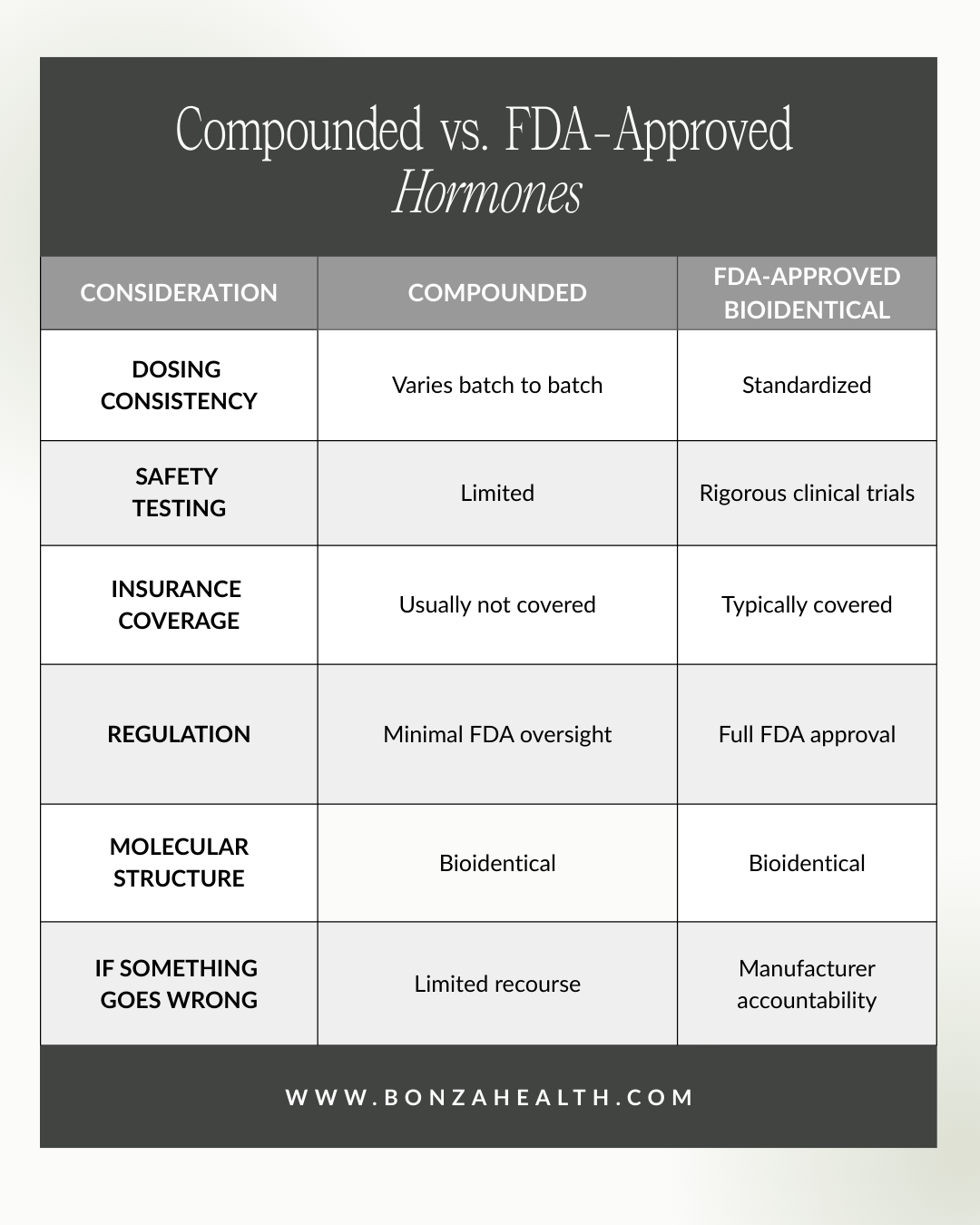
Compounded vs. FDA-approved hormone therapy
The Functional Perspective
Conventional medicine excels at checking off symptoms. The IFM approach looks at the Functional Medicine Matrix to see how your entire body responds to hormonal shifts. In my view, menopause hormone therapy isn't just a band-aid for hot flashes: it's a tool to restore communication between your brain, heart, and metabolic systems.
We use a specific hormone hierarchy: the "terrain" has to be healthy first. That means addressing the adrenals, then the thyroid, and finally the sex steroids. If your stress levels are through the roof, your body may divert precursors away from sex hormones to produce more cortisol—a phenomenon sometimes called "cortisol steal."
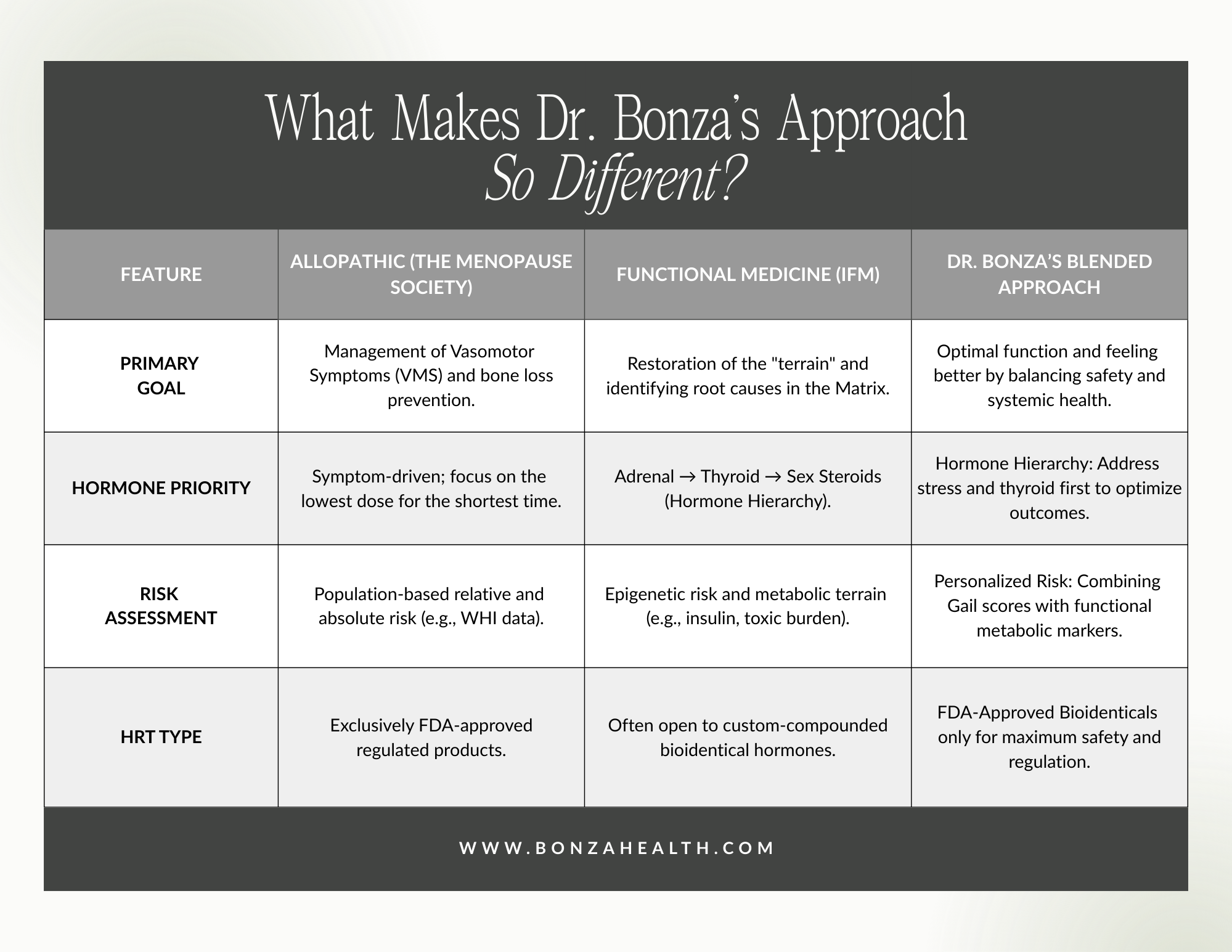
How Dr. Bonza’s blended approach differs from allopathic and functional medicine
A Tiered Diagnostic Strategy
I believe in being a good steward of your healthcare dollars. My diagnostic process is intentionally tiered:
Traditional testing first. We start with standard blood panels to evaluate your thyroid, insulin levels, and nutrient status (like ferritin and Vitamin D).
Functional testing as a deep dive. If traditional management doesn't find answers—say, you're struggling with persistent brain fog or what's functionally described as adrenal fatigue—we move to advanced functional testing.
HPA axis assessment. Tools like the Cortisol Awakening Response (CAR) through salivary testing show your unique stress-response rhythm, offering clarity that a single morning blood draw can't.
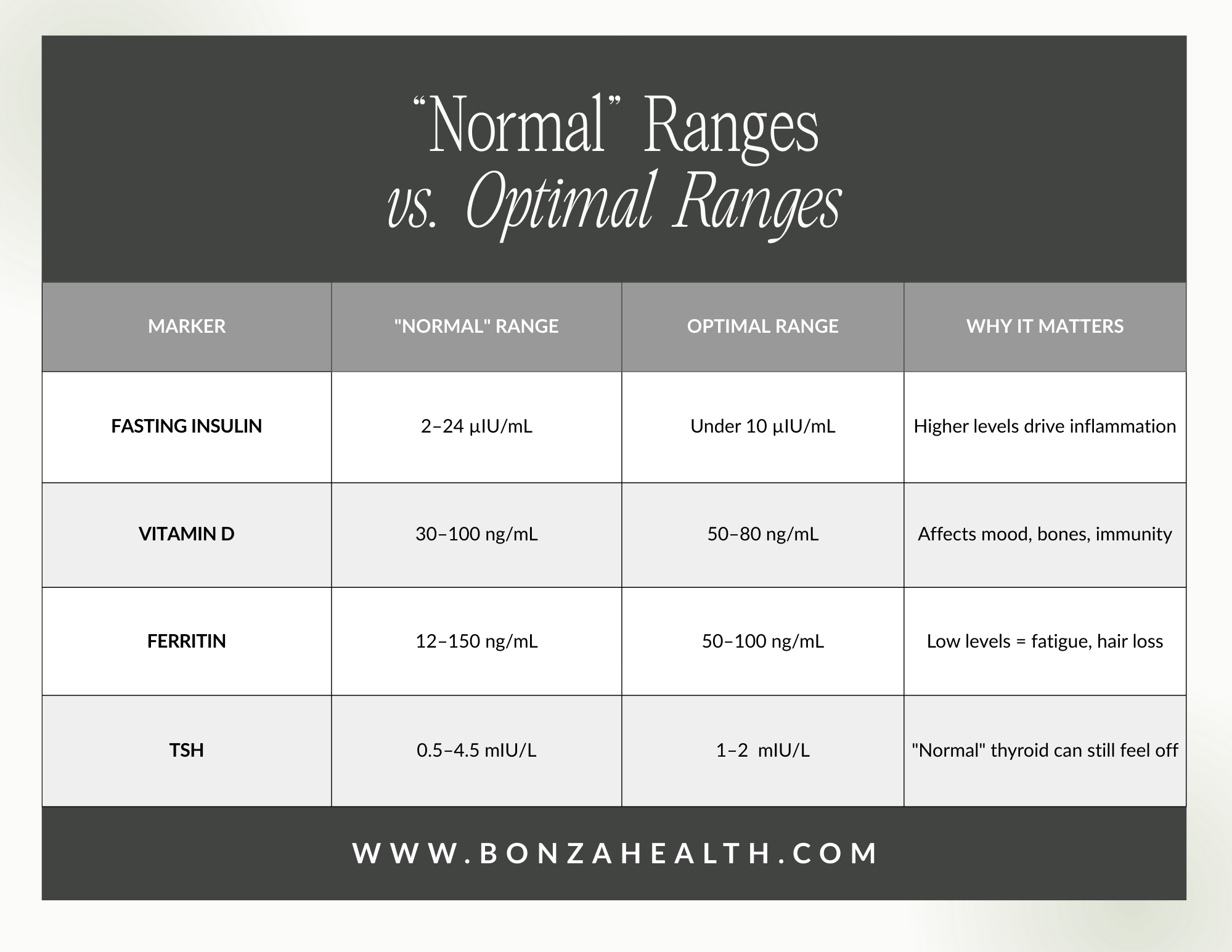
“Normal” vs. optimal lab ranges for fasting insulin, vitamin D, ferritin, and TSH
Feeling and Functioning Better
In my practice, we don't just check whether your labs fall into a "normal" reference range: we look at optimal ranges. A "normal" fasting insulin might be 24, but if yours is above 10, it could be driving inflammation and making your menopause symptoms worse.
By combining the preventative power of hormones for bone and heart health with functional medicine's lifestyle interventions (anti-inflammatory diets, stress resiliency), we don't just treat symptoms. We optimize your life [4,5].
Think of menopause management like restoring a historic home. The allopathic approach ensures the roof doesn't leak and the foundation is stable. The functional approach looks at the electrical wiring and the plumbing to make sure the house is actually comfortable to live in. Blend both, and the home isn't just standing; it's beautiful and functional for years to come.

Sign up for Fullscript to shop Dr. Bonza’s Supplement store.
References
[1] R. J. Santen et al., "Workshop on normal reference ranges for estradiol in postmenopausal women," Menopause, vol. 27, no. 6, pp. 614–624, 2020. https://doi.org/10.1097/gme.0000000000001556
[2] NAMS, "The 2020 genitourinary syndrome of menopause position statement," Menopause, vol. 27, no. 9, pp. 976–992, 2020.
[3] FDA, "Menopause & Hormones Common Questions," U.S. Food and Drug Administration, 2021.
[4] NAMS, "Revised Global Consensus Statement on Menopausal Hormone Therapy," Climacteric, 2016.
[5] NAMS, "The 2022 Hormone Therapy Position Statement," Menopause, vol. 29, no. 7, pp. 767–794, 2022. https://doi.org/10.1097/gme.0000000000002028
[6] NAMS, "Government-Approved vs. Compounded Bioidentical Hormones," Menopause, vol. 29, no. 7, 2022.