Perimenopause and Neurodivergence: Unmasking the Hormonal Connection
Written and edited by Sarah Bonza MD, MPH, FAAFP, MSCP, DipABLM, NBC-HWC

For neurodivergent women, the hormonal fluctuations of perimenopause can be especially destabilizing.
During perimenopause, many women experience fluctuating estrogen and progesterone levels that can have profound effects—not only on physical health, but on the brain and mood. For neurodivergent women, including those with ADHD or autism spectrum conditions, these changes may be especially destabilizing.
Estrogen and the Neurodivergent Brain
Estrogen enhances dopamine signaling, which helps regulate attention, motivation, and working memory. As estrogen drops during perimenopause, dopamine signaling weakens. This can worsen symptoms common in ADHD: difficulty focusing, increased forgetfulness, mental fatigue, and disorganization.[1]
Beyond dopamine, estrogen also supports cognitive flexibility, verbal fluency, and emotional regulation.[2] These capacities help many neurodivergent women "mask" their traits socially: using learned strategies to better blend in. When estrogen levels fall, masking becomes exhausting or impossible, leading to social withdrawal, increased meltdowns or shutdowns, and sensory overwhelm.
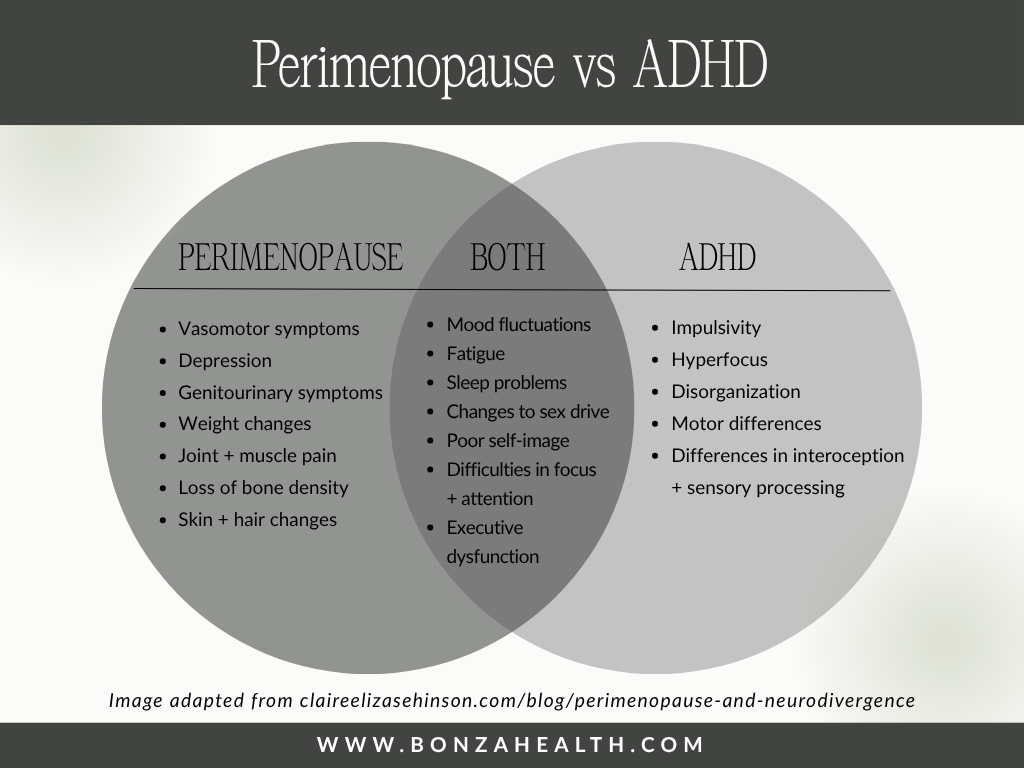
This image was adapted from claireelizasehinson.com/blog/perimenopause-and-neurodivergence
Serotonin, GABA, and Sensory Processing
Estrogen influences both serotonin and GABA, neurotransmitters that help filter sensory input and regulate mood. Lower estrogen during perimenopause means less efficient sensory gating—increasing sensitivity to light, sound, texture, and smell. Neurodivergent individuals may experience more frequent sleep problems or feel overwhelmed in busy environments.[3]
Falling estrogen also impacts serotonin, amplifying emotional sensitivity: mood swings, episodes of rage or tearfulness, and intensified rejection sensitivity. For women who are autistic or have ADHD, these shifts frequently exacerbate PMDD (premenstrual dysphoric disorder)—a condition marked by severe mood and physical symptoms tied to the late luteal phase, as well as depression or anxiety.[4] Research shows neurodivergent women are at higher risk for PMDD and more disabling premenstrual symptoms.

Neurodivergent women, such as those with ADHD, are at higher risk for premenstrual dysphoric disorder and more disabling premenstrual symptoms.
Progesterone’s Role
Progesterone, which also fluctuates during perimenopause, can further affect mood regulation and anxiety symptoms through its effects on GABA and other neuroactive steroids. The precise impact of progesterone on neurodivergent women’s mood is still under investigation, but initial studies suggest that disruptions to both estrogen and progesterone cycles amplify vulnerability to mood disorders and sensory overwhelm.
The Challenge of Burnout and Emotional Regulation
Managing neurodivergence requires constant mental effort—especially around social roles, executive functioning, and masking. When estrogen levels drop, mental stamina wanes, making it harder to cope with change, regulate emotions, or perform under pressure. This can trigger burnout, especially for women who have relied on internal or external strategies to "hold it together" socially and professionally.[5]
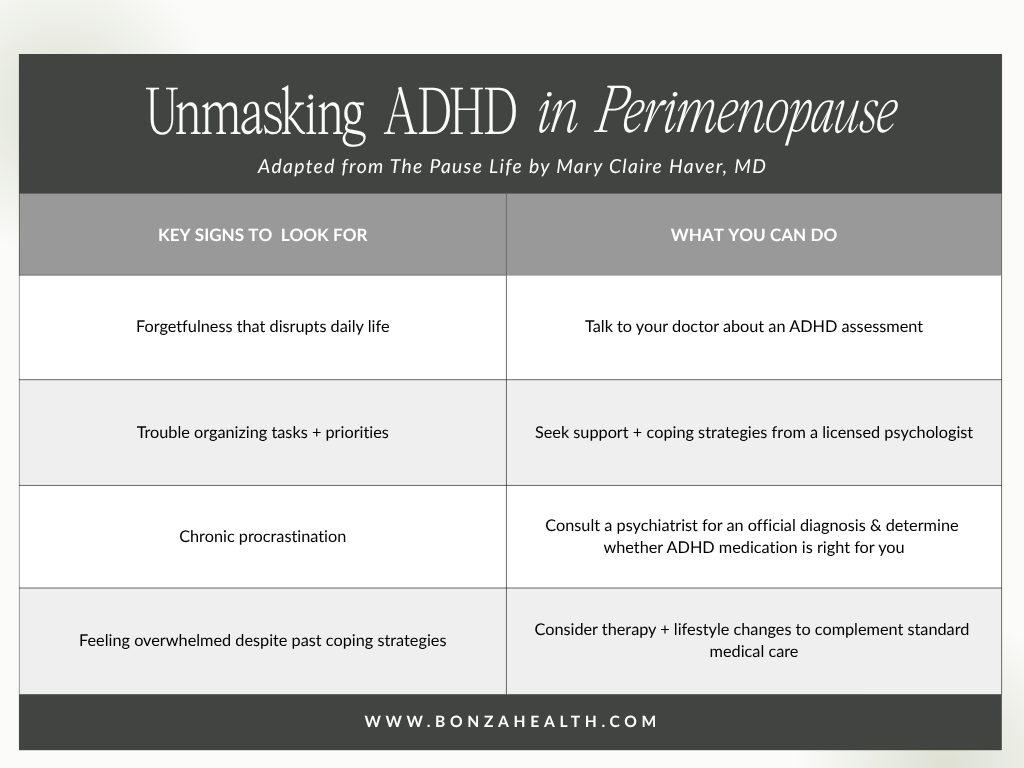
This table was adapted from The Pause Life, by Mary Claire Haver, MD
Where Research is Still Needed
While more studies are revealing how estrogen and progesterone impact neurotransmitter systems in the brains of neurodivergent women, gaps remain:
Few human studies directly examine hormone–neurodivergence interactions, especially in perimenopause.
The link between hormone cycles, PMDD severity, and neurodivergence is underexplored and warrants further clinical trials.
The optimal approach to hormone therapy for neurodivergent women navigating perimenopause and PMDD—balancing risks, benefits, and individual differences—remains unclear.
Key Takeaways
Falling estrogen and progesterone during perimenopause can intensify ADHD and autistic traits by destabilizing dopamine, serotonin, and GABA signaling.
Symptoms often include worsened executive function, sensory overload, mood swings, and burnout.
Neurodivergent women are at higher risk for severe PMDD and mood disturbances, underscoring the need for tailored support and more targeted clinical research.
If you are navigating neurodivergence and perimenopause, know that these challenges have a clear scientific basis—help is available, and advocacy for more research is crucial.

Bonza Health can help you reclaim your vitality with expert care.
References
[1] J. Wasserstein, G. A. Stefanatos, and M. V. Solanto, “2 Perimenopause, Menopause and ADHD,” Journal of the International Neuropsychological Society, vol. 29, p. 881, Nov. 2023, https://doi.org/10.1017/S1355617723010846.
[2] E. G. Jacobs and M. D’Esposito, “Estrogen Shapes Dopamine-Dependent Cognitive Processes: Implications for Women’s Health,” Journal of Neuroscience, vol. 31, no. 14, p. 5286, Apr. 2011, https://doi.org/10.1523/jneurosci.6394-10.2011.
[3] A. Haufe, F. C. Baker, and B. Leeners, “The role of ovarian hormones in the pathophysiology of perimenopausal sleep disturbances: A systematic review,” Sleep Medicine Reviews, vol. 66. Elsevier BV, p. 101710, Oct. 27, 2022. https://doi.org/10.1016/j.smrv.2022.101710.
[4] J. Yen, P. Wang, C. Su, T. Liu, C. Long, and C. Ko, “Estrogen levels, emotion regulation, and emotional symptoms of women with premenstrual dysphoric disorder: The moderating effect of estrogen receptor 1α polymorphism,” Progress in Neuro-Psychopharmacology and Biological Psychiatry, vol. 82, p. 216, Nov. 2017, https://doi.org/10.1016/j.pnpbp.2017.11.013.
[5] D. Converso, S. Viotti, I. Sottimano, B. Loera, G. Molinengo, and G. Guidetti, “The relationship between menopausal symptoms and burnout. A cross-sectional study among nurses,” BMC Women s Health, vol. 19, no. 1, Nov. 2019, https://doi.org/10.1186/s12905-019-0847-6.