Creatine Isn’t Just for Gym Bros Anymore: The First Study on Creatine in Perimenopausal Women Shows Surprising Brain and Mood Benefits
Written and edited by Sarah Bonza MD, MPH, FAAFP, MSCP, DipABLM, NBC-HWC

Creatine is a natural compound made from three amino acids: arginine, glycine, and methionine.
For decades, creatine has been associated with muscular men flexing in the weight room. But new science is reframing this modest molecule as one of the most exciting—and misunderstood—tools for women’s health, especially during the perimenopausal and menopausal transition.
A groundbreaking 2025 randomized controlled trial, recently published in the Journal of the American Nutrition Association, looked specifically at the effects of creatine on brain metabolism, mood, reaction time, and lipid health in midlife women.[1] The results were remarkable: even low doses of creatine hydrochloride led to measurable improvements in brain energy, focus, and emotional balance—with no identified adverse effects.
At Bonza Health, we’re passionate about helping women thrive through menopause. Let’s break down what creatine is, what this new research means, and how it may fit into a science-backed strategy for supporting vitality, cognition, and metabolic health after 40.
A groundbreaking 2025 randomized controlled trial found that even low doses of creatine hydrochloride led to measurable improvements in brain energy, focus, and emotional balance, with no identified adverse effects.
What Exactly Is Creatine?
Creatine is a natural compound made from three amino acids: arginine, glycine, and methionine. Your muscles and brain store creatine as phosphocreatine, a rapidly accessible source of cellular energy. It helps regenerate ATP (adenosine triphosphate), the body’s energy currency.
Your body produces creatine in the liver and kidneys, and you can get modest amounts from foods like red meat and seafood. But vegetarian and plant-based eaters—including many women at Bonza Health—often have lower baseline creatine stores, making supplementation particularly impactful.
For years, creatine has been linked to strength training, muscle mass, and athletic recovery. What most people don’t realize is that creatine plays a crucial role in brain energy metabolism. In fact, your brain uses about 20% of your body’s total energy at rest, and creatine helps keep neurons charged, even under stress or hormonal change.

While creatine has been linked to strength training, muscle mass, and athletic recovery, creatine also plays a crucial role in brain energy metabolism.
Why Creatine Matters During Perimenopause
During perimenopause, declining estrogen levels can affect neurotransmitters (like serotonin and dopamine), brain mitochondria, and energy use in neurons. This is partly why many women report increased brain fog, fatigue, and mood fluctuations during the transition.
Creatine supports:
Cognitive performance: by replenishing ATP in the frontal lobe, the region responsible for focus, decision-making, and working memory.[2]
Mood and emotional regulation: by improving neuronal energy and stabilizing brain chemistry under hormonal stress.[3]
Exercise recovery: by buffering muscle fatigue and supporting lean mass maintenance as estrogen levels drop.[4-5]
Healthy lipid metabolism: by optimizing cellular energy use, which can indirectly support better cardiovascular health.[6]
In essence, creatine provides an energy cushion during a time when the brain and body are recalibrating under hormonal shifts.

Declining estrogen levels can affect neurotransmitters, brain mitochondria, and energy use in neurons. This can lead to brain fog, attention issues, and mood changes.
The New 2025 RCT: What the Research Found
The CONCRET-MENOPA study was the first-ever randomized controlled trial to test creatine supplementation specifically in peri- and postmenopausal women.[1] Here’s what researchers found.
Study Snapshot:
Participants: 36 women, ages 40–60
Duration: 8 weeks
Design: Double-blind, randomized, placebo-controlled
Groups:
Low-dose creatine hydrochloride (750 mg/day)
Medium-dose creatine hydrochloride (1,500 mg/day)
Combination of creatine HCl + creatine ethyl ester (800 mg/day total)
Placebo
Key Results:
Faster reaction time: Women on 1,500 mg of creatine HCl improved reaction time by 12%—compared to just 1% in the placebo group.
Increased brain creatine levels: Magnetic resonance spectroscopy showed a 16% increase in frontal brain creatine in the medium-dose group.
Improved mood stability: Researchers noted fewer mood swings and better overall emotional balance compared to placebo.
Enhanced lipid profile: Small but clinically meaningful improvements in serum lipids were seen in the creatine HCl group.
No adverse effects: All treatments were well tolerated, with no significant side effects reported.
Perhaps most exciting, creatine boosted energy metabolism across multiple brain regions—frontal lobes, parietal white matter, and the thalamus—areas responsible for coordination, focus, and spatial processing. This provides the first human imaging evidence that creatine directly enhances brain energetic resilience during menopause.
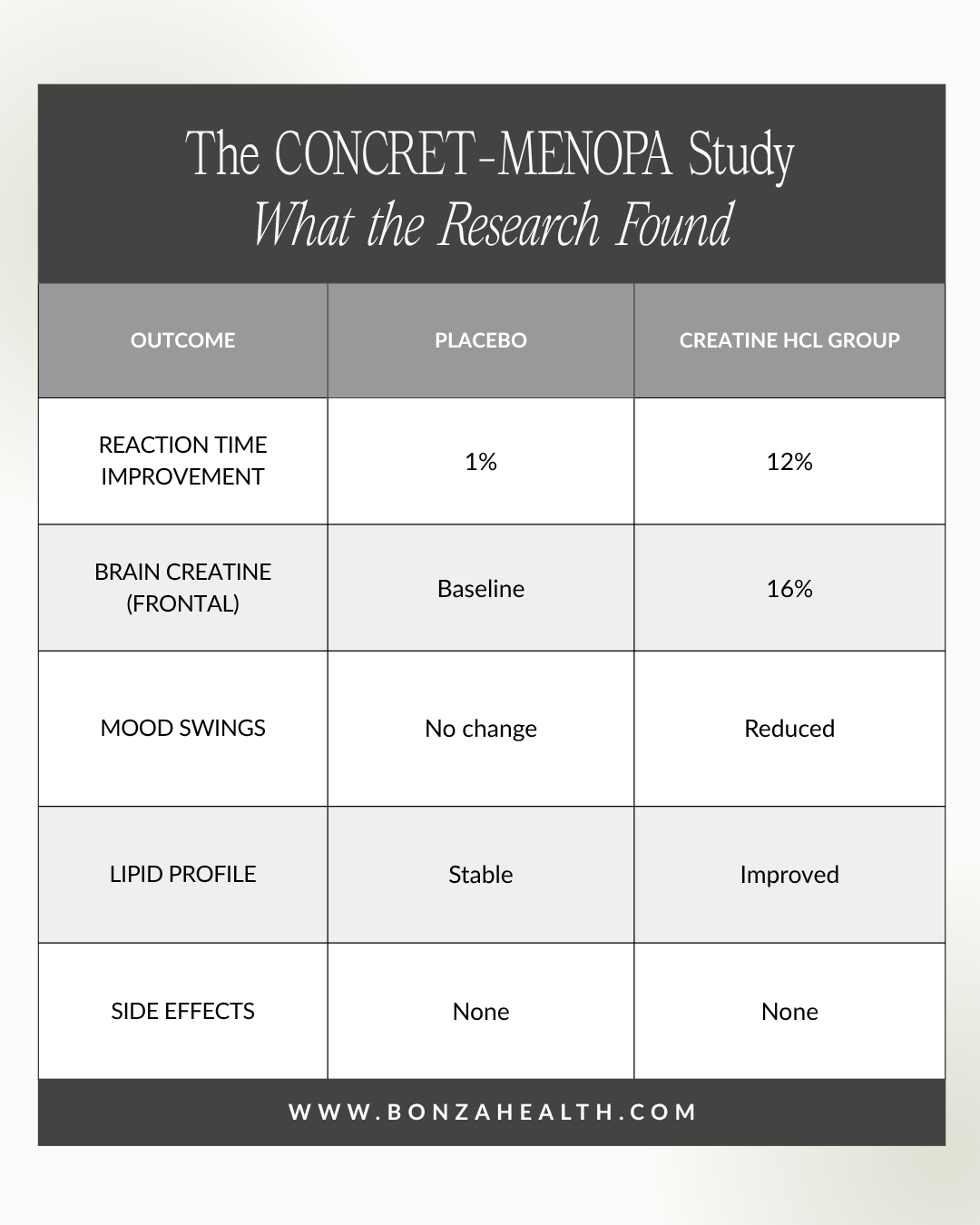
The CONCRET-MENOPA study found that creatine HCI could safely improve reaction time, increase brain creatine levels, improve mood stability, and enhance serum lipid levels in peri- and postmenopausal women.
Rethinking Creatine: From Muscle Fuel to Brain Food
This study confirms what neuroscientists and exercise physiologists have long suspected: creatine isn’t just a bodybuilding supplement—it’s a bioenergetic compound with whole-body benefits.
For perimenopausal women, those benefits extend far beyond the gym. Creatine may support:
Sharper cognition: by improving attention, working memory, and task performance.
Mood support: potentially complementing menopause hormone therapy or lifestyle interventions for emotional well-being.
Fatigue reduction: by improving mitochondrial energy buffering and ATP availability.
Metabolic health: through favorable changes in lipid profiles and energy expenditure.
Muscle preservation: helping counter the age-related decline in lean mass (sarcopenia).
In essence, creatine helps power the systems that menopause tends to deplete—energy production, neuronal communication, and emotional stability.

Creatine supplementation may support cognition, mood, energy levels, metabolic health, and muscle preservation during perimenopause.
Best Form and Dose for Midlife Women
The 2025 study used creatine hydrochloride (HCl) instead of the more common creatine monohydrate. Creatine HCl is more soluble, gentler on the gut, and allows for lower effective doses.
Evidence-based dosing for women:
Creatine hydrochloride: 1,000–1,500 mg daily (no loading phase needed).
Creatine monohydrate: 3–5 grams daily (most widely studied, safe, and affordable).
Consistency matters more than dosage spikes. Taking creatine daily—preferably with a meal—optimizes uptake into muscle and brain tissue.
Women using menopausal hormone therapy (MHT) can safely combine creatine supplementation, as no interactions have been reported. Those with chronic kidney disease or other renal conditions should consult a medical professional first.
Creatine HCl is more soluble, gentler on the gut, and allows for lower effective doses.
When to Expect Results
Studies indicate that brain and muscle creatine levels increase gradually over several weeks.
Week 1–2: Subtle improvement in energy and concentration.
Week 3–4: Noticeable exercise recovery and reduced fatigue.
Week 6–8: Measurable cognitive and emotional improvement, as seen in the 2025 RCT.
Think of creatine as a slow-burner for cellular resilience—not a quick stimulant. Over time, it builds a more efficient energy network in your neurons and muscle tissue.
How to Choose a Quality Supplement
Look for creatine supplements that are:
Transparent in labeling: specify “creatine monohydrate” or “creatine HCl.”
Third-party tested: NSF Certified for Sport or Informed Choice approved.
Free from fillers: avoid added sugar, artificial dyes, or proprietary blends.
Vegan-friendly: many modern forms of creatine are plant-derived.
Bonza Health patients often use micronized creatine monohydrate (3 g/day) for muscle and cognitive support or creatine HCl (1.5 g/day) for better solubility and GI comfort.

At Bonza Health, we believe supporting the brain, body, and metabolism through functional nutrition—creatine included—can help women feel powerful, focused, and fully alive in midlife.
The Future of Creatine in Women’s Health
Until recently, most creatine research involved young male athletes. But that’s changing rapidly. New data suggest creatine may become a cornerstone supplement for women over 40, particularly for supporting energy, cognition, and mood through hormonal transition.
Beyond menopause, creatine is being studied for its promise in depression, neurodegenerative disorders, and metabolic syndrome. For midlife women, this opens the door to targeted, low-risk, evidence-backed support for brain and metabolic vitality.
The Takeaway
The first clinical trial of creatine supplementation in perimenopausal women marks a turning point. Just eight weeks of 1,500 mg daily creatine HCl improved mental focus, brain energy, and mood—reaffirming what many clinicians are now seeing in practice: creatine belongs in the conversation about menopausal health.
At Bonza Health, we believe optimal aging is an energy story. Supporting the brain, body, and metabolism through functional nutrition—creatine included—can help women feel not just “normal,” but powerful, focused, and fully alive in midlife.

Visit Fullscript for Dr. Bonza’s favorite creatine supplement.
References
[1] D. Korovljev et al., “The Effects of 8-Week Creatine Hydrochloride and Creatine Ethyl Ester Supplementation on Cognition, Clinical Outcomes, and Brain Creatine Levels in Perimenopausal and Menopausal Women (CONCRET-MENOPA): A Randomized Controlled Trial,” Journal of the American Nutrition Association, p. 1, Aug. 2025, https://doi.org/10.1080/27697061.2025.2551184
[2] X. Chen, S. Bi, W. Zhang, and L. Luo, “The effects of creatine supplementation on cognitive function in adults: a systematic review and meta-analysis,” Frontiers in Nutrition, vol. 11. Frontiers Media, Jul. 12, 2024. https://doi.org/10.3389/fnut.2024.1424972
[3] K. Walczak et al., “Effect of creatine supplementation on cognitive function and mood,” Journal of Education Health and Sport, vol. 73, p. 51712, Jun. 2024, https://doi.org/10.12775/JEHS.2024.73.51712
[4] A. N. Gordon et al., “The Effects of Creatine Monohydrate Loading on Exercise Recovery in Active Women throughout the Menstrual Cycle,” Carolina Digital Repository (University of North Carolina at Chapel Hill), Jan. 2023, https://doi.org/10.3390/nu15163567
[5] A. E. Smith‐Ryan, H. E. Cabre, J. M. Eckerson, and D. G. Candow, “Creatine Supplementation in Women’s Health: A Lifespan Perspective,” Nutrients, vol. 13, no. 3. Multidisciplinary Digital Publishing Institute, p. 877, Mar. 08, 2021. https://doi.org/10.3390/nu13030877
[6] H. Arazi, E. Eghbali, and K. Suzuki, “Creatine Supplementation, Physical Exercise and Oxidative Stress Markers: A Review of the Mechanisms and Effectiveness,” Nutrients, vol. 13, no. 3. Multidisciplinary Digital Publishing Institute, p. 869, Mar. 06, 2021. https://doi.org/10.3390/nu13030869