Your Nervous System Is Keeping Score: Tracking HRV Through Perimenopause
Written and edited by Sarah Bonza, MD, MPH, FAAFP, MSCP, DipABLM, NBC-HWC
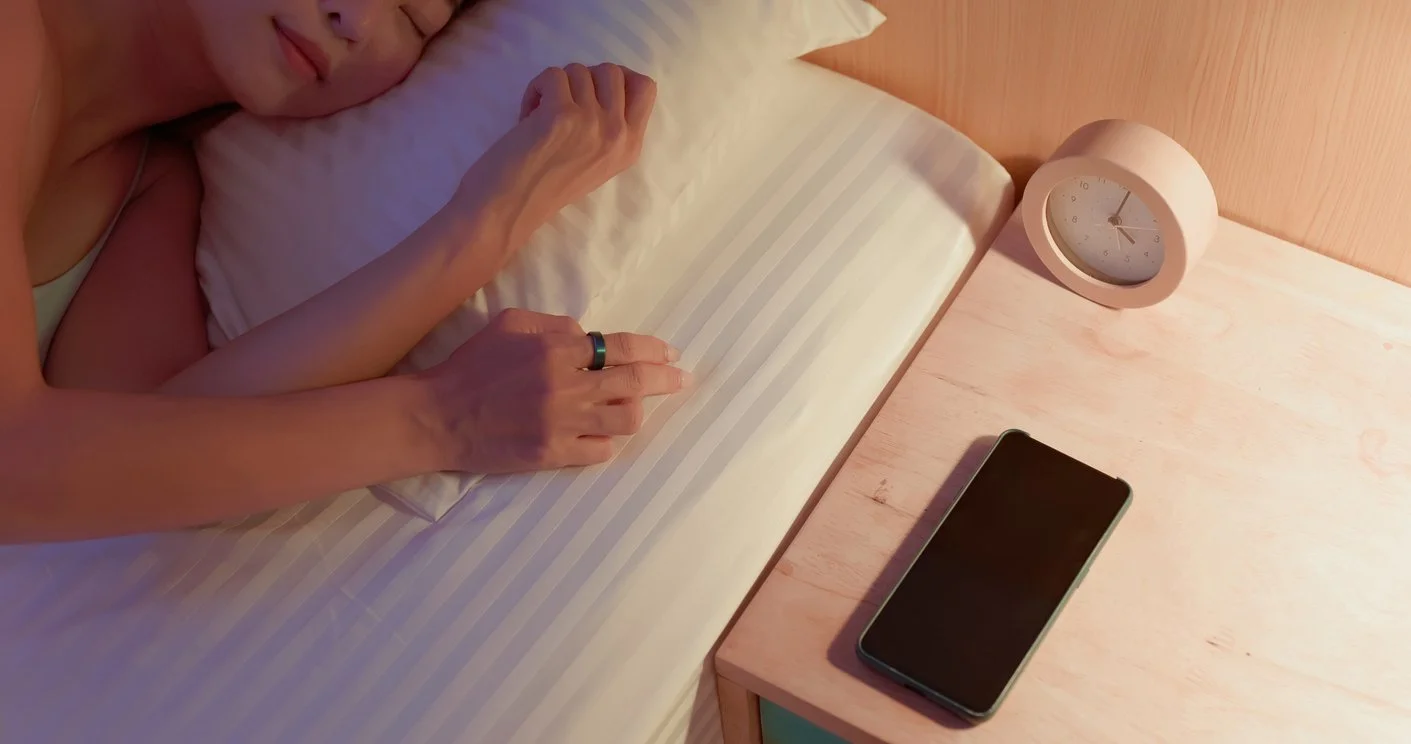
The Oura Ring captures overnight HRV (reported primarily as RMSSD, a vagally-mediated metric) while you sleep.
If you are a woman in your 40s who has spent decades being the one who holds it all together — the high performer, the fixer, the person everyone leans on — you may have noticed something lately that you can't quite name. The same stressors you used to absorb without a second thought now leave you wired, depleted, and staring at the ceiling at 3 a.m. You are doing everything you used to do, but the buffer that made it feel effortless seems to have quietly disappeared.
You are not imagining it, and you are not failing. What you are feeling is, in large part, a change in your nervous system — and there is now a way to see it.
A heart that beats like a metronome is not a healthy heart
We tend to assume a steady heartbeat is a calm, healthy one. The opposite is true. A resilient heart constantly adjusts the tiny intervals between beats in response to your breath, your emotions, and your environment. That beat-to-beat variation is called heart rate variability (HRV), and it is one of the most accessible windows we have into the autonomic nervous system [1,2].
Your autonomic nervous system runs on two branches:
The sympathetic branch — your accelerator. It mobilizes you for "fight or flight," raising heart rate, sharpening focus, and releasing stress hormones.
The parasympathetic branch — your brake, governed largely by the vagus nerve. It runs "rest, digest, and repair," slowing the heart, supporting digestion and sleep, and calming inflammation.
Higher HRV generally reflects strong vagal tone — a flexible, responsive nervous system that can shift gears smoothly. Chronically low HRV reflects a system stuck with the accelerator pressed down [1,2]. And here is what matters for the long game: across large cohort studies, lower HRV is associated with a meaningfully higher risk of cardiovascular events and all-cause mortality [3]. Vagal tone isn't just a wellness metric — it tracks with how well, and potentially how long, we age.

Vagal tone isn't just a wellness metric — it tracks with how well, and potentially how long, we age.
Why perimenopause changes the equation
Estrogen is not only a reproductive hormone. Estrogen receptors sit throughout the cardiovascular system and brain, and estrogen helps modulate cardiac autonomic balance — generally supporting parasympathetic (vagal) activity [4]. As estrogen and progesterone decline and fluctuate through the menopause transition, that supportive influence becomes erratic, and the autonomic balance in many women tilts toward sympathetic predominance [4,5].
The research picture is active and still being written, which is exactly why this is a frontier worth claiming:
In a prospective study, HRV measures were able to distinguish the intensity of menopausal symptoms, supporting the idea that autonomic regulation shifts meaningfully across the transition [5].
Researchers have documented measurable HRV changes during hot flashes themselves, linking vasomotor symptoms to autonomic events [6].
At the same time, a rigorously designed study of women with frequent hot flashes found no association between resting HRV and the frequency or bother of those symptoms [7] — a reminder that HRV reflects your whole autonomic state, not any single symptom.
Other work continues to probe how cardiac autonomic function relates to the hormonal and vasomotor changes of midlife [8].
The honest synthesis: declining estrogen reshapes autonomic balance, and HRV is one of the best non-invasive signals we have for watching that shift unfold in real life — even as science continues to refine exactly which patterns mean what.

HRV reflects your whole autonomic state, not just any single symptom.
The “high-functioning woman" problem
Here is the part that so rarely gets said out loud. Many of the women most affected are the ones who look the most "fine." If you have built a life on capability — on being reliable, on rarely saying no, on running slightly hot all the time — your nervous system has likely spent years leaning sympathetic. For a long time, robust estrogen helped buffer that load. As that buffer fades in perimenopause, the same lifestyle now produces a different physiological result: less recovery, lighter sleep, a shorter fuse, a body that struggles to downshift.
This is not a character flaw, and it is not "just stress." It is a measurable change in how your body buffers demand — and a declining HRV trend is often one of the earliest objective signals that your reserves are being spent faster than they are being replenished.
Sleep is where the story gets told
Restorative sleep depends on your parasympathetic system taking over at night. During deep, non-REM sleep, a healthy nervous system shifts firmly into vagal dominance — heart rate drops, the body repairs, and inflammation is quieted. Your overnight HRV is essentially a nightly report card on that recovery process. When sleep fragments — as it so often does in perimenopause — that nighttime vagal recovery suffers, and your HRV trend reflects it. This is why tracking HRV during sleep is so powerful: it captures your nervous system in its most honest, unmasked state.
Restorative sleep depends on your parasympathetic system taking over at night.
How to actually track it: the Oura Ring
You cannot manage what you cannot measure, and you do not need a clinic to measure HRV anymore. The Oura Ring captures overnight HRV (reported primarily as RMSSD, a vagally-mediated metric) while you sleep. In a head-to-head validation study against medical-grade ECG, the Oura Ring accurately measured nocturnal heart rate and RMSSD, with acceptable accuracy for several additional overnight HRV parameters [9]. In other words, for tracking your night-to-night vagal recovery trend at home, it is a genuinely useful tool.
A few principles for using the Oura Ring well:
Watch the trend, not the single night. One low number after a glass of wine or a hard workout means nothing. A two-week downward drift means something.
Compare yourself to yourself. HRV varies enormously between individuals by age, genetics, and sex. Your baseline is the only baseline that matters.
Use it as information, not a verdict. The goal is insight and self-compassion, not another metric to feel anxious about.

Once you can see your nervous system, you can work with it: paced "resonance" breathing, prioritizing sleep, strength, and zone-2 movement, managing alcohol and late caffeine, and protecting genuine downtime all tend to nudge vagal tone in the right direction over time.
A note on what Oura is and isn't: The Oura Ring is a consumer wellness and tracking device, not a medical or diagnostic device. It is wonderful for spotting trends and starting conversations — it does not diagnose or treat any condition. If your data concerns you, bring it to a clinician (I'd love for that clinician to be informed about the nervous system).
Ready to start tracking?
If you want to see your own nervous system at work — and start building the vagal resilience that supports your sleep, your mood, and your longevity — an Oura Ring is the single easiest place to begin.
👉 Order your Oura Ring through my Fullscript store here to receive 10% off → https://us.fullscript.com/welcome/bonzahealth

Through Fullscript's whole-person care platform, your Oura data can also be brought into a clinical context with a provider who actually understands the autonomic picture.
About the Author
Dr. Sarah Bonza (MD, MPH, FAAFP, DipABLM) is a board-certified family and lifestyle medicine physician and the founder of Bonza Health, where she helps women navigate perimenopause through the lens of the nervous system.
This article is for educational purposes and does not constitute medical advice or establish a physician–patient relationship. The Oura Ring is a wellness device and is not intended to diagnose, treat, cure, or prevent any disease. Consult a qualified clinician about your individual health. As a Fullscript practitioner, Dr. Bonza may receive compensation for products ordered through her dispensary.
References
[1] F. Shaffer and J. P. Ginsberg, "An overview of heart rate variability metrics and norms," Frontiers in Public Health, vol. 5, art. 258, Sep. 2017, https://doi.org/10.3389/fpubh.2017.00258
[2] F. Shaffer, R. McCraty, and C. L. Zerr, "A healthy heart is not a metronome: an integrative review of the heart's anatomy and heart rate variability," Frontiers in Psychology, vol. 5, art. 1040, Sep. 2014, https://doi.org/10.3389/fpsyg.2014.01040
[3] S.-C. Fang, Y.-L. Wu, and P.-S. Tsai, "Heart rate variability and risk of all-cause death and cardiovascular events in patients with cardiovascular disease: a meta-analysis of cohort studies," Biological Research for Nursing, vol. 22, no. 1, pp. 45–56, 2020, https://doi.org/10.1177/1099800419877442
[4] J. J. von Holzen, G. Capaldo, M. Wilhelm, and P. Stute, "Impact of endo- and exogenous estrogens on heart rate variability in women: a review," Climacteric, vol. 19, no. 3, pp. 222–228, 2016, https://doi.org/10.3109/13697137.2016.1145206
[5] P. M. Martinelli, I. C. E. Sorpreso, R. D. Raimundo, et al., "Heart rate variability helps to distinguish the intensity of menopausal symptoms: a prospective, observational and transversal study," PLOS ONE, vol. 15, no. 1, art. e0225866, Jan. 2020, https://doi.org/10.1371/journal.pone.0225866
[6] R. C. Thurston, K. A. Matthews, and Y. Chang, "Changes in heart rate variability during vasomotor symptoms among midlife women," Menopause, vol. 23, no. 5, pp. 499–505, May 2016, https://doi.org/10.1097/gme.0000000000000586
[7] S. M. Jones, K. A. Guthrie, A. Z. LaCroix, et al., "Is heart rate variability associated with frequency and intensity of vasomotor symptoms among healthy perimenopausal and postmenopausal women?," Clinical Autonomic Research, vol. 26, no. 1, 2016, https://doi.org/10.1007/s10286-015-0322-x
[8] C. J. Gibson, W. B. Mendes, M. Schembri, D. Grady, and A. J. Huang, "Cardiac autonomic function and hot flashes among perimenopausal and postmenopausal women," Menopause, vol. 24, no. 7, pp. 756–761, Jul. 2017, https://doi.org/10.1097/gme.0000000000000843
[9] R. Cao, I. Azimi, F. Sarhaddi, et al., "Accuracy assessment of Oura Ring nocturnal heart rate and heart rate variability in comparison with electrocardiography in time and frequency domains: comprehensive analysis," Journal of Medical Internet Research, vol. 24, no. 1, art. e27487, Jan. 2022, https://doi.org/10.2196/27487