Written and edited by Sarah Bonza, MD, MPH, FAAFP, MSCP, DipABLM, NBC-HWC | Bonza Health

What the evidence really shows about estradiol and breast cancer
Almost every week, a woman sits across from me with hot flashes, insomnia, and one big fear: "Will estrogen give me breast cancer?" It is the right question to ask. It deserves a better answer than a quick "yes" or a reflexive "no."
Here is what I tell her. The best randomized evidence shows that estrogen taken alone did not raise breast cancer risk, and actually lowered it. Most of the risk seen in older studies was tied to the type of progestogen given with estrogen. And there are real exceptions and real uncertainties that we need to talk through together.
My practice is built on shared decision-making. My job is to give you accurate, balanced evidence in plain language. Your job is to weigh it against your symptoms, your values, and your own health history. Every treatment carries some risk, including doing nothing. You have the right to make an informed choice about your own body, and I will support that choice with the best information available.
Why so many women are afraid of estrogen
In 2002, the Women's Health Initiative (WHI) stopped its estrogen-plus-progestin trial early and reported more breast cancers in the hormone group [1]. The headlines were frightening, prescriptions fell sharply, and in 2003 the FDA placed a "black box" warning on menopausal hormone products. A generation of women, and many clinicians, came to believe that estrogen causes breast cancer.
That picture has shifted. In November 2025, the FDA began removing the boxed warnings about breast cancer, cardiovascular disease, and probable dementia from menopausal hormone therapy labels [2]. The boxed warning about endometrial cancer remains for systemic estrogen-alone products used by women who still have a uterus. Breast cancer information also still appears in the full prescribing label.
I welcome that change, but I want to be clear about what it means. A label update is not a personal risk assessment. It tells us the evidence is more reassuring than the old warning implied. It does not tell you whether hormone therapy is right for you. That is the conversation we have in the exam room.
Why so many women are afraid of estrogen?
Estrogen alone: what the randomized trials show
The WHI actually ran two separate placebo-controlled trials. The one that rarely made headlines enrolled 10,739 women who had had a hysterectomy and gave them estrogen alone (conjugated equine estrogen, or CEE) or placebo.
After more than 20 years of follow-up, women randomized to estrogen alone had fewer breast cancers than women on placebo: an annual rate of 0.30% versus 0.37% (hazard ratio [HR] 0.78) [3]. They were also less likely to die of breast cancer (HR 0.60) [3]. In absolute terms, that is roughly 7 fewer breast cancers per 10,000 women per year.
This was not a one-trial fluke. A 2024 meta-analysis pooled 10 randomized trials with 14,282 participants. Breast cancer was diagnosed in 3.6% of women assigned to estrogen alone versus 4.7% assigned to placebo, a 23% relative reduction [4].
Randomized trials matter because they remove much of the bias that creeps into observational studies. Women who choose hormones often differ from women who don't, in how often they get mammograms, their weight, their alcohol use, and more. Randomization balances those differences. On the specific question of whether estrogen alone causes breast cancer in women at average risk, the highest-quality evidence says it does not.
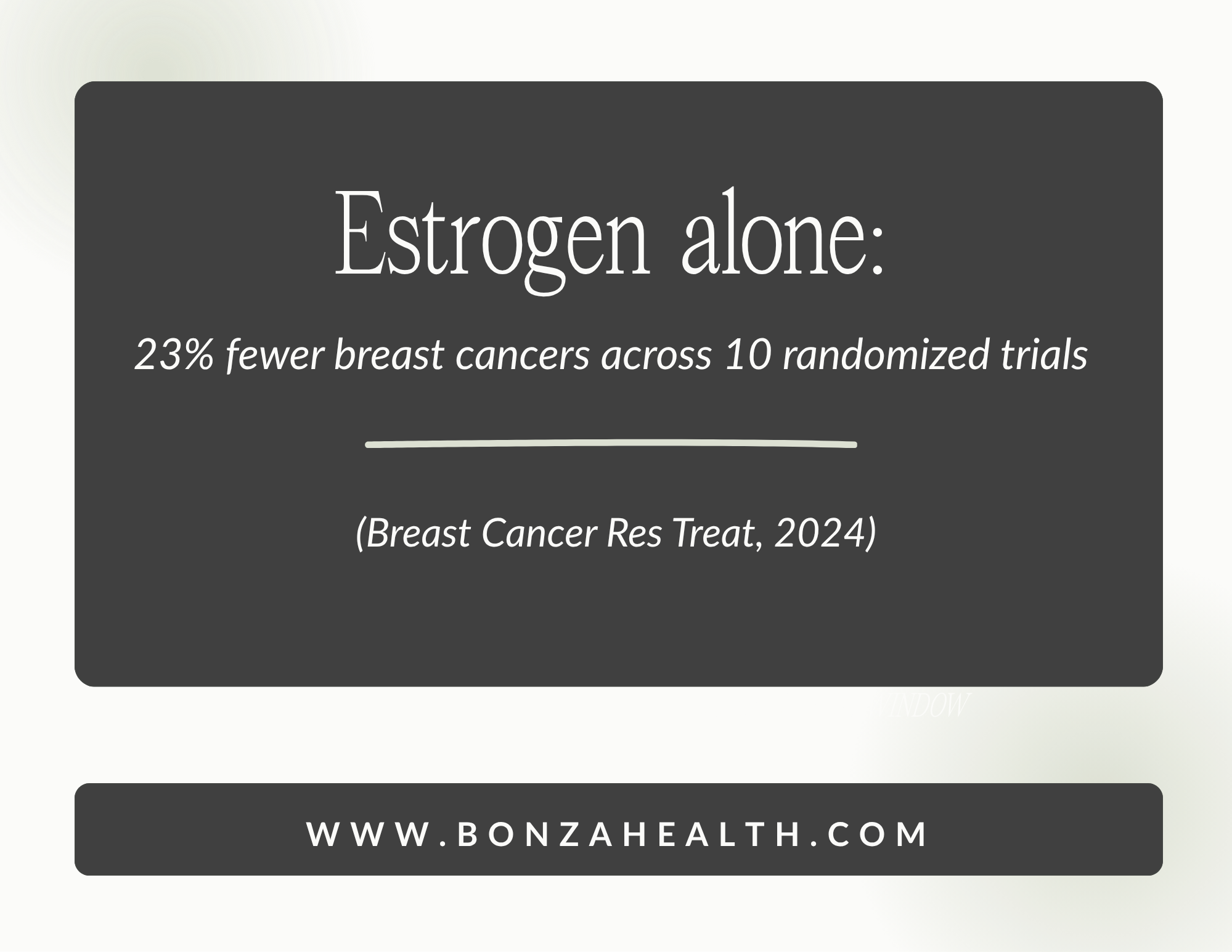
In a meta-analysis of 10 randomized trials, breast cancer was diagnosed in 3.6% of women assigned to estrogen alone versus 4.7% assigned to placebo, a 23% relative reduction [4].
Estrogen plus progestogen: where the risk showed up
Women who still have a uterus need a progestogen with estrogen to protect the uterine lining. In the WHI's second trial, women took CEE plus a synthetic progestin, medroxyprogesterone acetate (MPA). That combination increased breast cancer: 0.45% versus 0.36% per year (HR 1.28), or about 9 extra cases per 10,000 women per year [3]. The increase in breast cancer deaths was not statistically significant (HR 1.35) [3].
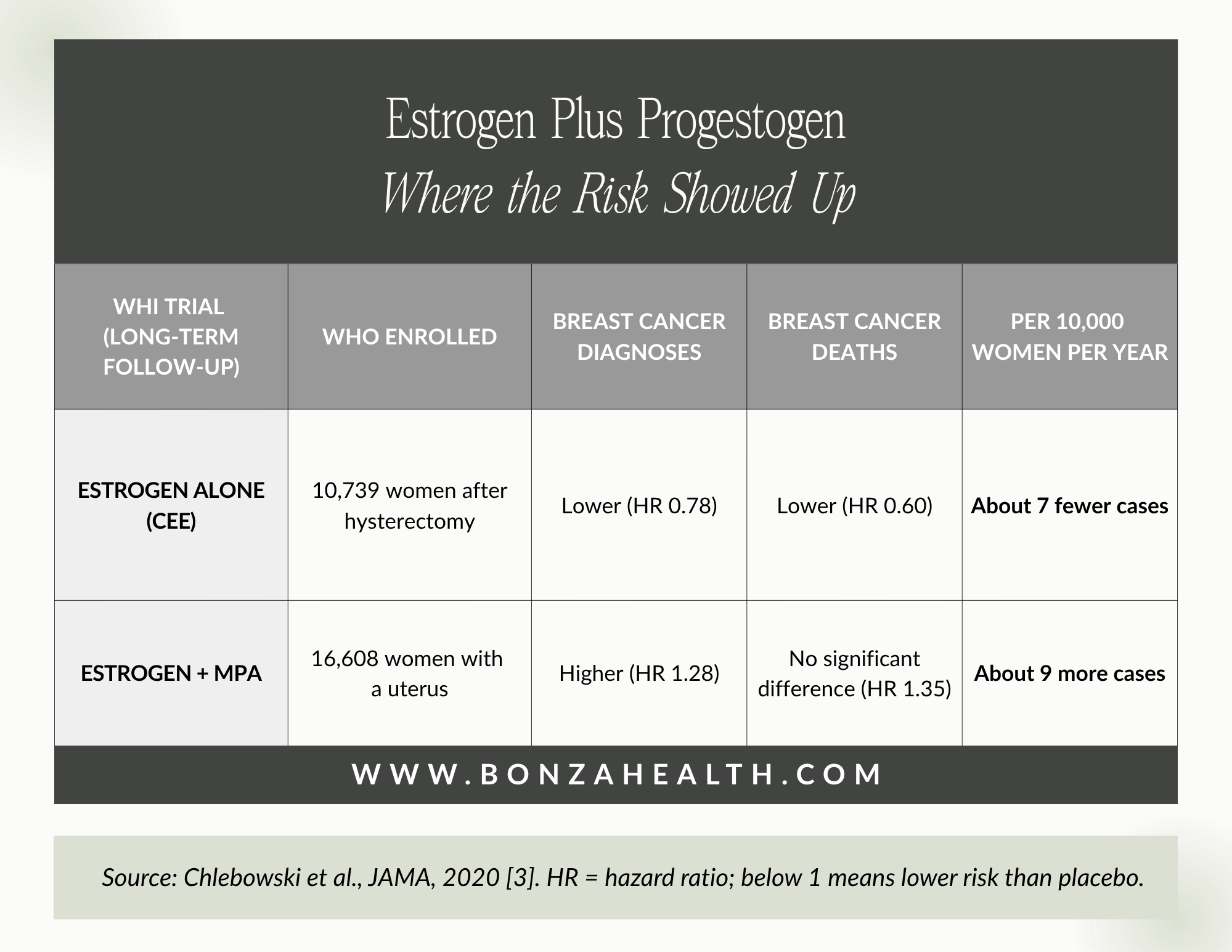
Estrogen plus progestogen: where the risk showed up
So the two regimens moved in opposite directions. The most likely explanation is the progestogen, not the estrogen [5].
Does the type of progestogen matter? Probably, though here the evidence is observational, not randomized. In the large French E3N cohort, estrogen combined with micronized (body-identical) progesterone was not linked to a clear increase in breast cancer, while estrogen with synthetic progestins was [6]. A large UK case-control study found similar patterns, with the lowest signal for micronized progesterone and dydrogesterone [7]. A 2026 review in The Lancet Diabetes & Endocrinology reaches a similar, cautious conclusion [8].
What I tell patients: micronized progesterone looks gentler on the breast, especially with shorter use. But "looks gentler" in observational data is not the same as "proven safe" in a trial.
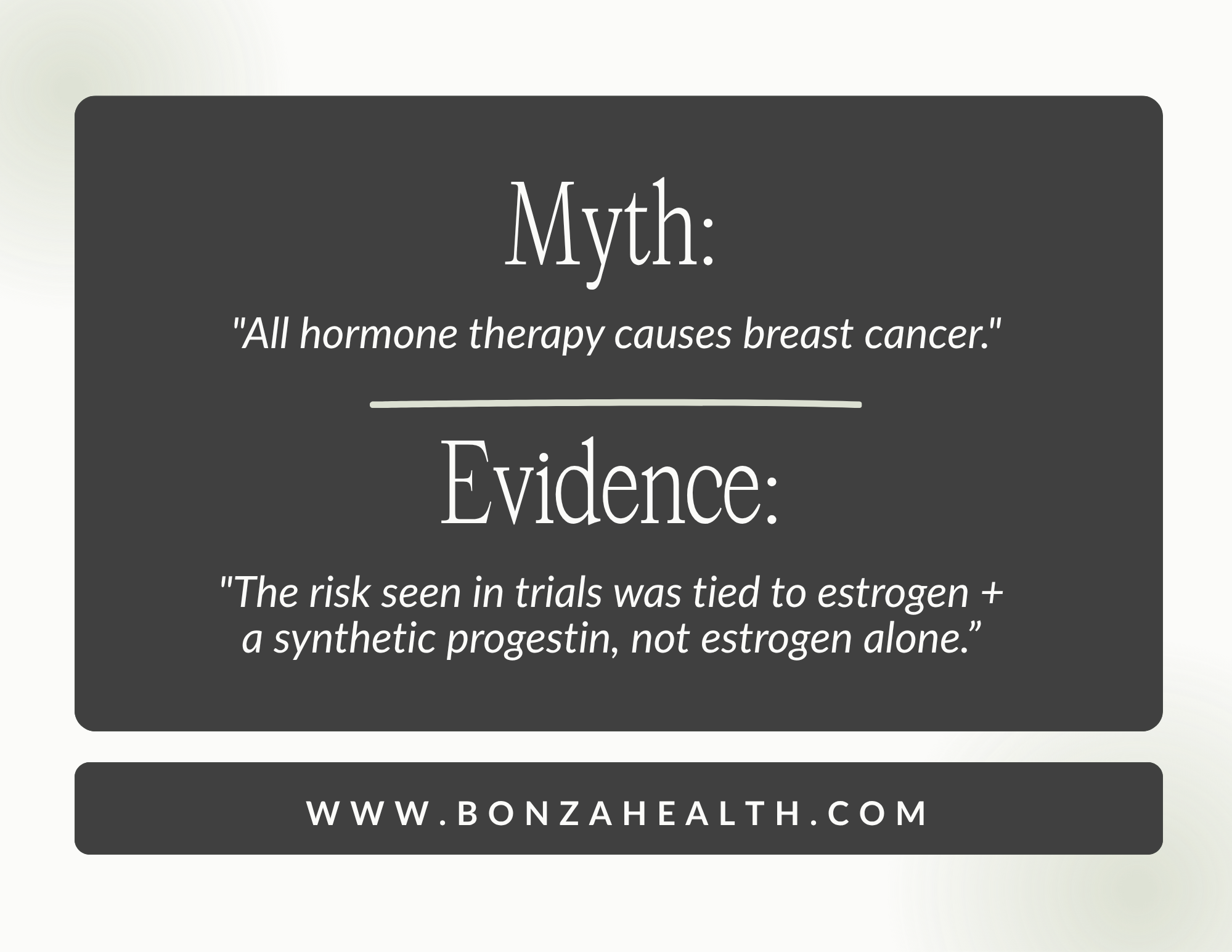
In reality, the risk seen in trials was tied to estrogen plus a synthetic progestin, not estrogen alone
The honest uncertainties
I would not be doing my job if I only shared the reassuring parts. Three limits deserve a place in every conversation.
The trials used CEE, not estradiol. WHI tested conjugated equine estrogen, an older oral product. Most women I treat today use estradiol, often as a patch or gel. It is reasonable to expect estradiol to behave similarly, but that is an extrapolation, not a directly proven result.
Observational studies disagree. A 2019 Lancet meta-analysis of more than 100,000 women with breast cancer found a small increase in risk even with estrogen alone, smaller than with combined therapy, and some risk persisting after stopping [9]. Why the randomized trials and observational data disagree is still debated. Differences in who chooses hormones, how often they are screened, and when therapy starts may all play a role [5].
Age and timing matter. The average WHI participant was 63 at enrollment, often more than a decade past menopause. Most women who seek treatment today are in their late 40s or 50s. Guidance generally favors starting therapy before age 60 or within 10 years of menopause, when the benefit–risk balance is most favorable [10].
None of this cancels out the randomized findings. It means we hold them with appropriate humility.
The Menopause Society's position is that for healthy women under 60, or within 10 years of menopause, the benefits of hormone therapy generally outweigh the risks when symptoms are bothersome [16]
Cause versus fuel: why survivors are a different conversation
Patients often ask: "If estrogen doesn't cause breast cancer, why do cancer doctors prescribe drugs like anastrozole to block it?" It is a sharp question, and the answer is that these are two different situations.
Whether estrogen starts a new cancer in a healthy woman is one question. Whether estrogen fuels a cancer that already exists is another. About 70% of breast cancers are estrogen receptor–positive, which means estrogen can stimulate their growth. Blocking estrogen after one of these cancers lowers the chance it returns. There is no contradiction.
For breast cancer survivors, the randomized data are mixed and deserve a careful look. The Swedish HABITS trial was stopped early after survivors taking hormone therapy had more recurrences (HR 2.4 at extended follow-up) [11]. A parallel Stockholm trial, which used less progestogen, did not find a significant increase [12]. For survivors with bothersome vaginal dryness, low-dose vaginal estrogen can be considered after discussion with the oncology team [13].
Other groups need individualized, specialist-informed discussion rather than a reflex answer:
BRCA1/2 carriers without breast cancer who have had their ovaries removed early. Observational studies have not shown a higher breast cancer risk with hormone therapy, and estrogen alone looks especially reassuring [14-15].
Women with atypical hyperplasia, lobular carcinoma in situ, or chest radiation at a young age, whose baseline risk is already elevated.
Women with a strong family history, where formal risk assessment and genetic counseling can clarify the starting point.
For these women, the answer is not automatically "no." It is "let's look closely, together, and bring in your specialists."
Breast cancer survivors are a different conversation
How we decide together in my practice
The Menopause Society's position is that for healthy women under 60, or within 10 years of menopause, the benefits of hormone therapy generally outweigh the risks when symptoms are bothersome [16]. That is a starting point for a conversation, not a prescription.
When a patient and I talk about estradiol, we walk through these steps:
Your goals. Hot flashes, sleep, mood, vaginal and bladder symptoms, bone health. What would a good outcome look like for you?
Your personal risk. Personal and family history of breast, ovarian, and related cancers; prior biopsies; breast density; blood clots; heart disease. When the history is complex, we use a formal risk calculator or refer for genetic counseling.
Your uterus. If you have had a hysterectomy, estrogen alone is an option, which is the most reassuring situation for the breast. If not, we choose a progestogen, and I usually discuss micronized progesterone.
Route and dose. Patch, gel, spray, or pill, and the lowest dose that controls your symptoms.
Screening. Staying current with routine mammograms. Current USPSTF guidance recommends screening every two years starting at 40 [17]. No special extra scan is needed just to start estrogen.
Your decision, revisited. We check in regularly. You can change your mind at any point.
Some women choose hormones. Some choose non-hormonal options. Some decide to wait. All of those can be well-informed, reasonable choices. A 2026 VA/DoD guideline similarly emphasizes individualized, shared decisions [18].

As a patient, you have the right to make an informed choice about your own body
Questions to bring to your appointment
Based on my history, is my breast cancer risk average or higher?
Would estrogen alone be an option for me, or do I need a progestogen? Which one, and why?
What are my non-hormonal options, and how well do they work?
How will we monitor my breasts while I am on therapy?
If I start and later want to stop, how do we do that?
The bottom line
Estrogen alone is not the breast cancer villain it was made out to be. The randomized evidence is reassuring, the progestogen matters, and some women need a closer look. You deserve the full picture, and you deserve to make the call. Bring this article to your clinician and decide together.
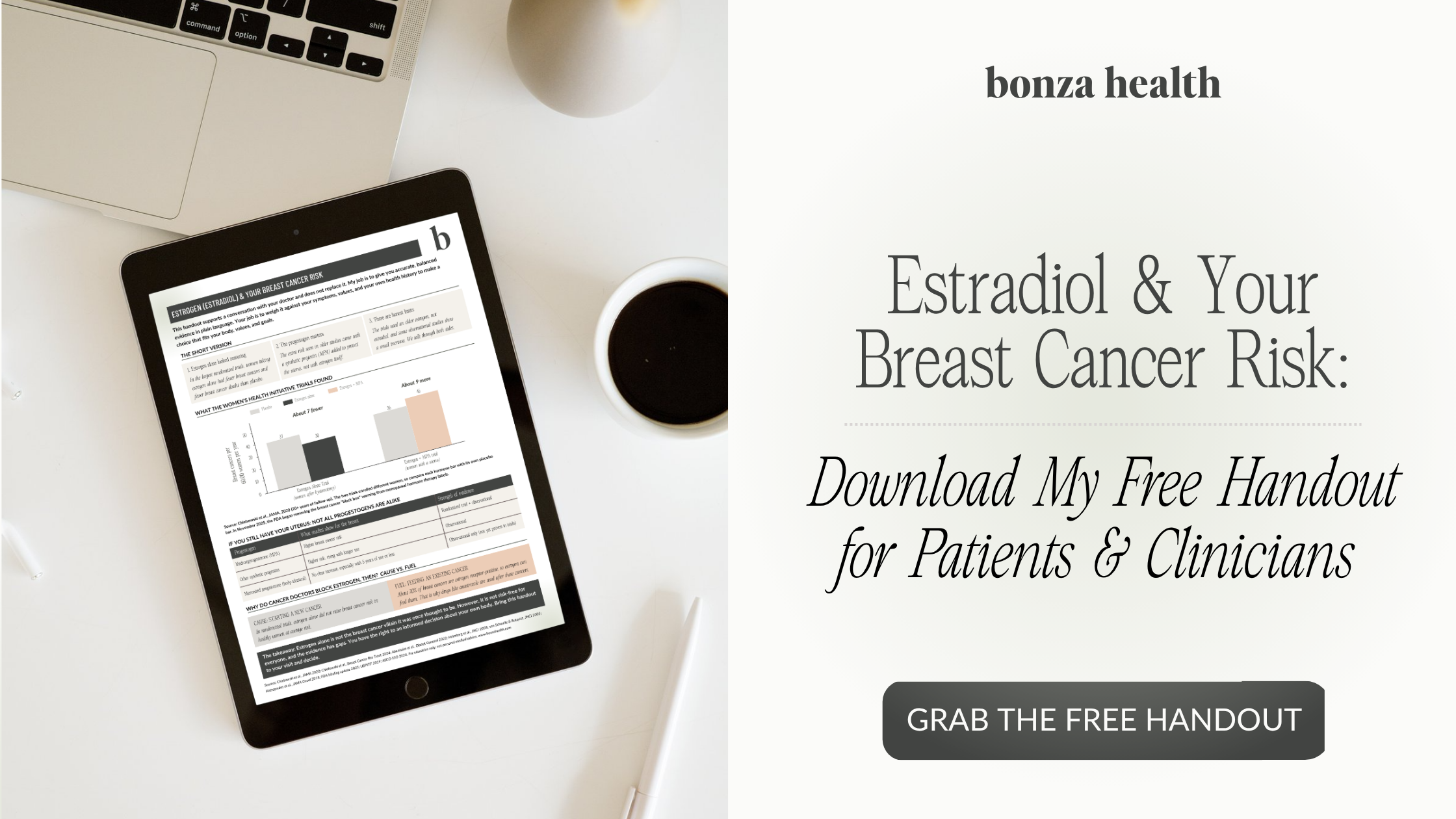
Download my free Estradiol & Breast Cancer Risk handout
This article is for education and does not replace personalized medical advice.
References
[1] J. E. Rossouw et al., "Risks and benefits of estrogen plus progestin in healthy postmenopausal women: Principal results from the Women's Health Initiative randomized controlled trial," JAMA, vol. 288, no. 3, pp. 321–333, 2002. https://doi.org/10.1001/jama.288.3.321
[2] M. A. Makary et al., "Updated labeling for menopausal hormone therapy," JAMA, 2025, https://doi.org/10.1001/jama.2025.22259. See also U.S. Food and Drug Administration, "HHS advances women's health, removes misleading FDA warnings on hormone replacement therapy," Nov. 2025.
[3] R. T. Chlebowski et al., "Association of menopausal hormone therapy with breast cancer incidence and mortality during long-term follow-up of the Women's Health Initiative randomized clinical trials," JAMA, vol. 324, no. 4, pp. 369–380, 2020. https://doi.org/10.1001/jama.2020.9482
[4] R. T. Chlebowski et al., "Randomized trials of estrogen-alone and breast cancer incidence: A meta-analysis," Breast Cancer Res. Treat., vol. 206, no. 1, pp. 177–184, 2024. https://doi.org/10.1007/s10549-024-07307-9
[5] R. T. Chlebowski and A. K. Aragaki, "The Women's Health Initiative randomized trials of menopausal hormone therapy and breast cancer: Findings in context," Menopause, 2023. https://doi.org/10.1097/gme.0000000000002154
[6] A. Fournier, F. Berrino, and F. Clavel-Chapelon, "Unequal risks for breast cancer associated with different hormone replacement therapies: Results from the E3N cohort study," Breast Cancer Res. Treat., vol. 107, no. 1, pp. 103–111, 2008. https://doi.org/10.1007/s10549-007-9523-x
[7] H. A. Abenhaim et al., "Menopausal hormone therapy formulation and breast cancer risk," Obstet. Gynecol., vol. 139, no. 6, pp. 1103–1110, 2022. https://doi.org/10.1097/aog.0000000000004723
[8] A. Gompel and R. Simcock, "Menopausal hormone treatment and breast cancer," Lancet Diabetes Endocrinol., 2026. https://doi.org/10.1016/S2213-8587(25)00394-8
[9] Collaborative Group on Hormonal Factors in Breast Cancer, "Type and timing of menopausal hormone therapy and breast cancer risk: Individual participant meta-analysis of the worldwide epidemiological evidence," Lancet, vol. 394, no. 10204, pp. 1159–1168, 2019. https://doi.org/10.1016/S0140-6736(19)31709-X
[10] C. J. Crandall, J. M. Mehta, and J. E. Manson, "Management of menopausal symptoms: A review," JAMA, vol. 329, no. 5, pp. 405–420, 2023. https://doi.org/10.1001/jama.2022.24140
[11] L. Holmberg et al., "Increased risk of recurrence after hormone replacement therapy in breast cancer survivors," J. Natl. Cancer Inst., vol. 100, no. 7, pp. 475–482, 2008. https://doi.org/10.1093/jnci/djn058
[12] E. von Schoultz and L. E. Rutqvist, "Menopausal hormone therapy after breast cancer: The Stockholm randomized trial," J. Natl. Cancer Inst., vol. 97, no. 7, pp. 533–535, 2005. https://doi.org/10.1093/jnci/dji071
[13] American College of Obstetricians and Gynecologists, "Treatment of urogenital symptoms in individuals with a history of estrogen-dependent breast cancer: Clinical Consensus No. 2," Obstet. Gynecol., vol. 138, no. 6, pp. 950–960, 2021. https://doi.org/10.1097/aog.0000000000004601
[14] J. Kotsopoulos et al., "Hormone replacement therapy after oophorectomy and breast cancer risk among BRCA1 mutation carriers," JAMA Oncol., vol. 4, no. 8, pp. 1059–1065, 2018. https://doi.org/10.1001/jamaoncol.2018.0211
[15] A. M. Kaunitz and J. D. Wright, "Menopausal estrogen therapy and risk of breast cancer," Obstet. Gynecol., 2026. https://doi.org/10.1097/aog.0000000000006397
[16] The North American Menopause Society, "The 2022 hormone therapy position statement of The North American Menopause Society," Menopause, vol. 29, no. 7, pp. 767–794, 2022. https://doi.org/10.1097/gme.0000000000002028
[17] U.S. Preventive Services Task Force, "Screening for breast cancer: US Preventive Services Task Force recommendation statement," JAMA, vol. 331, no. 22, pp. 1918–1930, 2024. https://doi.org/10.1001/jama.2024.5534
[18] U.S. Department of Veterans Affairs and Department of Defense, "VA/DoD clinical practice guideline for the management of menopause," 2026. https://www.healthquality.va.gov/HEALTHQUALITY/guidelines/WH/menopause/