Getting Menopausal Hormone Therapy Right: Why the Details Matter
Written and edited by Sarah Bonza MD, MPH, FAAFP, MSCP, DipABLM, NBC-HWC

Beyond hot flashes: the sleep crisis no one talks about
If you're waking up multiple times a night drenched in sweat, unable to fall back asleep, and feeling exhausted all day, you're not alone. For many women going through menopause, severe sleep disruption is more debilitating than hot flashes. Yet the conversation around menopausal hormone therapy often oversimplifies the solution.
The truth is, not all hormone therapy is created equal. The type of hormones you use, how they're delivered, and when you start them can mean the difference between relief and continued suffering. Or even between safety and risk.
Let's break down what modern science tells us about optimizing hormone replacement for menopause, focusing on the three key players: estradiol, progesterone, and testosterone support.
Estradiol: Why Your Skin Matters More Than Your Stomach
The Patch vs. The Pill
When it comes to replacing estrogen, how you take it matters just as much as taking it at all. Oral estrogen pills might seem convenient, but they come with a hidden problem: they go through your liver first, triggering the production of clotting factors and inflammatory proteins that can increase your risk of blood clots and stroke.[1]
Transdermal estradiol—delivered through patches, gels, or sprays applied to your skin—bypasses the liver entirely. Your body absorbs it directly into your bloodstream, mimicking the natural way your ovaries used to release estrogen. The result? A dramatically different safety profile.
The research is clear: Transdermal estradiol at standard doses (patches delivering 25-50 mcg/day or gels at 0.5-1.5 mg/day) does not increase your risk of blood clots or stroke above your baseline risk.[2,3] Oral estrogen, on the other hand, can double to quadruple that risk, especially if you start it more than 10 years after menopause or after age 60.
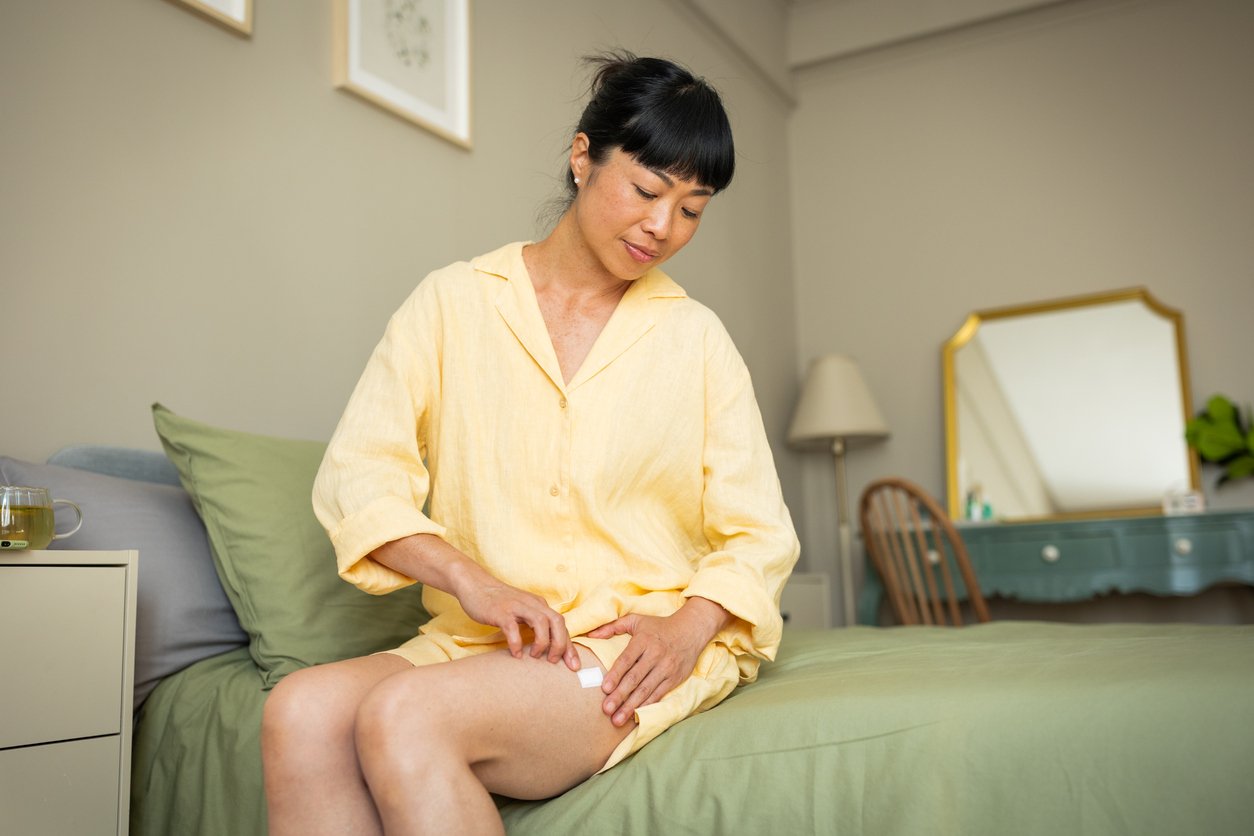
Your body absorbs transdermal estradiol directly into your bloodstream, mimicking the natural way your ovaries used to release estrogen.
Real Relief for Sleep and Hot Flashes
Beyond safety, transdermal estradiol works. Clinical studies show significant reductions in moderate-to-severe hot flashes within 2-3 weeks, with continued improvement over the first three months.[4] But what often surprises women is the improvement in sleep.
A 2024 study found that women on hormone therapy saw their sleep quality scores improve significantly after just 1-3 months, not just because they had fewer night sweats, but because estrogen helps stabilize the brain's temperature control center and restores normal sleep architecture.[1]
Timing Is Everything: The Window of Opportunity
Here's something critical that many doctors still get wrong: when you start hormone therapy matters enormously. Research shows the greatest benefits (and the best safety profile) occur when you start within 10 years of your final period or before age 60.[1,3]
Start early in this window, and estrogen helps maintain healthy blood vessels and prevent early bone loss. Start too late, and you may miss out on these protective benefits. If you're 51 and experiencing severe symptoms, you're in the ideal window to start.
If you still have your uterus and you're taking estrogen, you must also take progesterone.
Progesterone: Your Secret Weapon for Sleep
Why You Need It (If You Have a Uterus)
If you still have your uterus and you're taking estrogen, you must also take progesterone. Estrogen alone stimulates the uterine lining, which can lead to precancerous changes or even cancer. Progesterone protects against this risk.[5]
The dosing is straightforward:
Continuous regimen: 100-200 mg of micronized progesterone every night
Cyclic regimen: 200 mg for 12-14 days each month
But here's where it gets interesting: micronized progesterone does far more than protect your uterus.
The Sleep Benefit You Didn't Know About
Micronized progesterone has a remarkable property that synthetic progestins don't share: it converts in your body to a compound called allopregnanolone, which acts on the same brain receptors as anti-anxiety medications and sleep aids.[6]
A comprehensive 2021 analysis of multiple clinical trials found that women taking micronized progesterone fell asleep faster and reported better sleep quality compared to those taking placebo.[6] The effect is real, measurable, and happens without the tolerance issues or "hangover" effects of sleeping pills.
This is why taking your progesterone at bedtime is such a smart strategy. One capsule gives you:
Uterine protection
Reduced night sweats
Easier sleep onset
Better overall sleep quality
Not All Progestins Are Equal
It's worth noting that synthetic progestins like medroxyprogesterone acetate (found in products like Provera or Prempro) don't provide these sleep benefits. They also may carry higher risks for breast cancer and could offset some of estrogen's cardiovascular benefits. Micronized progesterone, which is bioidentical to what your ovaries used to make, appears to have a safer profile.[5]

Not all hormone therapy is created equal. The type of hormones you use, how they're delivered, and when you start them can mean the difference between relief, continued suffering, and safety.
Testosterone and DHEA: Supporting Your Energy and Drive
The Hormone We Don't Talk About Enough
Testosterone isn't just a male hormone. Women produce it too, and it plays important roles in maintaining muscle mass, bone density, energy levels, and libido. During menopause, testosterone levels decline; not as dramatically as estrogen, but enough to make a difference in how you feel.
Direct testosterone replacement (typically as a cream or gel applied to the skin) can be highly effective for low libido and decreased energy. But not everyone tolerates it well. Some women experience persistent headaches, acne, or unwanted hair growth even at low doses.
When DHEA Makes Sense
This is where DHEA (dehydroepiandrosterone) comes in. DHEA is a hormone your adrenal glands produce that serves as a precursor; your body can convert it into both testosterone and estrogen as needed.
Recent research from 2024 analyzing 21 clinical trials found that DHEA supplementation in postmenopausal women significantly increases both testosterone and estradiol levels.[7] The body essentially uses DHEA as raw material to make what it needs.
The clinical benefits are still being studied, but DHEA supplementation appears most helpful for:[8]
Women who can't tolerate direct testosterone
Supporting bone health when combined with resistance training
Possibly improving mood and energy (though research is mixed)
Vulvovaginal symptoms (when used as a vaginal insert)
Typical doses range from 10-50 mg daily. Newer liposomal formulations may improve absorption and provide steadier hormone levels throughout the day.
Making the Choice: Testosterone vs. DHEA
Think of it this way:
Direct testosterone is like giving your body the finished product: more predictable, often more effective for sexual desire
DHEA is like giving your body the ingredients: gentler, potentially better tolerated, but results may be more variable
If you tried testosterone and couldn't tolerate the side effects, DHEA offers a reasonable alternative worth discussing with your provider.

Direct testosterone replacement (typically as a cream or gel applied to the skin) can be highly effective for low libido and decreased energy.
Putting It All Together: A Personalized Approach
The clinical case we started with—a 51-year-old woman with severe sleep disruption and vasomotor symptoms—illustrates how these three hormones work together:
Her regimen:
Transdermal estradiol gel (0.75 mg daily) for hot flashes and sleep stability
Micronized progesterone (200 mg at bedtime) for uterine protection and sleep support
Liposomal DHEA after experiencing headaches from testosterone cream
This combination addresses her immediate symptoms while supporting long-term bone and cardiovascular health, all with a safety profile supported by current research.
What This Means for You
If you're struggling with menopausal symptoms, especially sleep disruption, here are the key takeaways:
Choose transdermal over oral estrogen when possible; it's safer and just as effective
Take micronized progesterone at bedtime to maximize both protection and sleep benefits
Consider DHEA if testosterone isn't tolerated or as a gentler first approach to androgen support
Start within the window, ideally within 10 years of menopause or before age 60
Work with a knowledgeable provider who understands that details matter in hormone therapy
You deserve more than a one-size-fits-all approach to hormone therapy.
Beyond the One-Size-Fits-All Approach
The evolution from standard conjugated horse estrogen pills to personalized bioidentical hormone regimens represents a fundamental shift in how we approach menopause. We now understand that the route of delivery, the type of progesterone, and the timing of initiation all profoundly influence both safety and effectiveness.
At Bonza Health, we believe in evidence-based, individualized care that considers your unique symptom profile, risk factors, and health goals. Hormone therapy isn't right for everyone, but when it is appropriate, getting the details right can transform your experience of menopause from something to endure into a transition you navigate with energy, good sleep, and confidence.
Your menopause journey deserves better than a one-size-fits-all approach. It deserves precision, personalization, and partnership with providers who stay current with the latest research.

At Bonza Health, we specialize in personalized menopausal hormone therapy that considers your unique needs and health goals. Schedule a consultation to discuss whether hormone optimization is right for you.
References:
[1] Mukherjee S, et al. Menopausal Hormone Therapy—Risks, Benefits and Emerging Options. Int J Mol Sci. 2025;26(22):11098. https://doi.org/10.3390/ijms262211098
[2] National Institute for Health and Care Excellence. Menopause: diagnosis and management. NICE guideline [NG23]. Updated 2024. https://www.nice.org.uk/guidance/ng23
[3] Mukherjee A, et al. Update on Menopause Hormone Therapy. Clin Endocrinol (Oxf). 2025. https://doi.org/10.1111/cen.15211
[4] Archer DF, et al. Transdermal estradiol gel for symptomatic postmenopausal women. Menopause. 2012;19(6):622-9. https://doi.org/10.1097/gme.0b013e31823b8867
[5] Mueck AO, et al. Impact of micronized progesterone on the endometrium: systematic review. Climacteric. 2016;19(4):316-28. https://doi.org/10.1080/13697137.2016.1187123
[6] Caufriez A, et al. Efficacy of Micronized Progesterone for Sleep: Meta-analysis. J Clin Endocrinol Metab. 2021;106(4):e942-e954. https://doi.org/10.1210/clinem/dgaa873
[7] Mohammadi-Kordkhayli M, et al. DHEA supplementation in postmenopausal women: meta-analysis. Diabetol Metab Syndr. 2025;17(1):11.
[8] Rutkowski K, et al. DHEA supplementation position statement. Gynecol Endocrinol. 2020;36(12):1039-1045.