The Study That Scared a Generation of Women — And What It Actually Found
Written and edited by Sarah Bonza, MD, MPH, FAAFP, MSCP, DipABLM, NBC-HWC | Bonza Health

The WHI study that scared a generation of women, and what it actually found
A patient of mine — a physician herself — had a hysterectomy and started transdermal estradiol a few weeks later. Then her breasts began to ache. Not a little. Enough that a seatbelt hurt. Enough that she lay awake at 2 a.m. reading about estrogen and breast cancer and arrived in my office certain she had done something dangerous to her own body.
She is a trained clinician. She has read papers. And she was still terrified.
That tells you something about how thoroughly one 2002 press conference reshaped what an entire generation of women — including the ones with medical degrees — believe about estrogen.
So let's go back to what the Women's Health Initiative actually found. Not the headline. The data.
There were two trials, not one
The WHI hormone program was two separate randomized trials running in parallel [1,2]:
Women with a uterus received conjugated equine estrogen plus medroxyprogesterone acetate — CEE + MPA, sold as Prempro. 16,608 women.
Women with a prior hysterectomy received conjugated equine estrogen alone — CEE, sold as Premarin. 10,739 women.
Two different drugs. Two different populations. Two different results.
In July 2002, the combined-therapy arm was stopped early and announced to the world. Breast cancer was the headline. What almost nobody heard is that the estrogen-alone trial kept running — and when it reported, it said something close to the opposite.
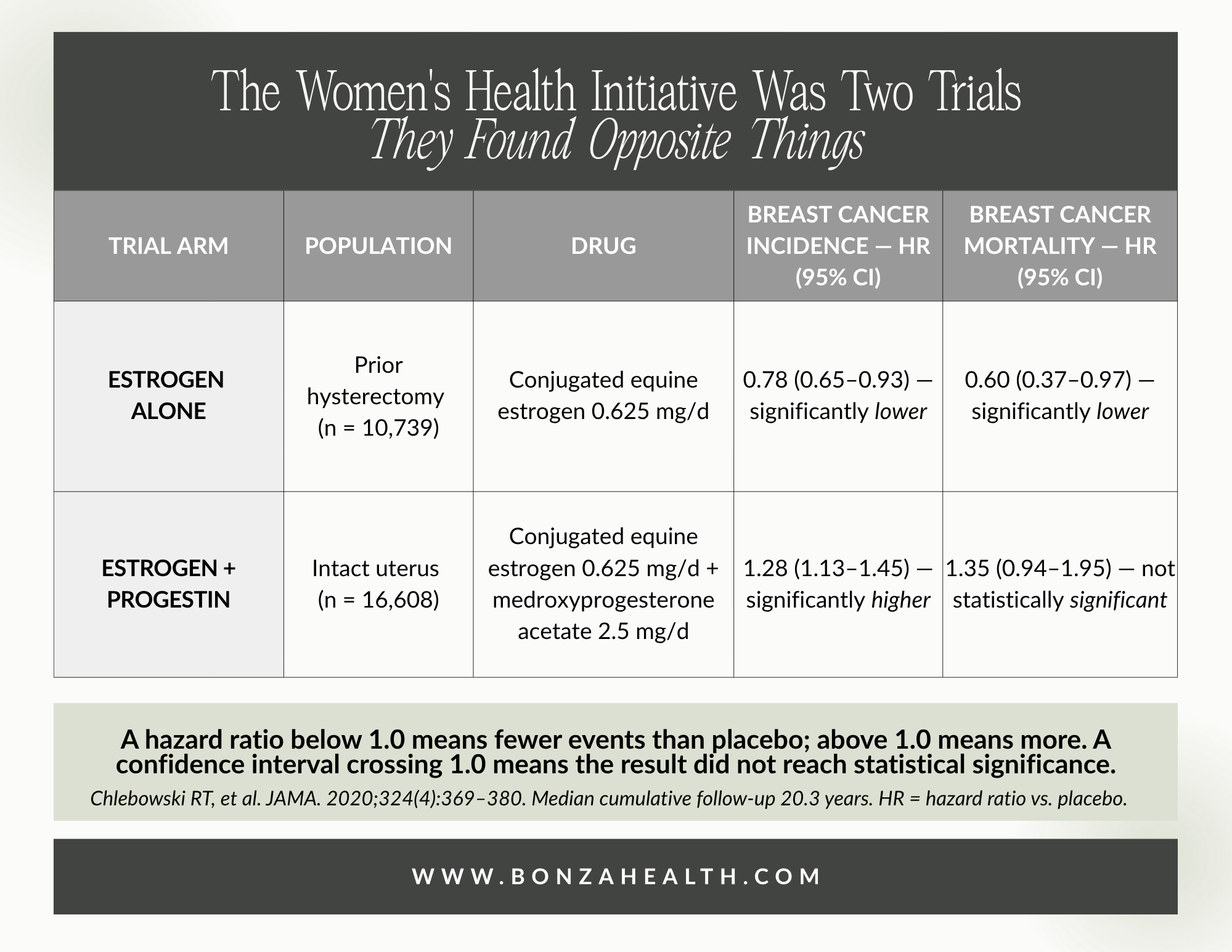
The Women's Health Initiative was two trials. They found opposite things.
What the estrogen-alone trial found
At the time the CEE-alone trial stopped, invasive breast cancer was lower in the estrogen group than in placebo: a hazard ratio of 0.80, which did not reach statistical significance at that point [3].
With longer follow-up, the finding held and strengthened. In extended follow-up published in Lancet Oncology, women randomized to estrogen alone had significantly fewer invasive breast cancers than women on placebo, and among those who did develop breast cancer, mortality was lower [4].
Then came the 20-year follow-up, published in JAMA in 2020, with mortality data on more than 98% of participants [5]. In the estrogen-alone trial:
Breast cancer incidence was significantly lower — HR 0.78 (95% CI 0.65–0.93), 238 cases versus 296 on placebo.
Breast cancer mortality was significantly lower — HR 0.60 (95% CI 0.37–0.97), 30 deaths versus 46 on placebo.
The authors noted this was, to their knowledge, the first pharmacologic intervention shown to significantly reduce deaths from breast cancer [5].
In the same paper, the combined CEE + MPA arm showed higher breast cancer incidence — HR 1.28 (95% CI 1.13–1.45) — with no statistically significant difference in breast cancer mortality [5].
Same trial program. Same investigators. Same journal. Opposite directions. The variable that changed was the progestogen.
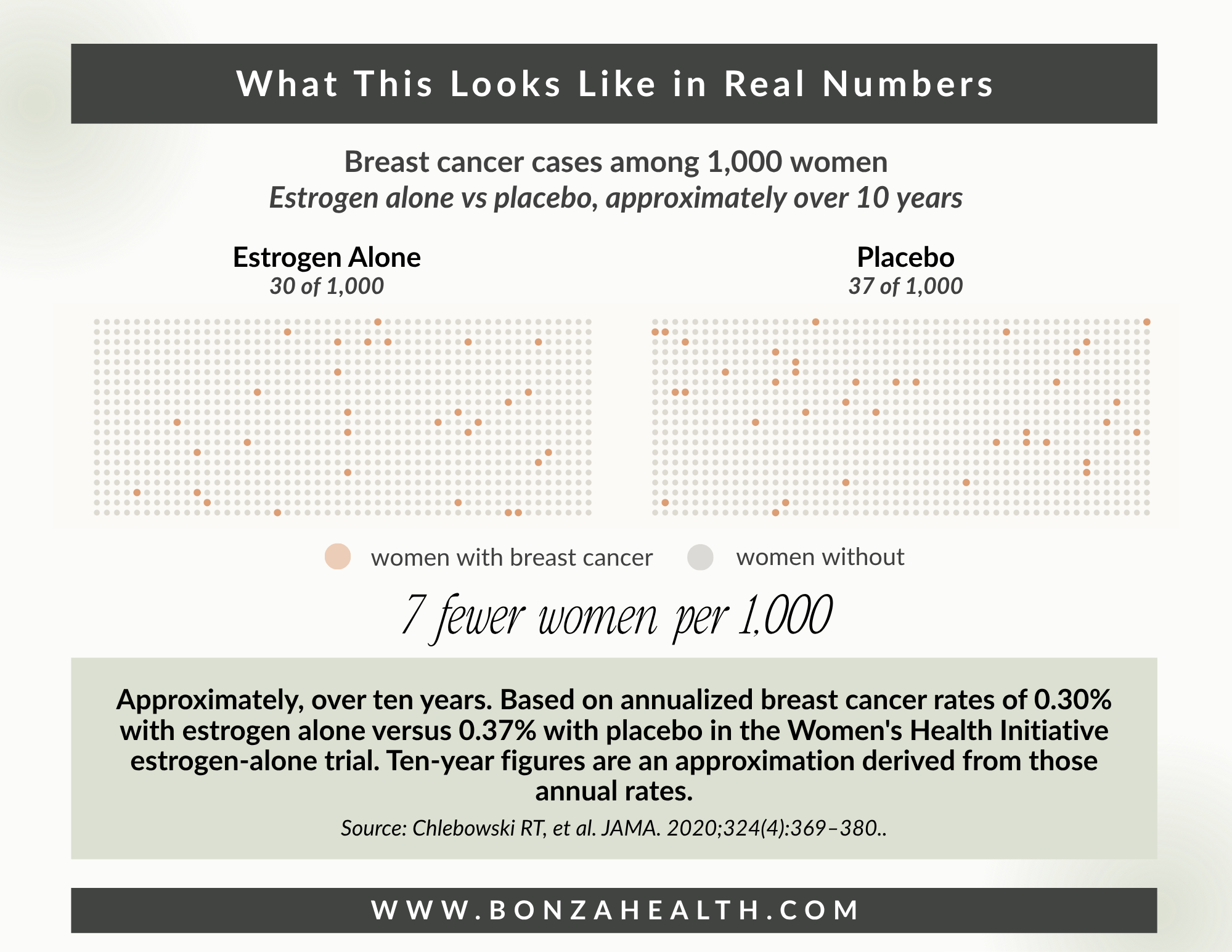
What this looks like in real numbers
About that 2002 headline
The number that launched a thousand news segments was a hazard ratio of 1.26 for invasive breast cancer in the CEE + MPA arm [1]. What was less discussed: in the original publication, that estimate was reported with a nominal 95% confidence interval of 1.00–1.59, while the confidence interval adjusted for multiple comparisons — the statistically appropriate one for a trial monitoring many outcomes at once — crossed 1.0 [1].
In plain English: the finding that terminated the trial and reset global prescribing practice did not, at the moment it was announced, meet the threshold for statistical significance once the analysis accounted for how many outcomes were being watched.
Longer follow-up did go on to confirm a real increase in incidence with CEE + MPA [5]. The point is not that the signal was imaginary. The point is that a provisional result from one drug combination was communicated as a settled fact about "hormone therapy" as a category — and the trial that tested estrogen by itself was left out of the story entirely.
Worth adding: over 18 years of cumulative follow-up, neither regimen was associated with increased all-cause mortality. All-cause mortality was 27.1% with hormone therapy versus 27.6% with placebo [6].
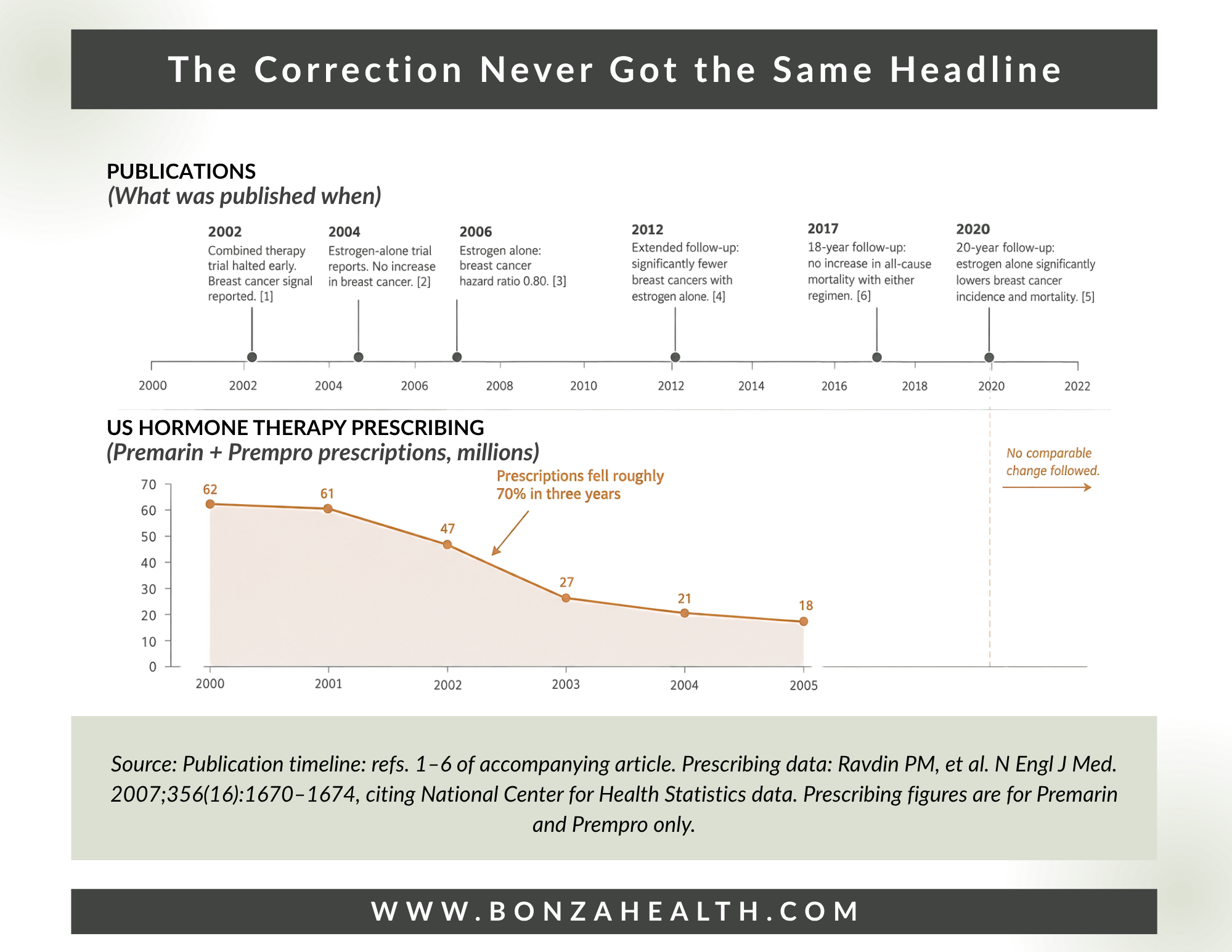
The correction never got the same headline.
Not all progestogens behave the same way
If the progestogen is the variable that matters, the obvious next question is whether all progestogens carry the same risk. The available evidence says no.
The French E3N cohort followed more than 80,000 postmenopausal women and separated hormone therapy by which progestogen was used [7]. Compared with never-use, relative risk of breast cancer was:
1.00 (95% CI 0.83–1.22) for estrogen plus micronized progesterone
1.16 (95% CI 0.94–1.43) for estrogen plus dydrogesterone
1.69 (95% CI 1.50–1.91) for estrogen plus other synthetic progestins
An earlier E3N analysis found the same pattern: risk was significantly higher with synthetic progestins than with micronized progesterone [8].
A very large UK study using the QResearch and CPRD databases — nearly 99,000 breast cancer cases matched to over 457,000 controls — found the same ordering. Among recent, long-term users, combined estrogen–progestogen therapy carried an adjusted odds ratio of 1.79, while estrogen-only therapy carried 1.15. Within the combined group, risk was highest with norethisterone and lowest with dydrogesterone [9].
Different progestogens, different risk. This is not a fringe position; it is what the data show across multiple large datasets.

Same estrogen. Different progestogen. Different risk.
Where I will not overstate the case
I want to be precise here, because being loosely right is how misinformation gets made — even when the correction is pointed in the right direction.
First: the WHI tested conjugated equine estrogen, not estradiol. The randomized evidence showing reduced breast cancer incidence and mortality is evidence about CEE, taken orally. My patient is on transdermal estradiol. That is a different molecule by a different route. There has never been a large randomized trial of transdermal estradiol with breast cancer as a primary endpoint. Anyone who tells you the WHI proved transdermal estradiol is protective is going beyond the data.
Second: observational data on estrogen alone are less reassuring than the randomized data. In E3N, estrogen alone was associated with a modestly increased risk [7]. In the UK databases, long-term estrogen-only use carried an odds ratio of 1.15 [9]. A large individual-participant meta-analysis of worldwide epidemiological evidence also reported increased risk with estrogen-only therapy [10]. Randomized trials and observational studies genuinely disagree here, and honest clinicians should say so rather than quoting only the arm that suits them.
So the defensible statement is not "estrogen cannot cause breast cancer." It is this:
In the only large randomized trial of estrogen alone, breast cancer incidence and breast cancer mortality were lower than placebo. The increase in breast cancer seen in the WHI came from the arm that added a synthetic progestin. The risk attributed to "hormones" for two decades is substantially attributable to the progestogen component, and progestogens are not interchangeable.
That is a strong claim. It is also one I can defend line by line.
So what about the breast pain?
Here is the part that mattered most to my patient at 2 a.m.
Breast tenderness is one of the most common effects of starting estrogen. It is typically bilateral, diffuse, dose-related, and most pronounced in the first weeks of therapy. It is a signal about dose, not a signal about cancer. Reducing the estradiol dose and reassessing in six to eight weeks resolves it for most women — and current guidance supports using the lowest dose that controls symptoms, with periodic reevaluation [11].
What does warrant prompt evaluation, on hormone therapy or off it: a new discrete lump, one-sided focal pain that persists, nipple discharge, or skin or nipple changes. Starting hormone therapy does not exempt anyone from age-appropriate breast cancer screening.
My patient's pain was bilateral, diffuse, and began within weeks of starting a high-dose patch. We adjusted the dose. Her symptoms settled. Her fear took longer to settle than her breasts did — which is, in a sentence, the cost of twenty years of incomplete reporting.
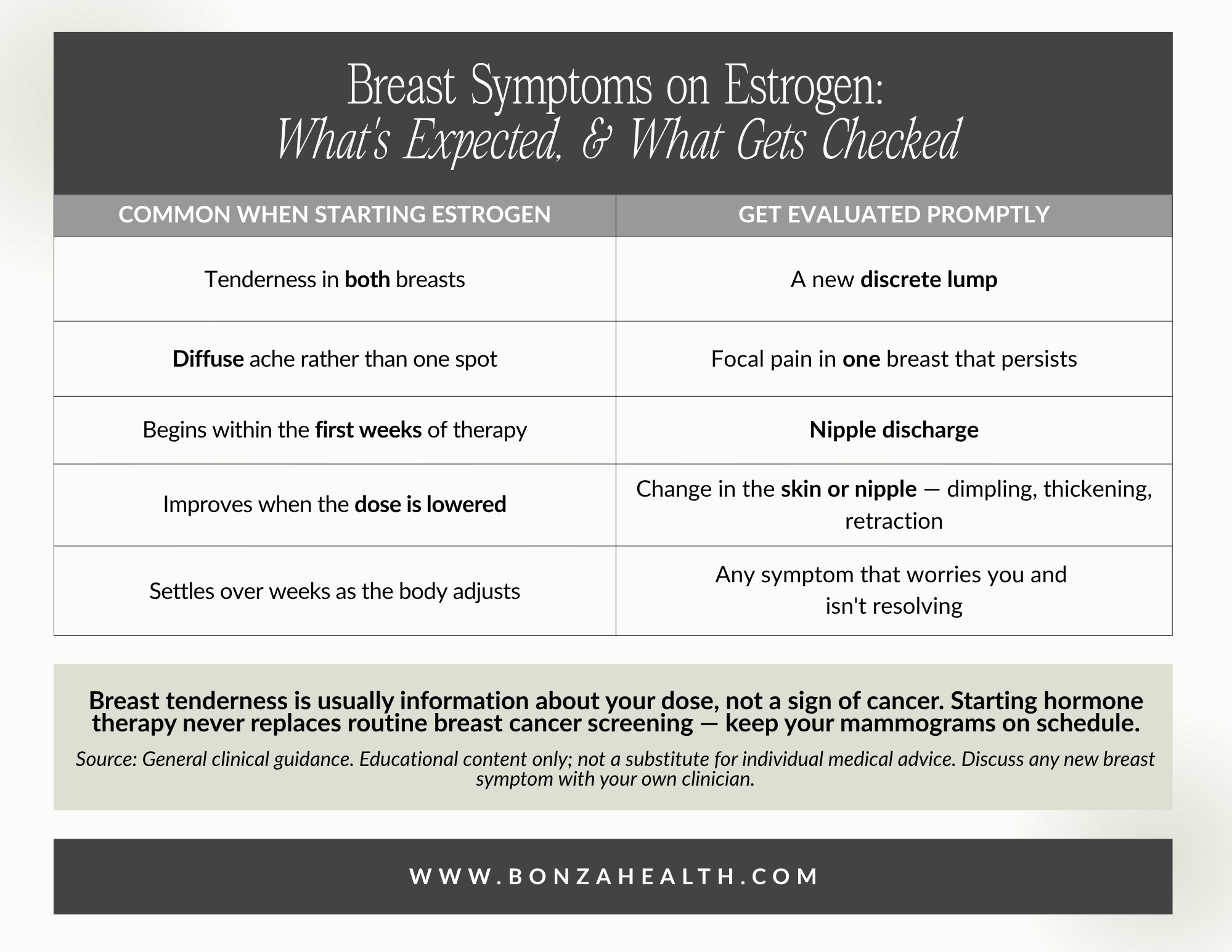
Breast symptoms on estrogen: what's expected, and what gets checked.
The bottom line
The Women's Health Initiative was not a bad study. It was a large, rigorous, enormously valuable trial whose most reassuring finding was buried under its most alarming one.
Women who have had a hysterectomy and do not need a progestogen have been carrying a fear that the randomized evidence simply does not support. Women who do need endometrial protection deserve a conversation about which progestogen, not a blanket refusal.
If you stopped hormone therapy because of what you heard in 2002, or were never offered it at all, that decision was made with half the evidence. It is reasonable to revisit it with a clinician who knows all of it.

Sign up for Fullscript to save 10% on professional-grade supplements.
References
[1] J. E. Rossouw, G. L. Anderson, R. L. Prentice, et al., "Risks and benefits of estrogen plus progestin in healthy postmenopausal women: principal results from the Women's Health Initiative randomized controlled trial," JAMA, vol. 288, no. 3, pp. 321–333, Jul. 2002. https://doi.org/10.1001/jama.288.3.321. PMID: 12117397.
[2] Women's Health Initiative Steering Committee, "Effects of conjugated equine estrogen in postmenopausal women with hysterectomy: the Women's Health Initiative randomized controlled trial," JAMA, vol. 291, no. 14, pp. 1701–1712, Apr. 2004. https://doi.org/10.1001/jama.291.14.1701. PMID: 15082697.
[3] M. L. Stefanick, G. L. Anderson, K. L. Margolis, et al., "Effects of conjugated equine estrogens on breast cancer and mammography screening in postmenopausal women with hysterectomy," JAMA, vol. 295, no. 14, pp. 1647–1657, Apr. 2006. https://doi.org/10.1001/jama.295.14.1647. PMID: 16609086.
[4] G. L. Anderson, R. T. Chlebowski, A. K. Aragaki, et al., "Conjugated equine oestrogen and breast cancer incidence and mortality in postmenopausal women with hysterectomy: extended follow-up of the Women's Health Initiative randomised placebo-controlled trial," Lancet Oncol., vol. 13, no. 5, pp. 476–486, May 2012. https://doi.org/10.1016/s1470-2045(12)70075-x . PMID: 22401913.
[5] R. T. Chlebowski, G. L. Anderson, A. K. Aragaki, et al., "Association of menopausal hormone therapy with breast cancer incidence and mortality during long-term follow-up of the Women's Health Initiative randomized clinical trials," JAMA, vol. 324, no. 4, pp. 369–380, Jul. 2020. https://doi.org/10.1001/jama.2020.9482. PMID: 32721007.
[6] J. E. Manson, A. K. Aragaki, J. E. Rossouw, et al., "Menopausal hormone therapy and long-term all-cause and cause-specific mortality: the Women's Health Initiative randomized trials," JAMA, vol. 318, no. 10, pp. 927–938, Sep. 2017. https://doi.org/10.1001/jama.2017.11217. PMID: 28898378.
[7] A. Fournier, F. Berrino, and F. Clavel-Chapelon, "Unequal risks for breast cancer associated with different hormone replacement therapies: results from the E3N cohort study," Breast Cancer Res. Treat., vol. 107, no. 1, pp. 103–111, Jan. 2008. https://doi.org/10.1007/s10549-007-9523-x. PMID: 17333341.
[8] A. Fournier, F. Berrino, E. Riboli, V. Avenel, and F. Clavel-Chapelon, "Breast cancer risk in relation to different types of hormone replacement therapy in the E3N-EPIC cohort," Int. J. Cancer, vol. 114, no. 3, pp. 448–454, Apr. 2005.https://doi.org/10.1002/ijc.20710. PMID: 15551359.
[9] Y. Vinogradova, C. Coupland, and J. Hippisley-Cox, "Use of hormone replacement therapy and risk of breast cancer: nested case-control studies using the QResearch and CPRD databases," BMJ, vol. 371, p. m3873, Oct. 2020. https://doi.org/10.1136/bmj.m3873. PMID: 33115755.
[10] Collaborative Group on Hormonal Factors in Breast Cancer, "Type and timing of menopausal hormone therapy and breast cancer risk: individual participant meta-analysis of the worldwide epidemiological evidence," Lancet, vol. 394, no. 10204, pp. 1159–1168, Sep. 2019. https://doi.org/10.1016/s0140-6736(19)31709-x. PMID: 31474332.
[11] S. S. Faubion, C. J. Crandall, L. Davis, et al., "The 2022 hormone therapy position statement of The North American Menopause Society," Menopause, vol. 29, no. 7, pp. 767–794, Jul. 2022. https://doi.org/10.1097/gme.0000000000002028. PMID: 35797481.
[12] R. T. Chlebowski, G. Anderson, M. Gass, et al., "Estrogen plus progestin and breast cancer incidence and mortality in postmenopausal women," JAMA, vol. 304, no. 15, pp. 1684–1692, Oct. 2010. https://doi.org/10.1001/jama.2010.1500. PMID: 20959578.