Menopause Hormone Therapy When You Have Multiple Sclerosis: What the Evidence Actually Says
Written and edited by Sarah Bonza, MD, MPH, FAAFP, MSCP, DipABLM, NBC-HWC | Bonza Health

If high estrogen quiets multiple sclerosis, shouldn't the permanent estrogen decline of menopause worsen it? And shouldn't replacing that estrogen help?
Yesterday, a patient sat across from me and asked a question I've been hearing more and more often. She's in her mid-fifties, three years past her last period, living with relapsing-remitting multiple sclerosis, and she is exhausted. Not the vague tiredness of a busy week — the kind of fatigue that makes her cancel plans. She's waking at 2 a.m. drenched. Her thinking feels slower than it did two years ago. Her neurologist tells her the MRI is stable.
"So is this my MS getting worse," she asked, "or is this menopause? And if I start hormone therapy, am I going to make my MS worse?"
It's a genuinely good question, and for a long time the honest answer was we're not sure. That's changed. Over the past two years, several large studies have given us far clearer footing. Here's what we know now — and what I told her.
Why hormones and MS are tangled together in the first place
MS is not evenly distributed between the sexes. Women are diagnosed roughly three times as often as men, and that ratio has been climbing for decades [1]. That alone tells us something biological is going on.
The most striking clue comes from pregnancy. In the landmark PRIMS study, relapse rates dropped sharply during the third trimester — when estrogen and progesterone levels are at their lifetime peak — then rebounded in the first three months after delivery, when those hormones crash [2].
Estrogen appears to have genuine anti-inflammatory and neuroprotective properties: it dampens microglial activation, supports the blood-brain barrier, and may aid remyelination [3].
So the logic seems obvious. If high estrogen quiets MS, shouldn't the permanent estrogen decline of menopause worsen it? And shouldn't replacing that estrogen help?
That's a reasonable hypothesis. It's also, as it turns out, not quite what the data show.
Does menopause actually accelerate MS?
Early studies suggested it might. A 2016 longitudinal analysis from Brigham and Women's Hospital found an inflection point in disability scores around menopause [4]. An Italian multicentre study in 2019 reported that relapse rates fell after menopause but disability scores worsened [5]. And in a large online survey, women with MS overwhelmingly reported their symptoms got worse after menopause [6].
But the more recent, larger, better-controlled studies tell a different story.
In 2025, researchers using the MSBase registry followed 987 women with relapse-onset MS across eight Australian centres. After adjusting for age, disease duration, baseline disability, and high-efficacy therapy, menopause was not associated with an increased risk of confirmed disability progression or conversion to secondary progressive MS [7]. A Barcelona cohort followed from disease onset reached the same conclusion [8], as did a Norwegian population-based study [9]. A 2026 scoping review synthesising this literature found the evidence does not support menopause as a distinct inflection point [10].
The likely explanation: menopause happens to arrive at roughly the same time as another powerful biological process — ageing. Immunosenescence reduces the capacity for acute inflammation (which is why relapses become less frequent with age regardless of hormonal status), while "inflammaging" and reduced neural reserve drive slow progression. Most of what we once attributed to menopause appears to be attributable to chronological age.
That said, there is a subtler signal worth naming. A 2025 UCSF study found a modest but statistically significant rise in serum neurofilament light chain — a marker of neuroaxonal injury — across the menopausal transition, along with slight worsening on the Timed 25-Foot Walk, though standard disability scores didn't budge [11]. Other work has linked lower ovarian reserve to greater grey matter atrophy [12] and found that postmenopausal women with MS have more upper cervical cord atrophy than premenopausal women [13]. These findings are intriguing rather than definitive — small samples, no healthy control groups, awaiting replication.
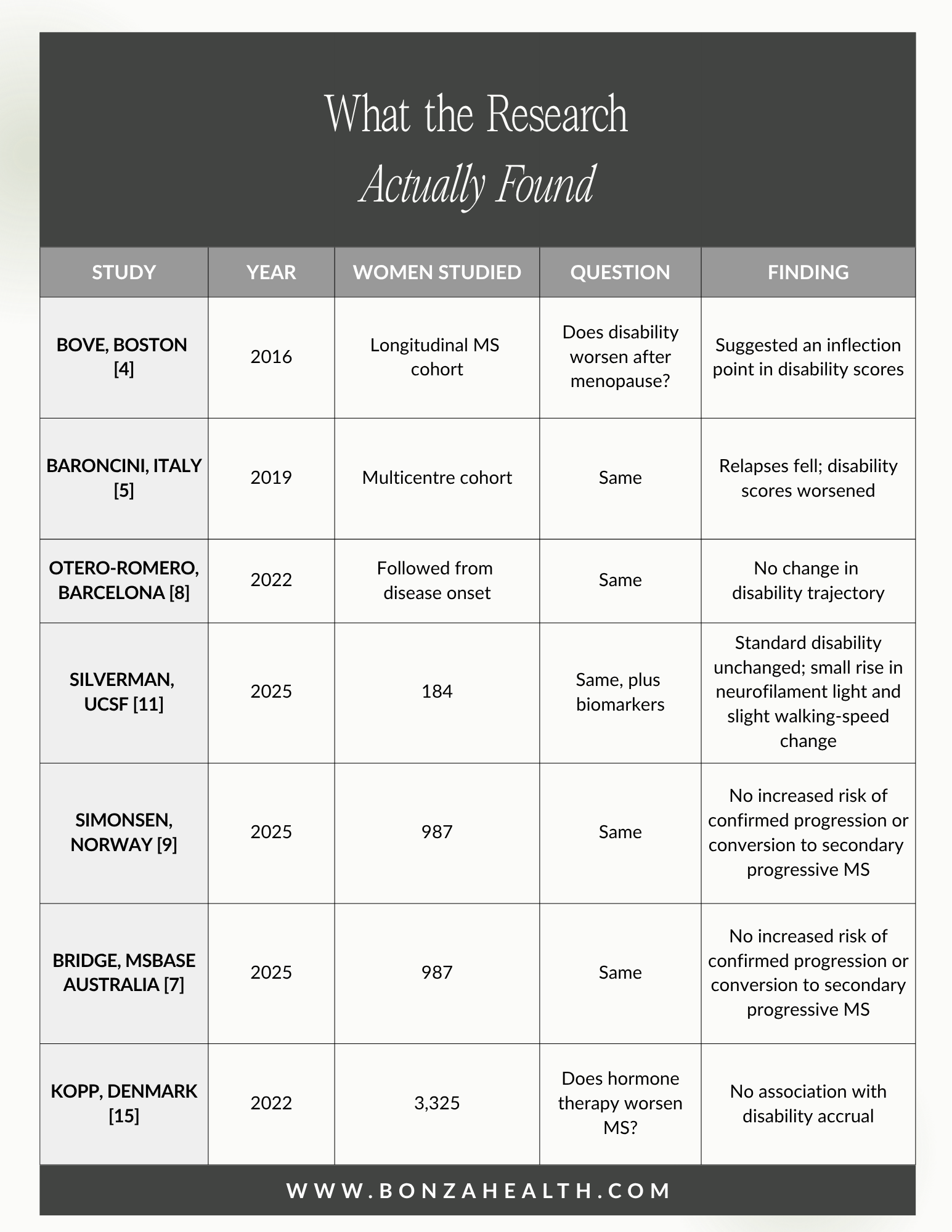
The practical upshot: menopause is best understood as a modifier of vulnerability, not a driver of MS progression.
The attribution problem — and why it matters more than you'd think
Here is the part that affects women most in day-to-day life. Look at how much overlap there is:
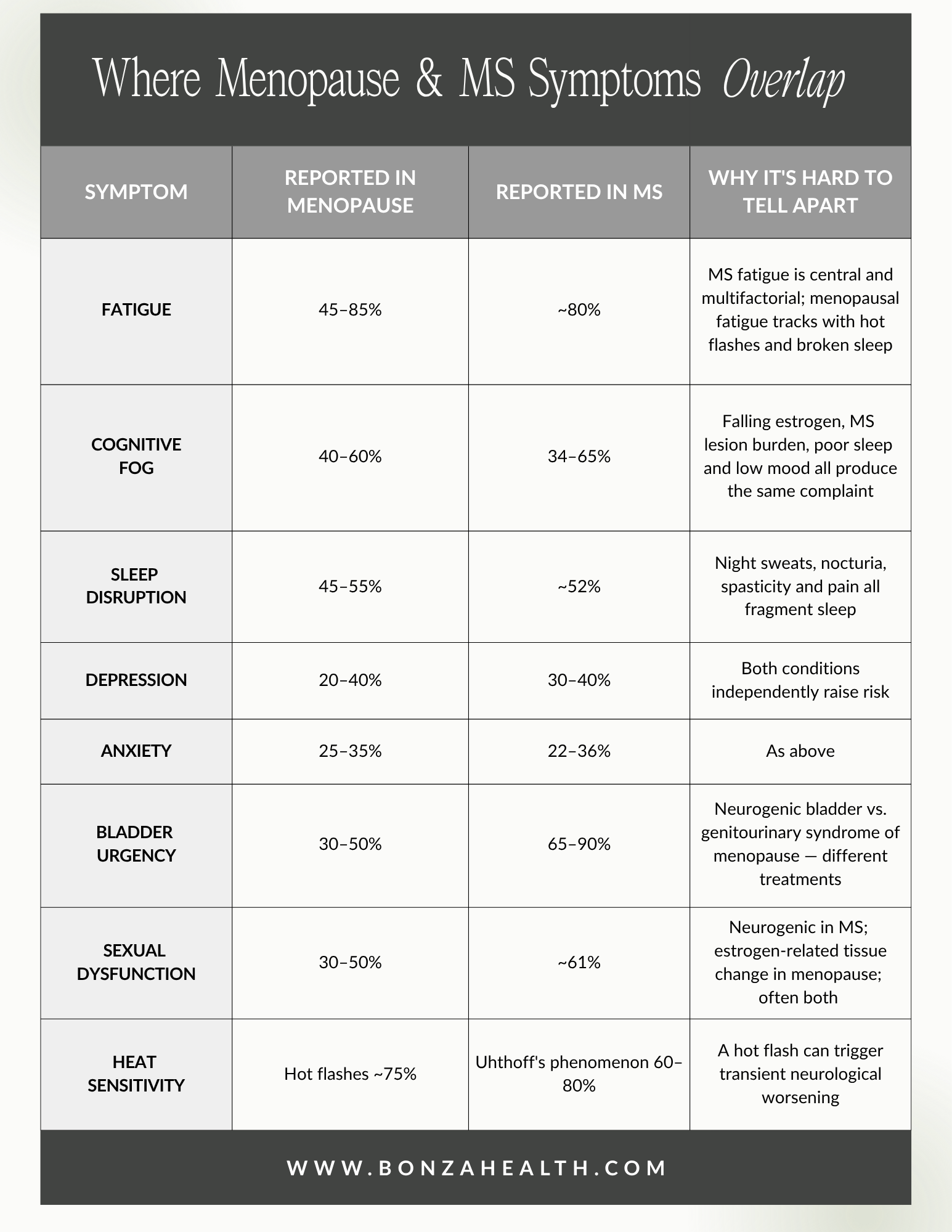
Where menopause and MS symptoms overlap (prevalence ranges compiled in [25])
That last row deserves attention. In MS, rising body temperature causes temporary conduction block in demyelinated nerves — the transient worsening known as Uhthoff's phenomenon. A woman having ten hot flashes a day may be triggering ten brief episodes of neurological worsening a day, with no new inflammation whatsoever.
This ambiguity has real consequences. In the Norwegian cohort, women who reached menopause before their MS diagnosis waited an average of 3.3 years longer to be diagnosed — their neurological symptoms had been chalked up to menopause [9]. In the same study, 30% of women changed, started, or stopped a disease-modifying therapy in the year they reported menopause, raising the possibility that hormonal symptoms were being read as treatment failure [9].
And yet the conversation often doesn't happen at all. In a 2025 survey, most women with MS reported menopausal symptoms — but roughly two-thirds had never discussed them with a healthcare provider [14].
If you take one thing from this article: bring it up. Symptom worsening in midlife deserves a menopause assessment, not just an MRI.

In MS, rising body temperature causes temporary conduction block in demyelinated nerves — the transient worsening known as Uhthoff's phenomenon.
Will hormone therapy change my MS?
Probably not — in either direction. And that's genuinely useful information.
The largest dataset comes from Denmark, where researchers linked 3,325 women in the national MS registry to national prescription records. They found no association between hormone therapy and disability accrual, particularly for use under five years [15].
Small prospective studies are similarly reassuring. A Finnish study gave estradiol with cyclical dydrogesterone to peri- and early postmenopausal women with and without MS for a year. Hot flashes and depressive symptoms improved in both groups, insomnia improved in the MS group, and MS activity remained stable on clinical assessment and MRI at twelve months [16]. A phase Ib/IIa randomised trial of conjugated estrogens plus bazedoxifene in women with MS found good tolerability, high retention, greater treatment satisfaction, and no safety signals — though it was small and short [17].
You may encounter the estriol trial, and it's worth understanding why it doesn't apply here. In a phase 2 study, 164 women aged 18–50 with relapsing-remitting MS received estriol (the estrogen unique to pregnancy) at 8 mg daily alongside glatiramer acetate. Relapse rates fell 47% at twelve months compared with glatiramer acetate alone [18]. Encouraging — but that's a pregnancy-level dose of a different estrogen, in premenopausal women, as an add-on to disease-modifying therapy. It is not menopause hormone therapy, and it has not been carried into phase 3.
The specialty remains genuinely split on the bigger question. In 2024, the journal Multiple Sclerosis ran opposing position pieces: one arguing every woman with MS should start hormone therapy at menopause absent contraindications [19], the other arguing the evidence doesn't support that [20]. Both authors are serious scientists. The disagreement is real, and it's about disease modification — not about symptom relief.
What hormone therapy does reliably do — and why it may matter more in MS
Here's where the reasoning gets clearer. Menopause hormone therapy is the most effective treatment we have for vasomotor symptoms, and it prevents bone loss [21].
Both of those matter more if you have MS.
Bone. Women with MS already carry a higher risk of low bone density and osteoporosis than age-matched peers — reduced weight-bearing activity, corticosteroid exposure, and low vitamin D all contribute [22]. Layer estrogen withdrawal on top of that, add an elevated falls risk from gait and balance impairment, and fracture becomes a serious threat to independence.
Symptoms. Vasomotor symptoms in women with MS correlate meaningfully with sleep quality, mood, and overall quality of life [23]. Improving sleep and reducing hot flashes may translate into less fatigue and better daily function — even with the MS itself unchanged.

Menopause almost certainly won't accelerate your MS. Hormone therapy almost certainly won't either — and it won't treat your MS, so it isn't a substitute for disease-modifying therapy.
How I approach the decision
I use the same framework I'd use for any woman, with a few MS-specific adjustments [21,24]:
Timing. The benefit-risk profile is most favourable for women under 60 or within ten years of their final period. Beyond that window, absolute risks of cardiovascular events, stroke, clot, and dementia rise [21].
Route matters — and it matters more in MS. Transdermal estradiol (patch, gel, spray) bypasses first-pass liver metabolism and carries lower thromboembolic risk than oral estrogen [21]. For a woman with reduced mobility and therefore a higher baseline clot risk, I strongly prefer transdermal.
Progestogen if you have a uterus. Estrogen alone with an intact uterus raises endometrial cancer risk. Micronised progesterone or a levonorgestrel IUD are both reasonable.
Vaginal estrogen is a separate conversation. Low-dose vaginal estrogen for genitourinary symptoms has minimal systemic absorption and can be used by many women who aren't candidates for systemic therapy [21]. Given how common bladder and sexual dysfunction are in MS, this is underused.
Contraindications still apply. Hormone-sensitive cancer, prior VTE or stroke, active liver disease, unexplained bleeding.
Coordinate with neurology. Not because of a known interaction — but so that if your symptoms shift, both of us know what changed and when.
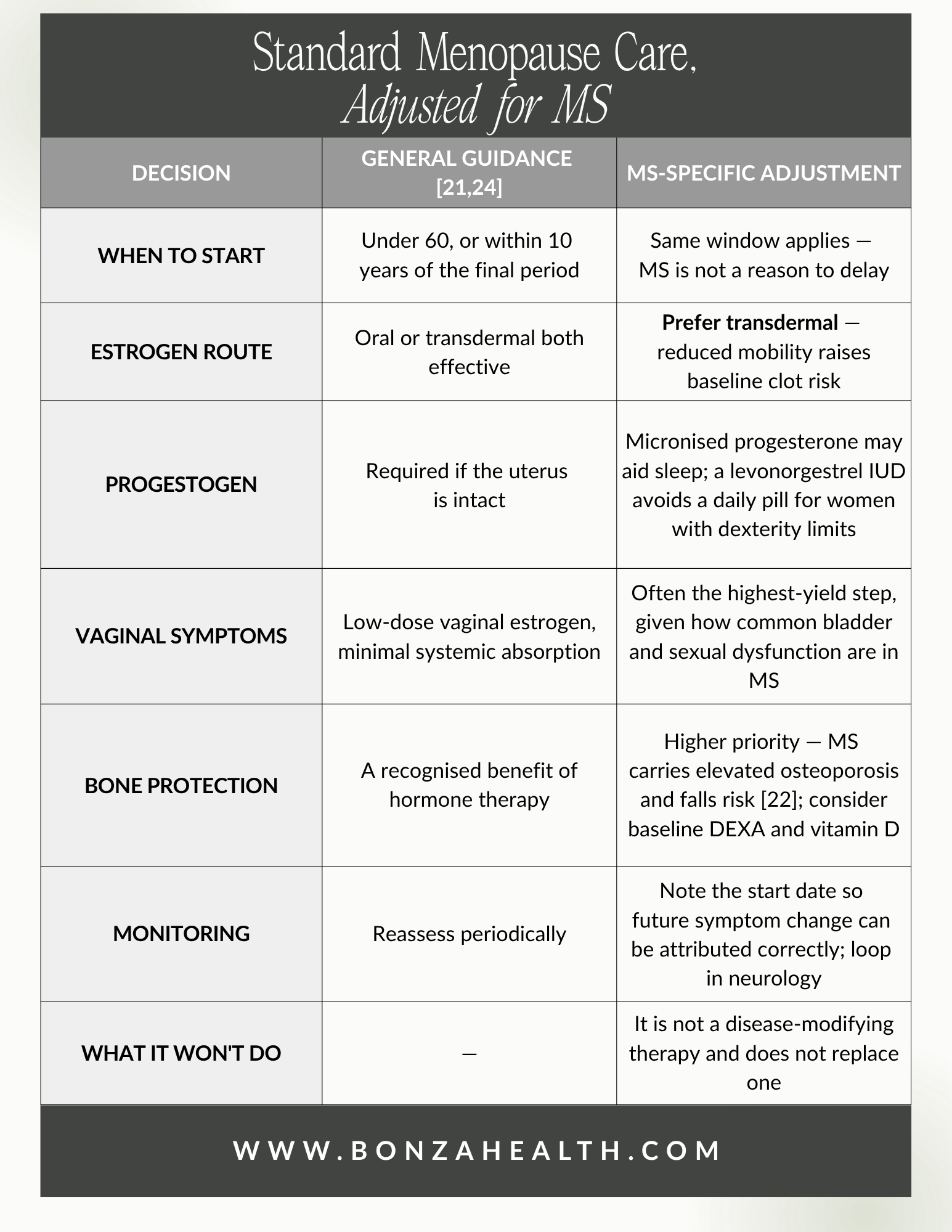
Standard menopause care, adjusted for MS
The bottom line
Menopause almost certainly won't accelerate your MS. Hormone therapy almost certainly won't either — and it won't treat your MS, so it isn't a substitute for disease-modifying therapy. What it can do is treat menopausal symptoms that are quietly amplifying your MS symptom burden, and protect bone you can't afford to lose.
Having MS is not a reason to be excluded from a conversation the rest of your midlife peers are having. In the absence of contraindications, you deserve the same individualised assessment as anyone else.
That's what I told my patient. We're starting transdermal estradiol with micronised progesterone next week, with a DEXA scan and a follow-up in three months.
This article is for educational purposes and is not a substitute for individualised medical advice. Please discuss any changes to your treatment with your own clinician.

Ready to build a midlife plan that fits your body and medical history? Book a consultation at Bonza Health.
References
[1] M. Magyari and P. S. Sørensen, "The changing course of multiple sclerosis: rising incidence, change in geographic distribution, disease course, and prognosis," Curr. Opin. Neurol., vol. 32, no. 3, pp. 320–326, 2019. PMID: 30925518. https://doi.org/10.1097/wco.0000000000000695
[2] C. Confavreux, M. Hutchinson, M. M. Hours, P. Cortinovis-Tourniaire, and T. Moreau, "Rate of pregnancy-related relapse in multiple sclerosis," N. Engl. J. Med., vol. 339, no. 5, pp. 285–291, 1998. PMID: 9682040. https://doi.org/10.1056/nejm199807303390501
[3] C. Nesbitt, A. van der Walt, H. Butzkueven, A. S. Cheung, and V. G. Jokubaitis, "Exploring the role of sex hormones and gender diversity in multiple sclerosis," Nat. Rev. Neurol., vol. 21, no. 1, pp. 48–62, 2025. PMID: 39658653. https://doi.org/10.1038/s41582-024-01042-x
[4] R. Bove, B. C. Healy, A. Musallam, B. I. Glanz, P. L. De Jager, and T. Chitnis, "Exploration of changes in disability after menopause in a longitudinal multiple sclerosis cohort," Mult. Scler., vol. 22, no. 7, pp. 935–943, 2016. PMID: 26447063. https://doi.org/10.1177/1352458515606211
[5] D. Baroncini et al., "Impact of natural menopause on multiple sclerosis: a multicentre study," J. Neurol. Neurosurg. Psychiatry, vol. 90, no. 11, pp. 1201–1206, 2019. PMID: 31189614. https://doi.org/10.1136/jnnp-2019-320587
[6] R. Bove et al., "Patients report worse MS symptoms after menopause: findings from an online cohort," Mult. Scler. Relat. Disord., vol. 4, no. 1, pp. 18–24, 2015. PMID: 25787049. https://doi.org/10.1016/j.msard.2014.11.009
[7] F. Bridge et al., "Menopause impact on multiple sclerosis disability progression," JAMA Neurol., vol. 82, no. 12, pp. 1219–1226, 2025. PMID: 41021242. https://doi.org/10.1001/jamaneurol.2025.3538
[8] S. Otero-Romero et al., "Menopause does not modify disability trajectories in a longitudinal cohort of women with clinically isolated syndrome and multiple sclerosis followed from disease onset," Eur. J. Neurol., vol. 29, no. 4, pp. 1075–1081, 2022. PMID: 33609298. https://doi.org/10.1111/ene.14782
[9] C. S. Simonsen et al., "The influence of menopause on multiple sclerosis," Eur. J. Neurol., vol. 32, no. 1, e16566, 2025. PMID: 39601490. https://doi.org/10.1111/ene.16566
[10] D. Morgan et al., "Menopause and multiple sclerosis: a scoping review of symptoms, disease course, and lived experience," Maturitas, vol. 206, 108826, 2026. PMID: 41529424. https://doi.org/10.1016/j.maturitas.2026.108826
[11] H. E. Silverman et al., "Association of menopause with functional outcomes and disease biomarkers in women with multiple sclerosis," Neurology, vol. 104, no. 2, e210228, 2025. PMID: 39715474. https://doi.org/10.1212/wnl.0000000000210228
[12] J. S. Graves et al., "Ovarian aging is associated with gray matter volume and disability in women with MS," Neurology, vol. 90, no. 4, pp. e254–e260, 2018. PMID: 29273686. https://doi.org/10.1212/WNL.0000000000004843
[13] B. Zeydan et al., "Upper cervical spinal cord atrophy in MS: sex, menopause, and neurodegeneration," Mult. Scler., vol. 31, no. 3, pp. 278–289, 2025. PMID: 39825669. https://doi.org/10.1177/13524585241311441
[14] K. A. Johnson, L. E. DuBose, A. A. Shah, and B. W. Fling, "The impact of menopause in women with multiple sclerosis: a survey study," Mult. Scler. Relat. Disord., vol. 99, 106485, 2025. https://doi.org/10.1016/j.msard.2025.106485
[15] T. I. Kopp, Ø. Lidegaard, and M. Magyari, "Hormone therapy and disease activity in Danish women with multiple sclerosis: a population-based cohort study," Eur. J. Neurol., vol. 29, no. 6, pp. 1753–1762, 2022. PMID: 35196406. https://doi.org/10.1111/ene.15299
[16] L. Juutinen, K. Ahinko, H. Tinkanen, E. Rosti-Otajärvi, and M. L. Sumelahti, "Menopausal symptoms and hormone therapy in women with multiple sclerosis: a baseline-controlled study," Mult. Scler. Relat. Disord., vol. 67, 104098, 2022. PMID: 35994896. https://doi.org/10.1016/j.msard.2022.104098
[17] R. Bove et al., "A hormonal therapy for menopausal women with MS: a phase Ib/IIa randomized controlled trial," Mult. Scler. Relat. Disord., vol. 61, 103747, 2022. PMID: 35397292. https://doi.org/10.1016/j.msard.2022.103747
[18] R. R. Voskuhl et al., "Estriol combined with glatiramer acetate for women with relapsing-remitting multiple sclerosis: a randomised, placebo-controlled, phase 2 trial," Lancet Neurol., vol. 15, no. 1, pp. 35–46, 2016. PMID: 26621682. https://doi.org/10.1016/s1474-4422(15)00322-1
[19] R. Voskuhl, "All women with multiple sclerosis should start hormone replacement therapy at menopause unless contraindicated: yes," Mult. Scler., vol. 30, no. 9, pp. 1107–1109, 2024. PMID: 38907632. https://doi.org/10.1177/13524585241255002
[20] M. Magyari, "All women with multiple sclerosis should start hormone replacement therapy at menopause unless contraindicated: no," Mult. Scler., vol. 30, no. 9, pp. 1109–1111, 2024. PMID: 38907634. https://doi.org/10.1177/13524585241254987
[21] The North American Menopause Society, "The 2022 hormone therapy position statement of The North American Menopause Society," Menopause, vol. 29, no. 7, pp. 767–794, 2022. PMID: 35797481. https://doi.org/10.1097/gme.0000000000002028
[22] E. J. Bisson, M. L. Finlayson, O. Ekuma, W. D. Leslie, and R. A. Marrie, "Multiple sclerosis is associated with low bone mineral density and osteoporosis," Neurol. Clin. Pract., vol. 9, no. 5, pp. 391–399, 2019. PMID: 31750024. https://doi.org/10.1212/CPJ.0000000000000669
[23] D. Morales-Rodriguez et al., "Well-being at midlife: correlates of mental health in ambulatory menopausal women with multiple sclerosis," Mult. Scler., vol. 29, no. 11–12, pp. 1493–1502, 2023. PMID: 37715710. https://doi.org/10.1177/13524585231197056
[24] L. Cho et al., "Rethinking menopausal hormone therapy: for whom, what, when, and how long?" Circulation, vol. 147, no. 7, pp. 597–610, 2023. PMID: 36780393. https://doi.org/10.1161/circulationaha.122.061559
[25] C. S. Simonsen and E. G. Celius, "Menopause and ageing in women with multiple sclerosis," Front. Neurol., vol. 17, 1838550, 2026. PMID: 42343999. https://doi.org/10.3389/fneur.2026.1838550