Written and edited by Sarah Bonza, MD, MPH, FAAFP, MSCP, DipABLM, NBC-HWC | Bonza Health

Why neurodivergence can feel louder in perimenopause
She is 46, and she says she has always been "a lot." She says it with a small laugh, sitting across from me. She keeps color-coded calendars and sets three alarms for every appointment. She built a career on being the person who never drops the ball.
Now she drops it every day. She loses words in meetings. The grocery store under fluorescent lights feels like an assault. In the week before her period, she doesn't recognize herself: tearful, then furious, then too exhausted to cook dinner. Her last doctor called it stress. A friend sent her a reel about ADHD. She came to me asking, "Am I falling apart, or was I always like this?"
(The woman above is a composite of many patients. I've changed her details, but not her question.)
I hear some version of that question every week. I care for women in perimenopause, and many of them have ADHD, autism, or both. Some have known for decades. Many are just finding out. If your brain has always worked differently, perimenopause may hit it differently too. That isn't weakness. It's biology.
The short version
Women with ADHD and autistic women often report harder perimenopausal symptoms, especially with mood, focus, and daily functioning [7,8,11,12].
Estradiol doesn't simply fall in perimenopause. It swings, and the brain feels those swings [3,4,6].
The old coping strategies often stop working: the lists, the overworking, the masking. That's why many women get a first ADHD or autism diagnosis in midlife [8,12,13].
The research is young. Most of it comes from observational studies, small samples or interviews. There are no randomized trials of ADHD treatment in perimenopausal women [8]. We should say that out loud and still take your symptoms seriously.
First, what does "neurodivergent" actually mean?
Neurodivergent isn't a diagnosis. It describes a person whose brain works outside what society treats as the typical range. Neurodiversity means the natural variation across all human brains. It describes a group, not a person [1,2]. The ideas grew out of autistic self-advocacy in the late 1990s, and they focus on differences and strengths, not only deficits [2].
No official list says which conditions count. A 2026 scoping review in JAMA Psychiatry looked at 134 studies that used the words neurodivergent or neurodiverse. Autism appeared in about 69% of them and ADHD in about 64%. Dyslexia, dyspraxia, anxiety, and dyscalculia followed [1]. More than one in five studies never named a diagnosis at all [1]. The authors recommend precise diagnoses for clinical care and research, and the word neurodivergent for identity and lived experience [1].

Autism & ADHD Are the Conditions Most Often Labeled as Neurodivergent
That matters for you. Neurodivergent is a meaningful identity. But when we talk about treatment, we need to name the specific condition, because ADHD and autism don't respond to hormones in the same way. Some women are both, sometimes called AuDHD [13].
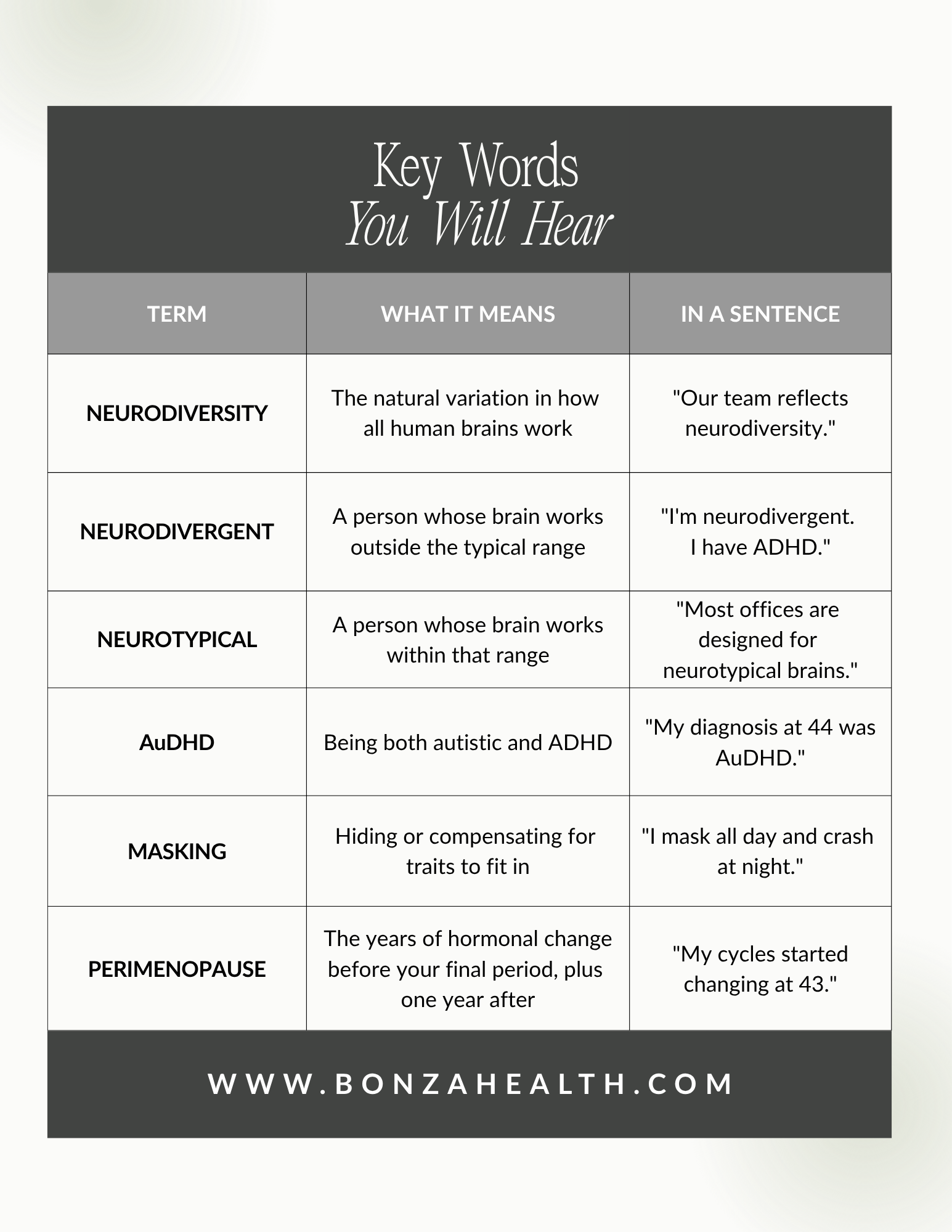
Table 1. Words you will hear
What perimenopause does to every woman's brain
Perimenopause lasts about four years on average, though it varies widely [3]. During those years, estradiol, the main estrogen, doesn't decline in a gentle slope. It surges and drops unpredictably before it finally falls [3]. Progesterone falls as ovulation becomes less regular.
Estradiol isn't just a reproductive hormone. It helps run brain energy use, synapses, immune signaling, and how brain regions talk to each other [3,4]. Imaging studies show changes during the transition in the limbic, temporal, and frontal regions. Those are the areas that handle emotion, memory, and planning [3,4]. Up to 80% of women have some mix of hot flashes, mood changes, sleep disruption, and thinking problems [3].
A 2026 study linked falling estradiol in perimenopause with lower BDNF, a protein that helps brain cells grow and connect. It also linked it with more inflammation, a smaller hippocampus, and weaker memory [5]. That is one study, and it doesn't mean your brain is declining. It does help explain why brain fog isn't imaginary.
Mood follows a similar pattern. A 2024 Lancet review found no universal rise in depression across the transition. Instead, the risk is concentrated in certain women [6]:
those with severe hot flashes, or hot flashes that disrupt sleep
those with a long transition or stressful life events
those whose mood is sensitive to hormone changes
those who have had major depression before
Hold on to that phrase: sensitive to hormone changes. It describes many of the neurodivergent women I see.

ADHD and autism can intensify in perimenopause
Why it can feel louder if you have ADHD
Dopamine already runs low. At its core, ADHD involves dopamine and norepinephrine in the brain's attention and planning networks. Estrogen and progesterone help regulate serotonin and dopamine. When they drop, attention and concentration can get worse [7].
The deficits stack. Perimenopause mostly affects attention and working memory, which is the ability to hold information in mind while you use it. It doesn't usually erase long-term memory [8]. A woman with ADHD already has a lifelong gap in executive function, and this lands on top of it. Hot flashes, broken sleep, and mood swings each worsen attention, too, so the effects add up [8].
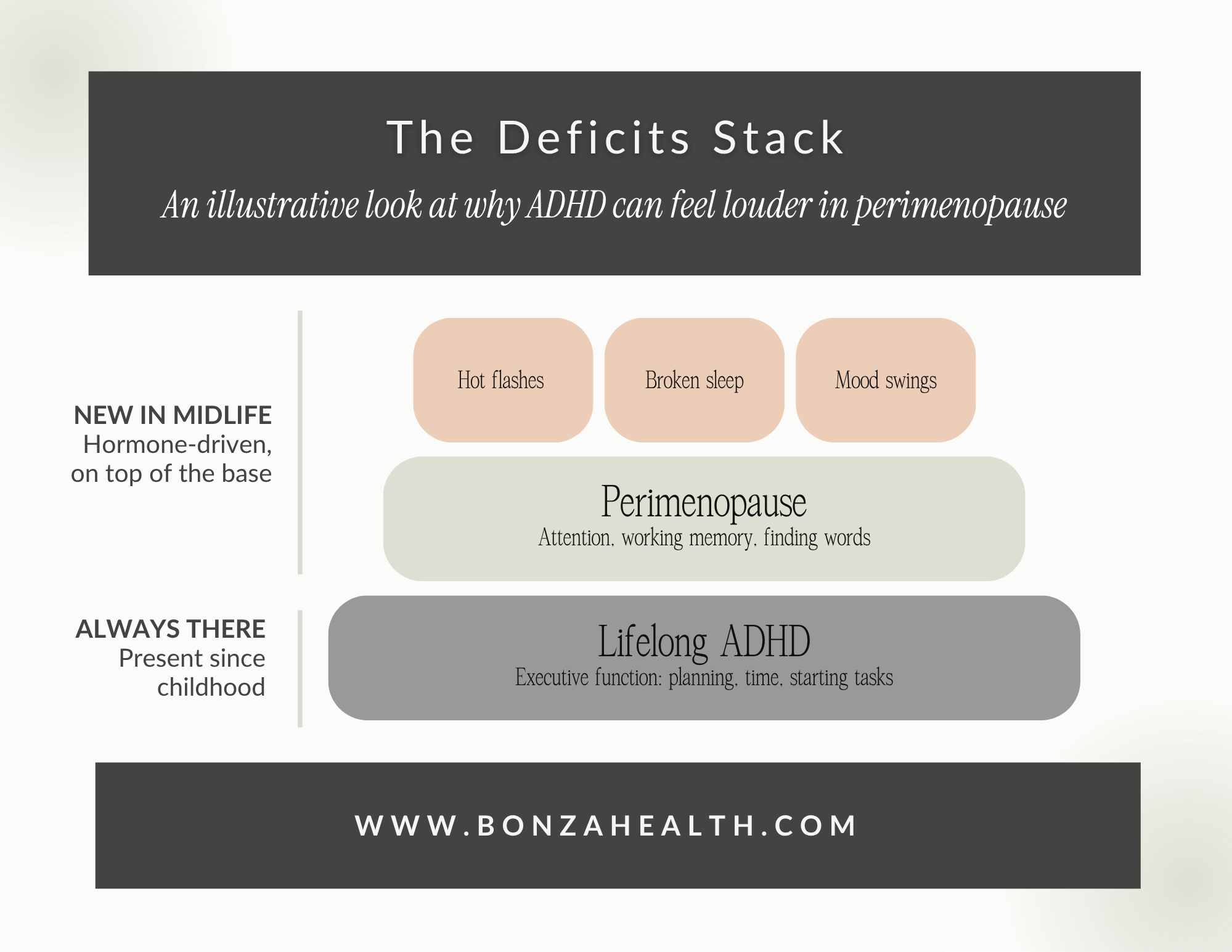
The deficits stack
Your hormone history is a clue. Women with ADHD have higher rates of premenstrual dysphoric disorder (PMDD) and postpartum depression. That suggests a broader sensitivity to hormone changes [7,8]. A 2025 UK survey of 715 young women compared PMDD screening results [9]:
about 31% of women with a clinical ADHD diagnosis screened positive
about 41% of women with high ADHD symptoms screened positive
roughly 9% to 10% of women without ADHD screened positive
Risk was highest in women who also had depression or anxiety [9]. Researchers are now asking whether the link starts as early as the teen years [10].
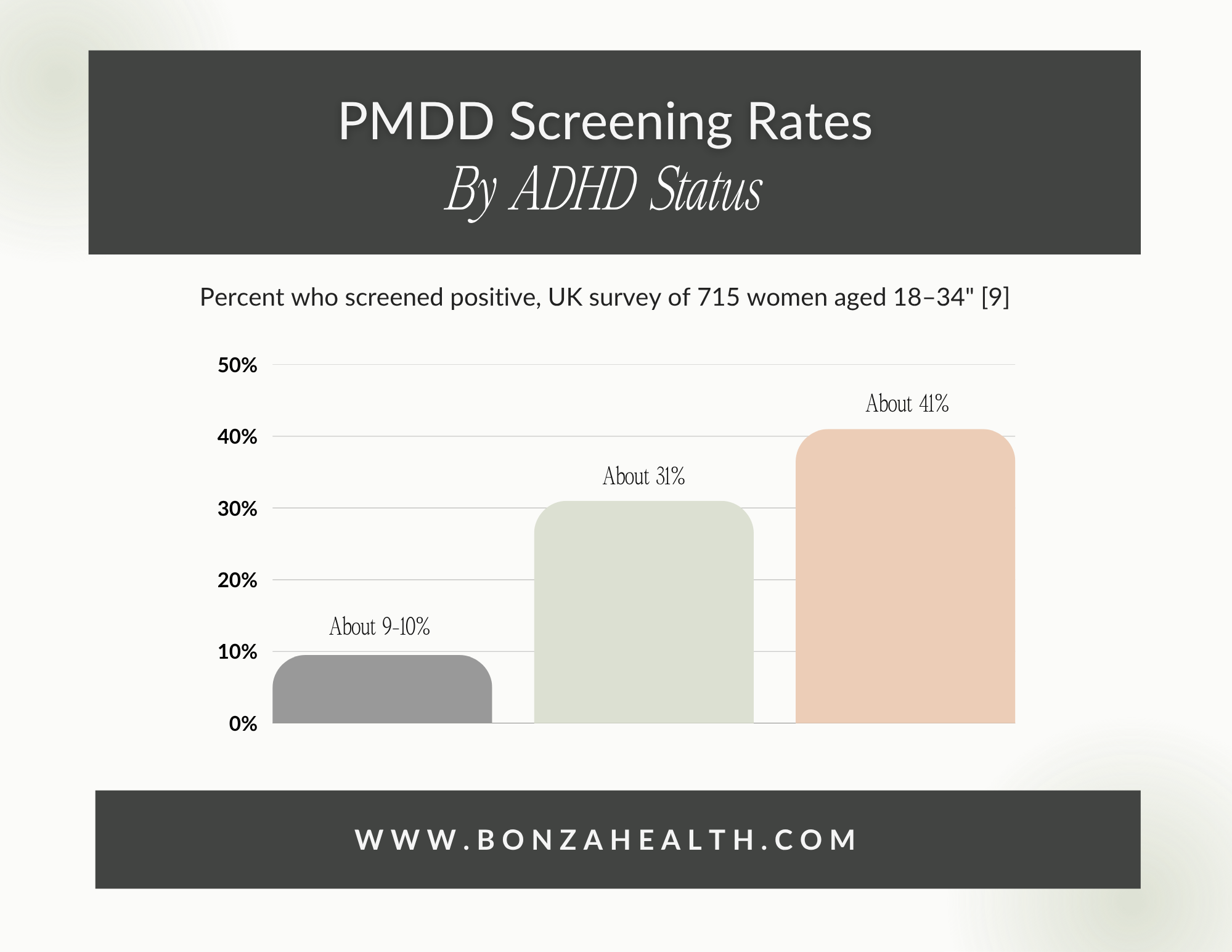
Screened positive, UK survey of 715 women aged 18–34" [9]
If your periods have always flattened you, that history belongs in your perimenopause conversation.
Medication may need a fresh look. Some women find their usual stimulant dose works less well as their hormones shift, and some need the dose changed [8]. That decision belongs with your prescriber, who will also keep an eye on your blood pressure and heart health.
Why it can feel louder if you're autistic
In a Dutch study, autistic women reported more menopausal complaints than non-autistic women. Those complaints were linked to depression and to how strong their autistic traits were [11]. PMDD was not significantly more common in the autistic women in that study [11]. That's a useful reminder that autism and ADHD are not the same story.
Interviews with autistic people going through the transition describe the same few themes again and again [12]:
Sensory sensitivity gets turned up. Sounds, lights, textures, and smells that were manageable become overwhelming.
Daily functioning slips. Routines that held life together become harder to keep.
Body signals are hard to read. Many autistic people have trouble noticing internal sensations, which is called interoception. That makes it harder to recognize a hot flash, hunger, or exhaustion as a hormonal change.
Information is missing. Participants described little accessible information and difficulty getting support.
In that small study, participants weren't recognized as autistic until an average age of about 47, right in the window of perimenopause [12]. Imagine learning two big new things about your brain and body at the same time.
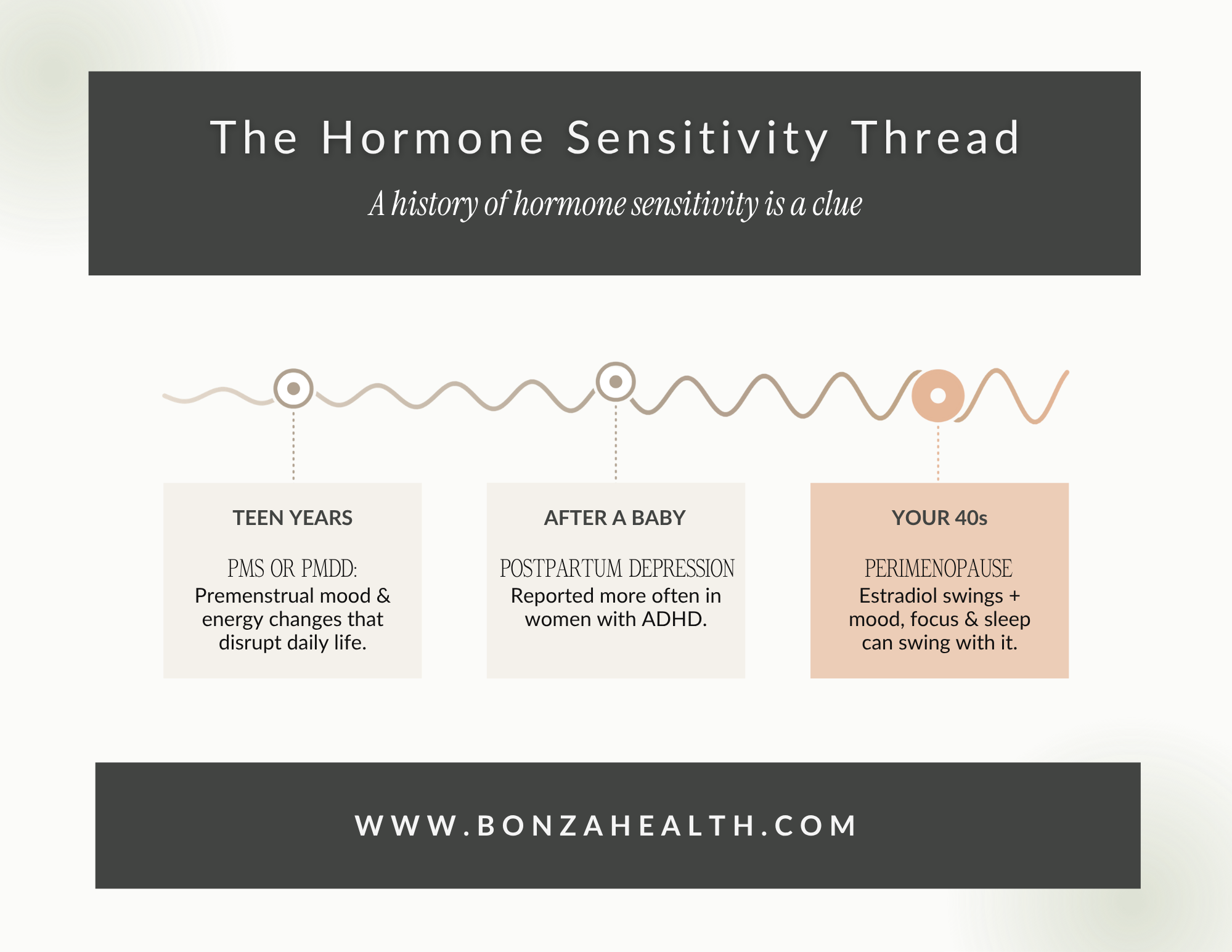
The hormone sensitivity thread
The mask slips
Many neurodivergent women have spent their lives masking. Masking means rehearsing conversations, overpreparing, perfectionism, people-pleasing, and spending enormous energy to look "fine." Midlife adds pressure on top of that: caregiving, career peaks, and aging parents [13].
Perimenopause can be the point where the mask simply costs too much. One 2024 study followed women diagnosed with both ADHD and autism as adults. For many of them, perimenopause was the catalyst that finally sent them for an evaluation, after decades of being missed [13]. ADHD in women is underdiagnosed, and perimenopause can bring hidden symptoms to the surface [8].
This is why I never tell a woman, "It's just hormones," or "It's just your ADHD." Very often, it is both.
Is it ADHD, perimenopause, or both?
This is one of the questions I hear most. Here is how I think it through.
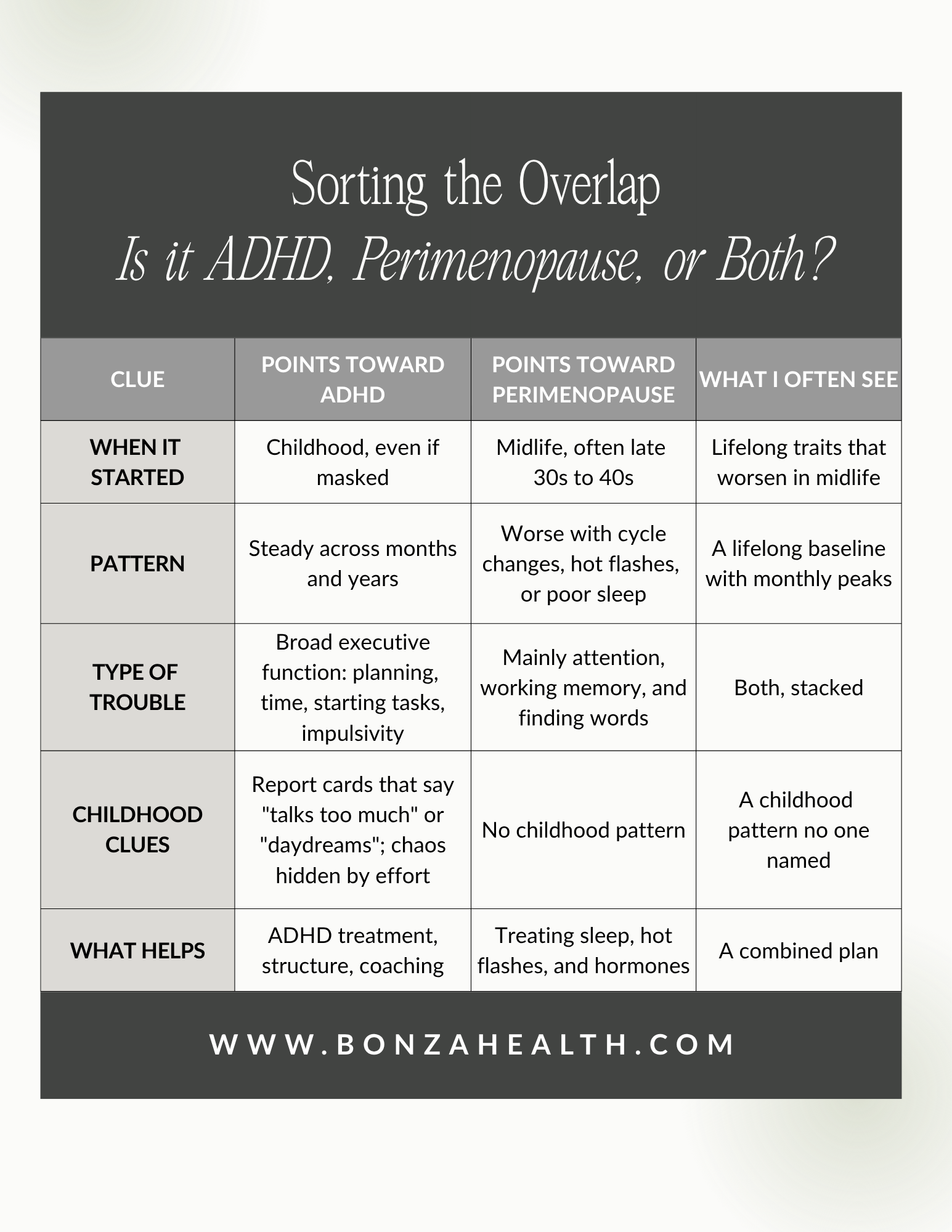
Table 2. Sorting the overlap
Telling them apart takes a real history [8]. ADHD symptoms begin in childhood. Menopausal thinking problems begin in midlife. A good adult ADHD evaluation includes three things [8]:
a childhood history
information from someone who knew you then, if possible
a structured interview such as the DIVA-5
A good perimenopause evaluation looks at your cycle pattern and your symptoms, and checks for other causes. We also screen for conditions that often come along with both: anxiety, depression, sleep problems, substance use, and personality disorders [8].
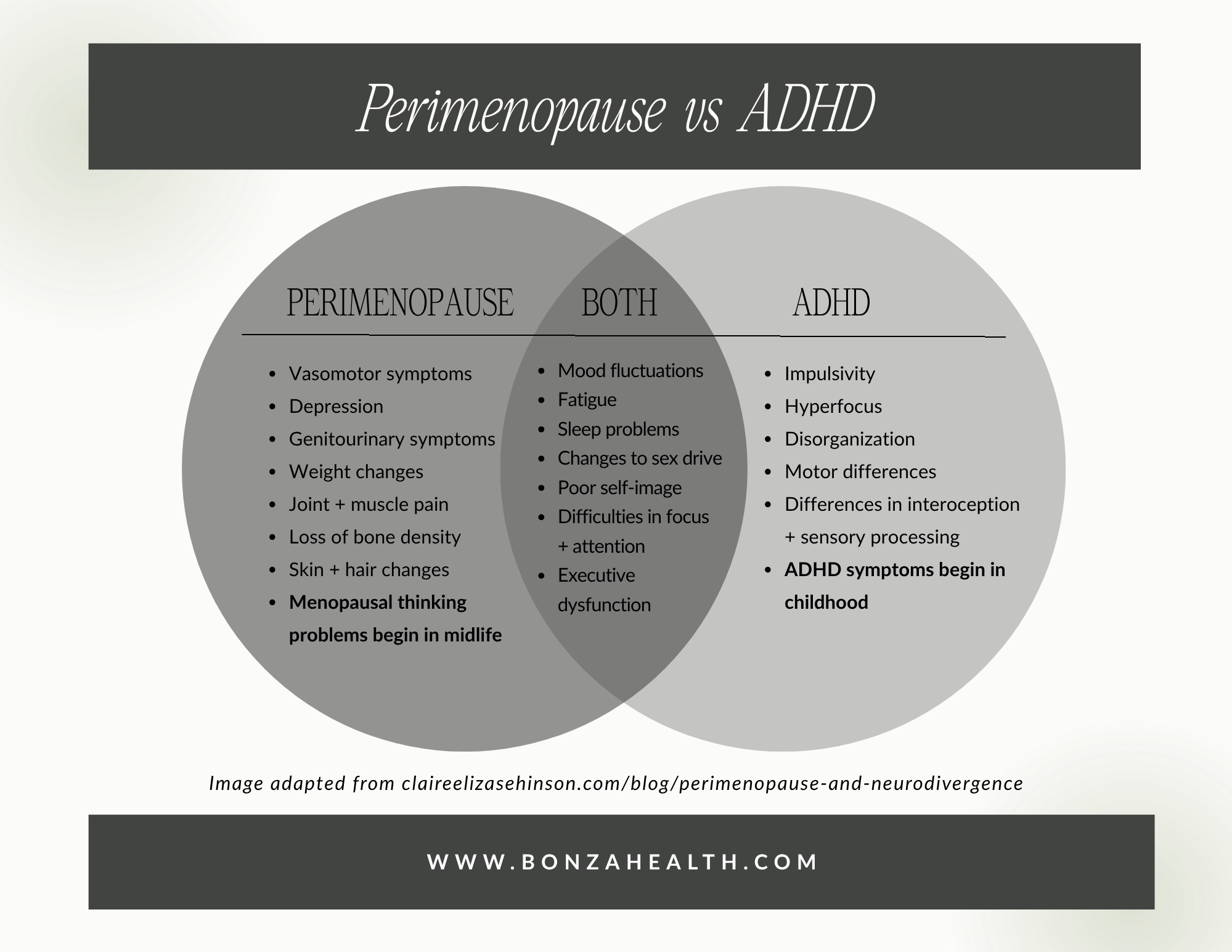
Comparison of ADHD and perimenopause clues
What actually helps
I want to be honest about the evidence. Current advice for treating ADHD in perimenopause rests mostly on expert consensus and on studies in younger women. There are no randomized trials yet [8]. Here is what that consensus, and my own practice, look like.
Track before you treat. A cycle and mood tracking app, or a paper log, helps you and your clinician see patterns and time medication changes [8]. Note your period, sleep, hot flashes, mood, focus, and moments of sensory overload.
Review your ADHD medication. Stimulant and non-stimulant doses are set for each woman individually, and they need cardiovascular monitoring [8].
Consider menopausal hormone therapy as an add-on. For the right woman, hormone therapy may help mood, sleep, and thinking alongside ADHD treatment [8]. It isn't an ADHD treatment on its own.
Treat the sleep. Broken sleep worsens attention, mood, and sensory tolerance in every brain. Night sweats, 3 a.m. waking, and sleep apnea all deserve attention.
Screen for depression and anxiety. This matters most if you've had either before, or had PMDD or postpartum depression [6,9].
Change the environment, not just the woman. Quieter spaces, softer lighting, written instructions, and predictable routines aren't indulgences. They are accommodations.
Ask for neurodiversity-affirming care. That means a clinician who respects how you communicate, assumes you are competent, and treats your lived experience as real information [2].

How to bring this to your doctor
If you're neurodivergent, the appointment itself can be overwhelming. These steps make it easier.
Write it down
Bring one page that lists:
your diagnoses, or the ones you suspect
how your cycles have changed
your top three symptoms
your hormone history: PMDD, postpartum depression, and reactions to birth control
Bring data
Two to three months of tracking speaks louder than "I'm just not myself."
Name your needs
"I process better in writing. Could you send me the plan after the visit?" is a reasonable request.
Use one clear sentence
"I have ADHD (or I'm autistic), and my symptoms have changed since my cycles changed. Can we look at my hormones and my neurodivergence together?"
Ask for a combined plan
If one clinician manages your ADHD medication and another manages your hormones, ask them to talk to each other.
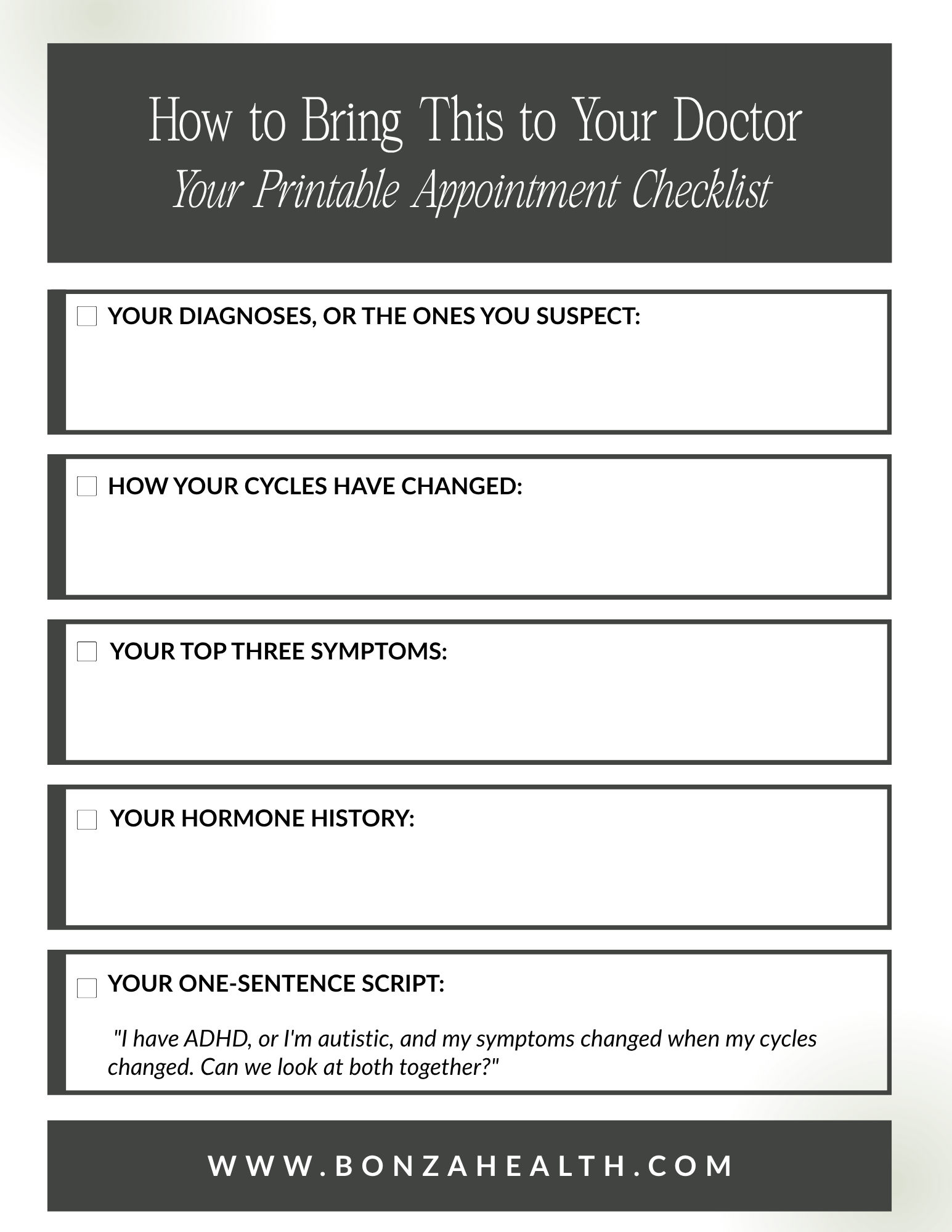
How to bring this to your doctor
A note from me
I recognized my own ADHD as an adult, once I realized I had been overfunctioning and masking most of my life. Perimenopause made the pattern impossible to ignore.
I became the doctor I wish I'd had. For neurodivergent women, that means seeing the whole picture: the brain she has always had, the hormones that are changing, and the life she is carrying on top of both. You aren't too much, and you aren't falling apart. You're a woman whose brain has always worked differently, meeting a transition that changes every brain. You deserve care that sees both.
If this sounds like you, book a visit at bonzahealth.com. In my upcoming book, The Doctor in the Hot Seat, I write about these conversations from both sides of the exam table.
This article is for education only and isn't a substitute for individual medical advice.
Book a visit with Dr. Sarah Bonza to receive one full year of menopause care
References
[1] A. Bellato et al., "Mapping clinical diagnoses associated with neurodiversity and neurodivergence in mental health research: A scoping review," JAMA Psychiatry, published online Sep. 16, 2026, https://doi.org/10.1001/jamapsychiatry.2026.2851.
[2] T. Shear et al., "Neurodiversity-affirming clinical care: Principles and pearls," J. Child Neurol., vol. 40, no. 9, pp. 799–803, Oct. 2025, https://doi.org/10.1177/08830738251340268.
[3] C. Barth, A. Crestol, A.-M. G. de Lange, and L. A. M. Galea, "Sex steroids and the female brain across the lifespan: Insights into risk of depression and Alzheimer's disease," Lancet Diabetes Endocrinol., vol. 11, no. 12, pp. 926–941, Dec. 2023, https://doi.org/10.1016/s2213-8587(23)00224-3.
[4] M. Hynd, “The brain in transition: Perimenopause through a translational lens,” Neurosci. Biobehav. Rev., vol. 187, Art. no. 106773, Aug. 2026, https://doi.org/10.1016/j.neubiorev.2026.106773 .
[5] S. Liu, Z. Huang, and Y. Zeng, “Estradiol reduction during perimenopause is associated with lower BDNF, elevated inflammation, hippocampal loss, and cognitive decline,” Exp. Gerontol., vol. 222, Art. no. 113219, Sep. 2026, https://doi.org/10.1016/j.exger.2026.113219.
[6] L. Brown et al., "Promoting good mental health over the menopause transition," Lancet, vol. 403, no. 10430, pp. 969–983, Mar. 2024, https://doi.org/10.1016/s0140-6736(23)02801-5.
[7] C. Boyd, M. Wrigley, K. Kilbride, A. Mulligan, and J. Bramham, "ADHD and the female reproductive stages: Menstruation, perinatal and menopause," Arch. Women's Ment. Health, vol. 29, no. 3, Art. no. 89, 2026, https://doi.org/10.1007/s00737-026-01718-x.
[8] D. Wynchank and S. Kooij, "Pharmacological management of ADHD in women across perimenopause, menopause and post-menopause," Drugs Aging, vol. 43, no. 5, pp. 385–395, May 2026, https://doi.org/10.1007/s40266-026-01291-z.
[9] T. Broughton, E. Lambert, J. Wertz, and J. Agnew-Blais, "Increased risk of provisional premenstrual dysphoric disorder (PMDD) among females with attention-deficit hyperactivity disorder (ADHD): Cross-sectional survey study," Br. J. Psychiatry, vol. 226, no. 6, pp. 410–417, Jun. 2025, https://doi.org/10.1192/bjp.2025.104.
[10] C. Kondo, H. Ihara, H. Ogata, S. Saima, and E. Nakane, “Association between premenstrual syndrome or premenstrual dysphoric disorder and presence of ASD or ADHD among adolescent females: A retrospective study,” Arch. Women’s Ment. Health, vol. 28, no. 6, pp. 1483–1490, Dec. 2025, https://doi.org/10.1007/s00737-025-01602-0.
[11] A. P. Groenman, C. Torenvliet, T. A. Radhoe, J. A. Agelink van Rentergem, and H. M. Geurts, "Menstruation and menopause in autistic adults: Periods of importance?," Autism, vol. 26, no. 6, pp. 1563–1572, Aug. 2022, https://doi.org/10.1177/13623613211059721.
[12] M. Karavidas and R. O. de Visser, "'It's not just in my head, and it's not just irrelevant': Autistic negotiations of menopausal transitions," J. Autism Dev. Disord., vol. 52, no. 3, pp. 1143–1155, Mar. 2022, https://doi.org/10.1007/s10803-021-05010-y.
[13] E. Craddock, “Being a woman is 100% significant to my experiences of attention deficit hyperactivity disorder and autism: Exploring the gendered implications of an adulthood combined autism and attention deficit hyperactivity disorder diagnosis,” Qual. Health Res., vol. 34, no. 14, pp. 1442–1455, Dec. 2024, https://doi.org/10.1177/10497323241253412.