Perimenopause Care for the Whole Woman
Written and edited by Sarah Bonza, MD, MPH, FAAFP, MSCP, DipABLM, NBC-HWC

Perimenopause is not a temporary inconvenience. It is a decade-long remodeling of a woman's cardiovascular, metabolic, skeletal, cognitive, and sexual health.
I want to tell you about a visit I have had some version of a hundred times.
A woman in her late forties sits down and starts apologizing. She is sorry for taking up time. She is sorry the list is long. She has been to a gynecologist about her cycles, which have gone from clockwork to unpredictable. She has been to her primary care provider about her cholesterol, which suddenly started creeping up for seemingly no reason. Her primary care doctor mentioned her weight. Someone offered her an antidepressant when she cried in an exam room. Nobody asked about her sleep. Nobody asked about her libido, or her marriage, or the fact that she is now afraid of meetings because she keeps forgetting words.
Four clinicians. Four problem lists. Not one of them looking at the same woman.
That is not a failure of any individual doctor. It is what happens when a whole-body transition gets divided up.
What is actually happening to women during perimenopause?
Perimenopause is a hormonal transition — and that is precisely why it is a whole-body one. Estrogen is not a reproductive hormone that happens to have many other roles. It is a systemic signaling molecule, and its receptors are distributed throughout blood vessels, bone, brain, skin, the bladder and urethra, the liver, and adipose tissue.
So when estrogen production becomes erratic in a woman's forties — not simply declining, but fluctuating unpredictably, sometimes spiking above premenopausal levels before dropping sharply — every one of those tissues starts receiving unpredictable instructions. The transition typically begins in the early-to-mid forties and can last a decade.
This is the piece that conventional care gets wrong. The mistake is not that clinicians focus too much on hormones. The mistake is defining hormones too narrowly — as though they govern periods and hot flashes and little else. Hormones are the whole story. We just have not been treating them like it.
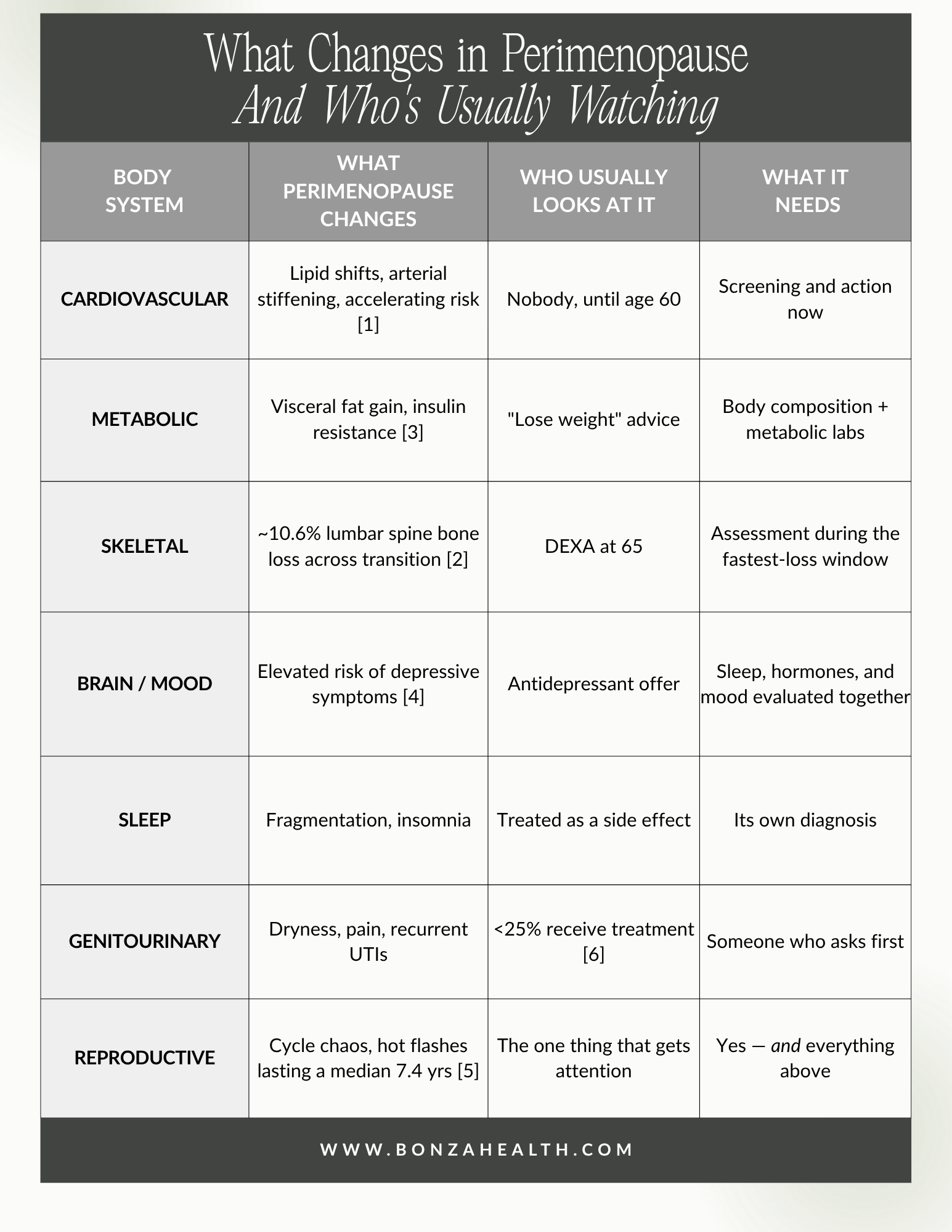
Perimenopause is a hormonal transition — and that is precisely why it is a whole-body one.
The research bears this out with uncomfortable clarity. The American Heart Association's 2020 scientific statement concluded that the menopause transition is a period of accelerating cardiovascular risk, marked by adverse shifts in lipids, body composition, and vascular structure — and called midlife a critical window for early prevention [1]. Data from the Study of Women's Health Across the Nation (SWAN) show that women lose bone rapidly around the final menstrual period, with cumulative losses of roughly 10.6% at the lumbar spine and 9.1% at the femoral neck across the transition [2]. Body composition shifts toward visceral fat even in women whose weight on the scale barely moves [3]. Risk of clinically significant depressive symptoms rises during the transition and stays elevated into early postmenopause, independent of life stress and prior depression history [4].
And symptoms last far longer than most women are told. SWAN found the median duration of frequent hot flashes and night sweats was 7.4 years — persisting a median of 4.5 years past the final period, and reaching a median of 10.1 years among Black women [5].
This is not a temporary inconvenience. It is a decade-long remodeling of a woman's cardiovascular, metabolic, skeletal, cognitive, and sexual health.
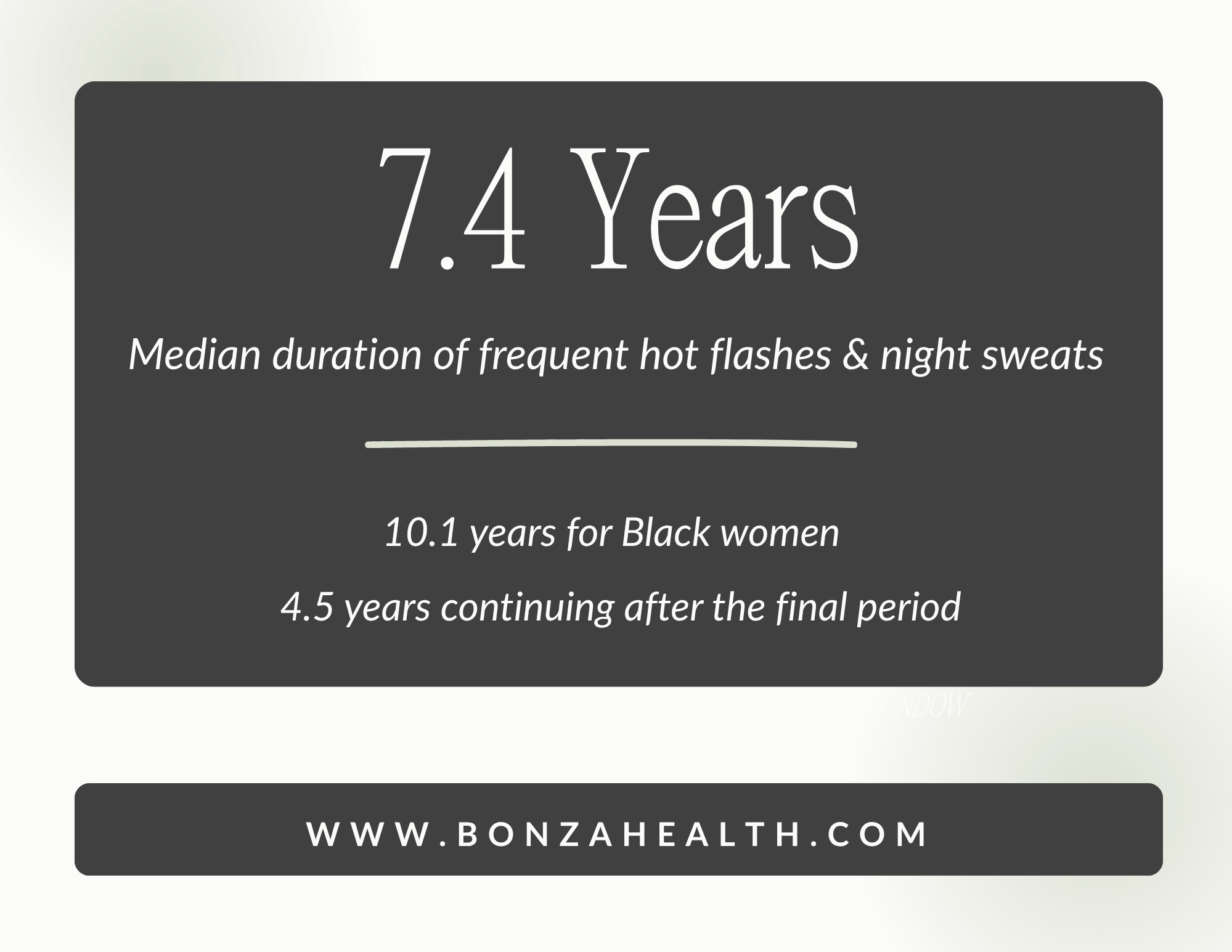
Source: SWAN, Avis et al., JAMA Internal Medicine, 2015
Why is narrow hormone care incomplete?
Narrow hormone care — replacing a hormone and then monitoring only the reproductive symptoms — is incomplete because it does not follow the hormone to the tissues it is actually acting on.
For the right woman at the right time, menopause hormone therapy can be genuinely transformative, and I think the pendulum swung far too hard against it for two decades. Taking hormones seriously is exactly the point. But taking them seriously means tracking what they are doing everywhere, not just where they are most visible. Consider what a narrow hormone visit does not do.
It does not check whether the visceral fat that arrived during your transition is now driving insulin resistance. It does not look at whether your ApoB has quietly climbed into a range that will matter in fifteen years. It does not screen your bone density at the moment your bone loss is fastest. It does not ask whether your sleep has been fragmented for three years, or whether that fragmentation is what is actually driving your mood and your memory complaints. It does not ask whether sex hurts — and roughly three-quarters of women with genitourinary symptoms never get treatment for a condition that is highly treatable [6]. It does not ask about your alcohol intake, though every additional 10 grams of daily alcohol raises postmenopausal breast cancer risk by about 11% [7]. It does not ask whether you are lonely, though social connection carries a mortality effect comparable to established risk factors [8].
Those are not side issues. Those are the things that will determine how the next thirty years of your life go.
The gap is not that individual clinicians don't care. It is that most of us were never taught this. In a survey of family medicine, internal medicine, and OB/GYN residents, only 6.8% felt adequately prepared to manage menopause, and one in five had received no menopause instruction at all during residency [9]. Meanwhile, a Mayo Clinic study of more than 4,400 employed women found 13% had experienced an adverse work outcome because of menopause symptoms, with an estimated $1.8 billion in annual lost work time in the United States [10].
We have a generation of highly trained physicians and a systematic blind spot sitting right in the middle of women's lives.
Narrow hormone care — replacing a hormone and then monitoring only the reproductive symptoms — is incomplete because it does not follow the hormone to the tissues it is actually acting on.
What does board certification in Family Medicine and Lifestyle Medicine actually change about a visit?
Family medicine training means I am responsible for the whole person and the whole timeline — your blood pressure, your mammogram, your thyroid, your mental health, your relationships, and your hormones, in one chart, over years. Lifestyle medicine certification means I am trained to treat the root drivers of chronic disease with evidence-based behavioral intervention, not only prescriptions.
I practice integratively, which for me means drawing on three things at once. Traditional medicine gives me the diagnostics, the guidelines, and the prescriptions — including hormone therapy — with decades of evidence behind them. Functional medicine gives me a systems lens: the discipline of asking why a symptom is appearing in this woman, in this body, at this moment, rather than stopping at the label. Lifestyle medicine gives me interventions with trial evidence that are frequently more powerful than anything I could write on a prescription pad.
Those three are not competing philosophies to choose between. In a transition where one hormone is acting on a dozen organ systems simultaneously, you need all three or you are working with one hand tied.
Practically, that changes three things.
It changes the length and shape of the visit. I cannot evaluate metabolism, sleep, mood, sexual health, bone, breast, and cardiovascular risk in eleven minutes, so I don't try to.
It changes what counts as treatment. A prescription is one tool. So is a structured nutrition change, a resistance training plan, a sleep intervention, an alcohol conversation, a referral to pelvic floor physical therapy.
It changes continuity. A systematic review of 22 studies across nine countries found that higher continuity of care with the same doctor is associated with lower mortality [11]. Perimenopause is a moving target over years. Fragmented care cannot follow a moving target.

Lifestyle medicine gives me interventions with trial evidence that are frequently more powerful than anything I could write on a prescription pad.
What are the five pillars of lifestyle medicine in midlife?
The five pillars are whole-food, plant-predominant nutrition; movement; restorative sleep; avoidance of risky substances; and social connection — with stress management running as a thread through all five. Here is what each one specifically means for women in midlife.
Nutrition. In randomized trials, a low-fat, plant-based diet with a daily half-cup of cooked soybeans significantly reduced the frequency and severity of postmenopausal hot flashes and improved menopause-specific quality of life [12], [13]. Nutrition is not a consolation prize offered after hormones. It is a first-line intervention with trial evidence behind it.
Movement. SWAN's longitudinal data link greater leisure-time physical activity to preservation of bone mineral density through the transition and into postmenopause [14]. Resistance training also directly counters the lean mass loss and visceral fat gain that characterize this window [3].
Restorative sleep. Sleep disruption in perimenopause is not merely a symptom of night sweats. It independently worsens insulin sensitivity, mood, and cognition. I treat it as its own diagnosis.
Avoidance of risky substances. Alcohol deserves an honest, non-judgmental conversation in midlife — for breast cancer risk [7], and because it degrades the sleep architecture many women are already fighting to protect.
Social connection. Across 148 studies and more than 300,000 people, stronger social relationships were associated with a 50% greater likelihood of survival [8]. Midlife is precisely when women's connections tend to erode under caregiving, career, and grief. I ask about it because it is a clinical variable.
Stress, running through everything. Perceived stress predicts longer-lasting vasomotor symptoms [5]. You cannot address perimenopause and leave the nervous system out of it.
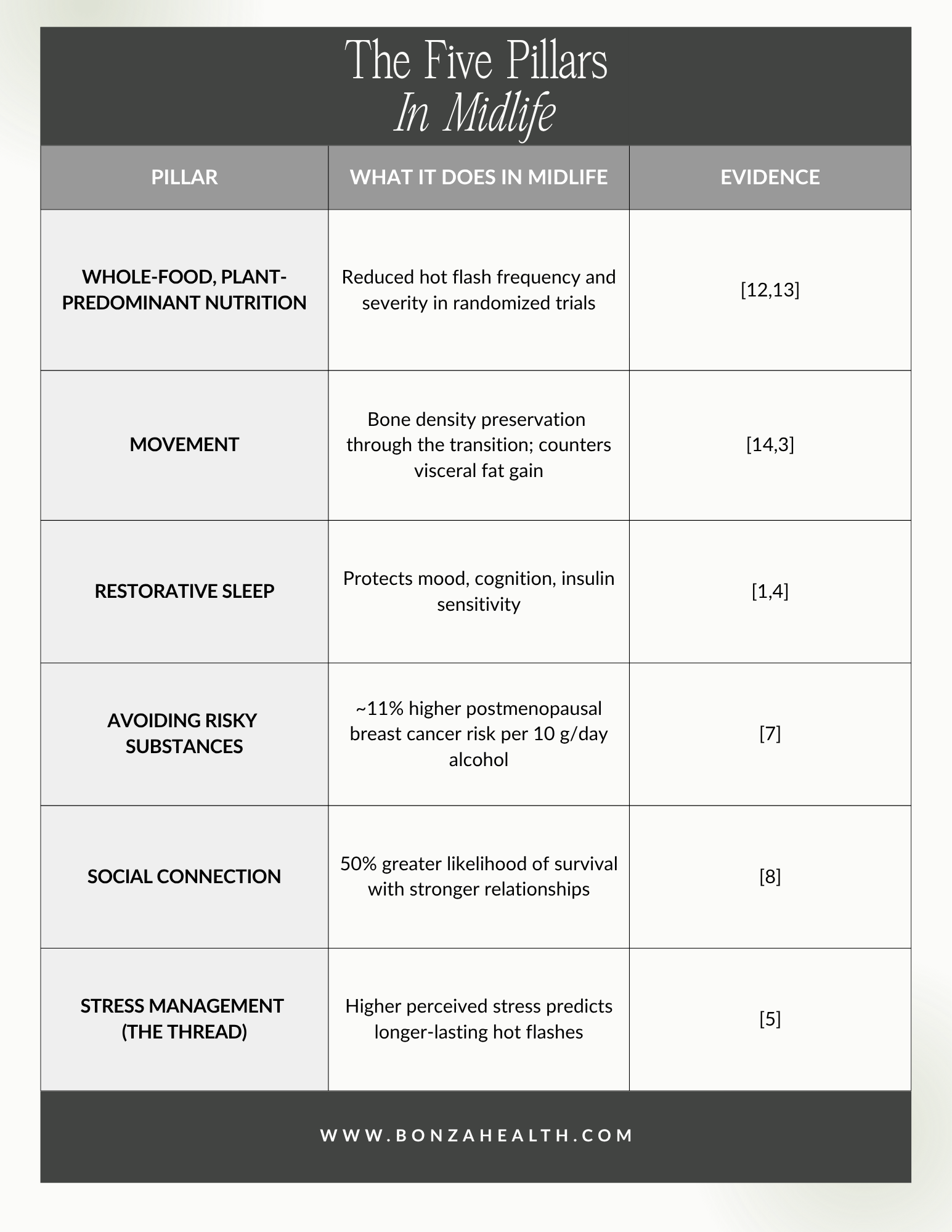
The five pillars are whole-food, plant-predominant nutrition; movement; restorative sleep; avoidance of risky substances; and social connection — with stress management running as a thread through all five.
Why do I look at all of it in the same visit?
Because your body does not experience these as separate problems, and because the connections between them are where the actual answers usually live.
The woman whose "weight gain" is a visceral fat redistribution problem needs resistance training and a metabolic workup, not a smaller calorie target. The woman whose "mood problem" is three years of fragmented sleep needs her sleep fixed before she needs a fourth medication trial. The woman whose "low libido" is untreated genitourinary syndrome needs local therapy, not a lecture on desire. The woman whose cholesterol jumped needs someone to recognize that this is the expected trajectory of the transition and to act on it now, in the prevention window the AHA identified [1] — not in ten years, after an event.
None of that is visible when the pieces sit in four different charts.
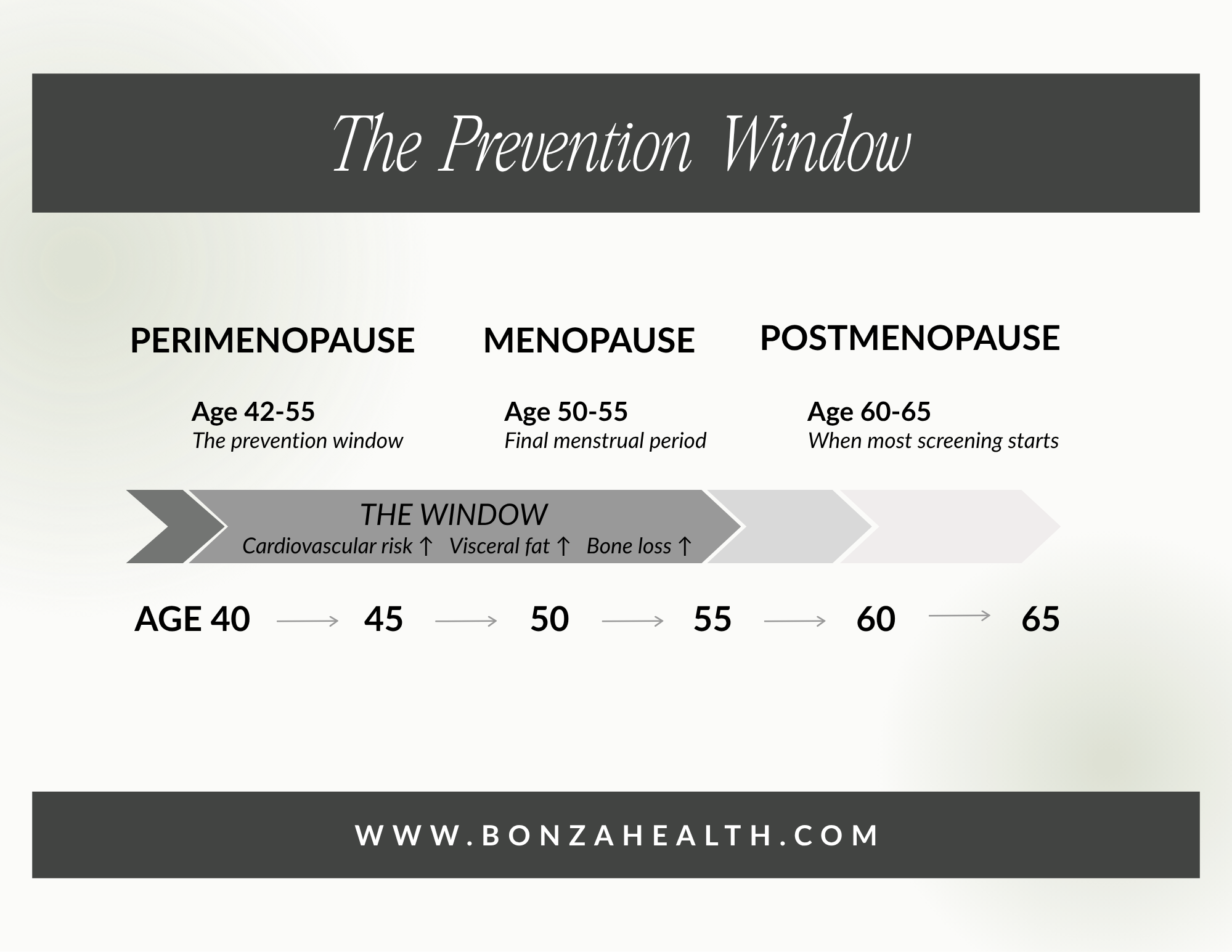
Sources: AHA 2020; SWAN
Cardiovascular risk ↑ [1], Visceral fat ↑ [3], Bone loss ↑ [2]
Am I a hormone clinic?
No, I consider Bonza Health a unique integrative practice that takes women’s midlife seriously.
That distinction matters. A hormone clinic narrowly focuses hormones only. I help her metabolism, her weight, her sleep, her libido, her relationships, her cholesterol, her breast health, her bone health, her mood, and her hormones, tracked in one place.
You are a whole woman in the middle of your life, and you deserve a doctor who is looking at all of you.
Frequently Asked Questions
What age does perimenopause start?
Most women begin perimenopause in their early to mid-forties, though it can start in the late thirties. It is defined by changes in cycle length and hormonal fluctuation, not by a single lab value.
Can a blood test diagnose perimenopause?
Usually not on its own. Because estrogen and FSH fluctuate dramatically day to day during the transition, a single hormone level can be misleading. Diagnosis is primarily clinical, based on cycle pattern and symptoms.
How long do perimenopause symptoms last?
SWAN data found a median of 7.4 years for frequent hot flashes and night sweats, persisting a median of 4.5 years beyond the final menstrual period [5].
Do I need hormone therapy?
Some women benefit substantially; others do well without it. The right answer depends on your symptoms, your cardiovascular and breast health history, and your goals. It should be a conversation, not a default in either direction.
What kind of doctor should manage perimenopause?
A clinician who will evaluate your cardiometabolic, bone, cognitive, sexual, and mental health alongside your hormones — and who will follow you over years, not one visit.

Ready for a visit where nothing gets left out? Schedule at www.bonzahealth.com.
References
[1] S. R. El Khoudary et al., "Menopause transition and cardiovascular disease risk: implications for timing of early prevention: a scientific statement from the American Heart Association," Circulation, vol. 142, no. 25, pp. e506–e532, Dec. 2020, https://doi.org/10.1161/cir.0000000000000912. PMID: 33251828.
[2] G. A. Greendale et al., "Bone mineral density loss in relation to the final menstrual period in a multiethnic cohort: results from the Study of Women's Health Across the Nation (SWAN)," Journal of Bone and Mineral Research, vol. 27, no. 1, pp. 111–118, Jan. 2012, https://doi.org/10.1002/jbmr.534. PMID: 21976317.
[3] G. A. Greendale et al., "Changes in body composition and weight during the menopause transition," JCI Insight, vol. 4, no. 5, e124865, Mar. 2019, https://doi.org/10.1172/jci.insight.124865.
[4] J. T. Bromberger et al., "Depressive symptoms during the menopausal transition: the Study of Women's Health Across the Nation (SWAN)," Journal of Affective Disorders, vol. 103, nos. 1–3, pp. 267–272, 2007. PMID: 17331589. https://doi.org/10.1016/j.jad.2007.01.034
[5] N. E. Avis et al., "Duration of menopausal vasomotor symptoms over the menopause transition," JAMA Internal Medicine, vol. 175, no. 4, pp. 531–539, Apr. 2015, https://doi.org/10.1001/jamainternmed.2014.8063. PMID: 25686030.
[6] "Genitourinary syndrome of menopause," in StatPearls. Treasure Island, FL, USA: StatPearls Publishing, 2024. [Online]. Available: https://www.ncbi.nlm.nih.gov/books/NBK559297/
[7] Q. Sun et al., "Alcohol consumption by beverage type and risk of breast cancer: a dose-response meta-analysis of prospective cohort studies," Alcohol and Alcoholism, vol. 55, no. 3, pp. 246–253, Apr. 2020, https://doi.org/10.1093/alcalc/agaa012. PMID: 32090238.
[8] J. Holt-Lunstad, T. B. Smith, and J. B. Layton, "Social relationships and mortality risk: a meta-analytic review," PLoS Medicine, vol. 7, no. 7, e1000316, Jul. 2010, https://doi.org/10.1371/journal.pmed.1000316.
[9] J. M. Kling et al., "Menopause management knowledge in postgraduate family medicine, internal medicine, and obstetrics and gynecology residents: a cross-sectional survey," Mayo Clinic Proceedings, vol. 94, no. 2, pp. 242–253, Feb. 2019, https://doi.org/10.1016/j.mayocp.2018.08.033. PMID: 30711122.
[10] S. S. Faubion et al., "Impact of menopause symptoms on women in the workplace," Mayo Clinic Proceedings, vol. 98, no. 6, pp. 833–845, Jun. 2023, https://doi.org/10.1016/j.mayocp.2023.02.025. PMID: 37115119.
[11] D. J. Pereira Gray, K. Sidaway-Lee, E. White, A. Thorne, and P. H. Evans, "Continuity of care with doctors—a matter of life and death? A systematic review of continuity of care and mortality," BMJ Open, vol. 8, no. 6, e021161, Jun. 2018, https://doi.org/10.1136/bmjopen-2017-021161. PMID: 29959146.
[12] N. D. Barnard, H. Kahleova, D. N. Holtz, F. del Aguila, M. Neola, L. M. Crosby, and R. Holubkov, "The Women's Study for the Alleviation of Vasomotor Symptoms (WAVS): a randomized, controlled trial of a plant-based diet and whole soybeans for postmenopausal women," Menopause, vol. 28, no. 10, pp. 1150–1156, Oct. 2021, https://doi.org/10.1097/gme.0000000000001812. PMID: 34260478.
[13] N. D. Barnard et al., "A dietary intervention for vasomotor symptoms of menopause: a randomized, controlled trial," Menopause, vol. 30, no. 1, pp. 80–87, Jan. 2023, https://doi.org/10.1097/gme.0000000000002080. PMID: 36253903.
[14] G. A. Greendale et al., "Leisure time physical activity and bone mineral density preservation during the menopause transition and postmenopause: a longitudinal cohort analysis from the Study of Women's Health Across the Nation (SWAN)," The Lancet Regional Health – Americas, 2023. [Online]. Available: https://www.thelancet.com/journals/lanam/article/PIIS2667-193X(23)00055-8/fulltext