She's Already Lifting, Already Eating Well, and Still Gaining. This Isn't Vanity — It's Physiology
Written and edited by Sarah Bonza, MD, MPH, FAAFP, MSCP, DipABLM, NBC-HWC
I want to spend real time on "vanity," because it is damaging to the women I see every week.
Blog Series: The Women in My Exam Room
She sits down and apologizes before she says anything else.
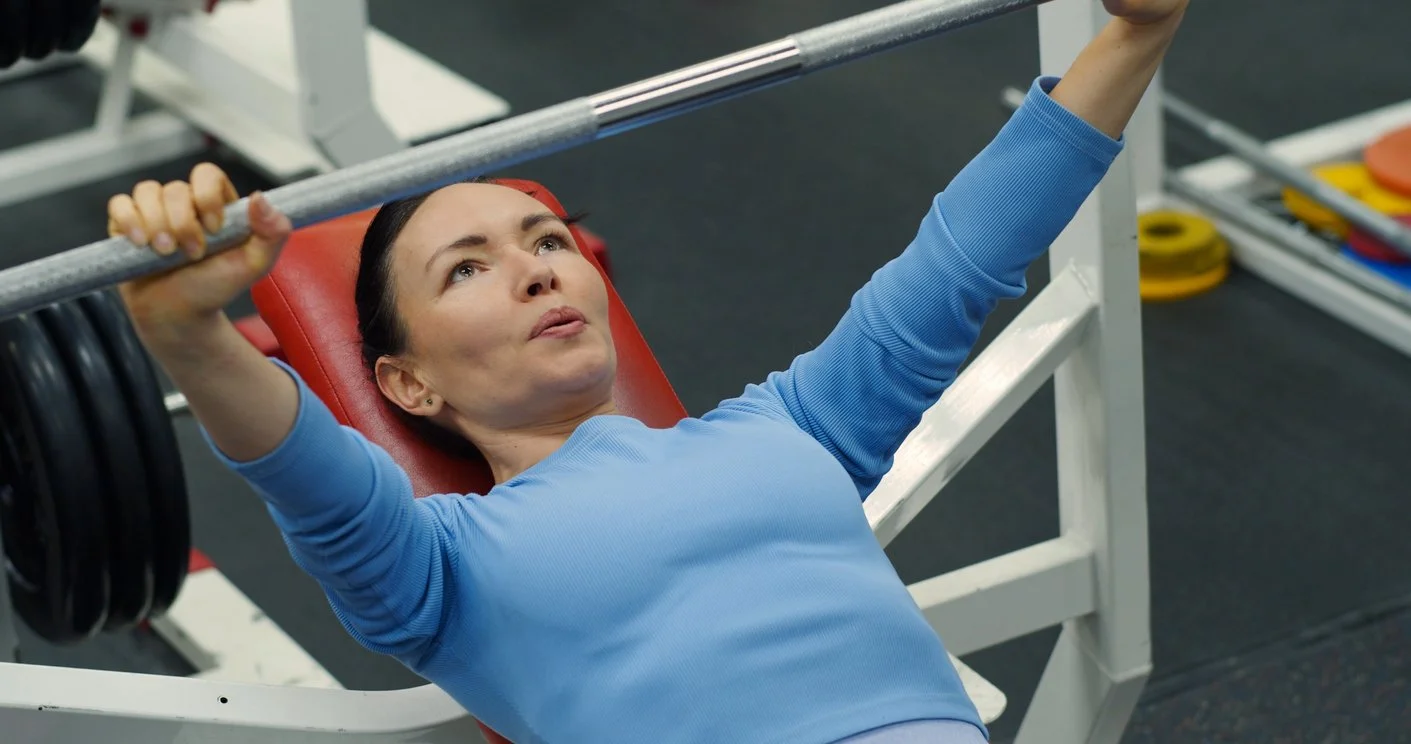
She is forty-six. She lifts three days a week and has for a decade. She tracks her protein. She walks the dog twice a day. Her labs, by most standards, look fine. And over the last two years she has gained eleven pounds that will not move — most of it through her midsection, in a pattern her body has never done before.
Then she says the sentence I hear more than any other in my exam room:
"I know it sounds vain, but—"
I want to answer that sentence carefully, because it deserves two separate answers and most physicians only give the second one.
The first answer: you don't need a medical reason to want this.
The second answer: and separately, what's happening to you is physiologic — which is why the work you're already doing stopped working.
Let me take those in order.
About the word she used
I want to spend real time on "vanity," because it is damaging to the women I see every week.
The women I'm describing hold themselves to a high standard in every domain of their lives. They are exacting about their work. They are exacting about how they show up for their families. They train with a consistency most people can't sustain for a month. Nobody calls a woman vain for wanting to make partner. Nobody calls her vain for wanting to run a faster half marathon, or to be the person her team can rely on, or to keep her house in order.
Apply that same exacting standard to her own body, though, and suddenly there's a word for it. And it is a word we deploy almost exclusively against women.
So here is my position, and I'll be clear that it is not a medical position — it's just a position:
A woman is allowed to want her body to feel like hers. She does not need a cardiovascular justification. She does not need a lab value that authorizes the request. She does not need me, or anyone else, to certify that her reason is serious enough to count.
And I want to name a trap, because a lot of well-meaning writing on this topic falls straight into it. If I reassure you "don't worry, this isn't vanity — it's a medical problem," I've quietly agreed with the accusation. I've conceded that wanting to look and feel like yourself is frivolous unless you can produce a disease to justify it.
I don't accept that premise.
The ten pounds matter because they matter to her. That is sufficient.
The physiology I'm about to walk through matters for an entirely different reason. It explains why her effort stopped converting into results. It is not the permission slip for wanting the result in the first place.

A woman is allowed to want her body to feel like hers.
Who I actually see
The stereotype of the woman seeking weight care is a woman who has never tried. That is not my patient population.
The women who come to me are typically in their late thirties and mid fifties. Physicians, attorneys, executives, teachers, nurses, founders, mothers of teenagers, toddlers and/ or young adults. They have a training program. Many have a nutritionist. They can tell me their protein intake to the gram and their deadlift to the pound. Several are, frankly, more disciplined than I am.
They are not asking me to hand them motivation. They are asking a much sharper question: why did the same inputs stop producing the same outputs?
That question deserves a physiologic answer, not a lecture.
Why the same inputs stopped working
The menopause transition is not a switch that flips at your final period. It is a multi-year endocrine renovation, and the body-composition changes begin before cycles stop [1,2].
In the Study of Women's Health Across the Nation (SWAN), fat mass gain accelerated roughly two years before the final menstrual period and continued for about eighteen months afterward, while lean mass declined over the same window [1]. Longitudinal imaging has shown that visceral adipose tissue rises specifically with the transition, alongside a measurable drop in energy expenditure [3]. A meta-analysis confirmed the pattern across cohorts: higher total fat and a distinctly more android distribution after menopause [4]. Critically, several of these changes track with menopausal status, not simply chronological age [5].
Here is what is actually moving underneath.

If you are eating adequate protein, training consistently, sleeping as well as your hormones permit, and still watching your body composition change — you have not failed at anything. You are experiencing a predictable endocrine transition that rewrote the terms of the equation you were solving.
Six variables changed. She changed none of them.
Notice what is not on that list: willpower.
This is not a discipline problem
I want to say this plainly, because most of my patients have never heard a physician say it.
If you are eating adequate protein, training consistently, sleeping as well as your hormones permit, and still watching your body composition change — you have not failed at anything. You are experiencing a predictable endocrine transition that rewrote the terms of the equation you were solving.
The women in my exam room have usually been told some version of eat less, move more, manage your stress. They have already done all three, impeccably, for years. Repeating that advice louder is not medicine. It is abandonment with a friendly tone.
Why I also take this seriously as a cardiometabolic issue
Everything above stands on its own. What follows is additional — not the justification, the escalation.
Subcutaneous fat and visceral fat are not the same tissue doing the same thing. Visceral adipose tissue is metabolically active and independently associated with atherosclerotic and cardiometabolic risk [12]. The American Heart Association has formally recognized the menopause transition as a window of accelerating cardiovascular risk in women, driven in part by exactly these shifts [13].
So when a woman tells me she has gained twelve pounds "in a completely different place," she is handing me two things at once: a goal that belongs to her, and a clinical finding that belongs in her chart. I take both seriously. I don't require the second to act on the first.

Subcutaneous fat and visceral fat are not the same tissue doing the same thing.
Where GLP-1 medications fit
GLP-1 and dual-agonist therapies changed what is possible. In STEP 1, semaglutide 2.4 mg produced approximately 15% mean body-weight reduction over 68 weeks [14]; tirzepatide 15 mg produced roughly 21% in SURMOUNT-1 [15].
But most of the women I'm describing don't need a 20% reduction. Their gap is ten to fifteen pounds, not sixty.
That distinction matters clinically, and it's where I see prescribing error in both directions — physicians who refuse to discuss these medications at all, and clinics that titrate every patient to maximum regardless of goal.
The dose-ranging data support calibration. In the phase 2 semaglutide trial, lower doses produced clinically meaningful weight reduction well below maximum dosing [16]. In practice: a low-dose, slowly-titrated strategy is often correct for a woman whose objective is metabolic recalibration rather than large-volume loss.
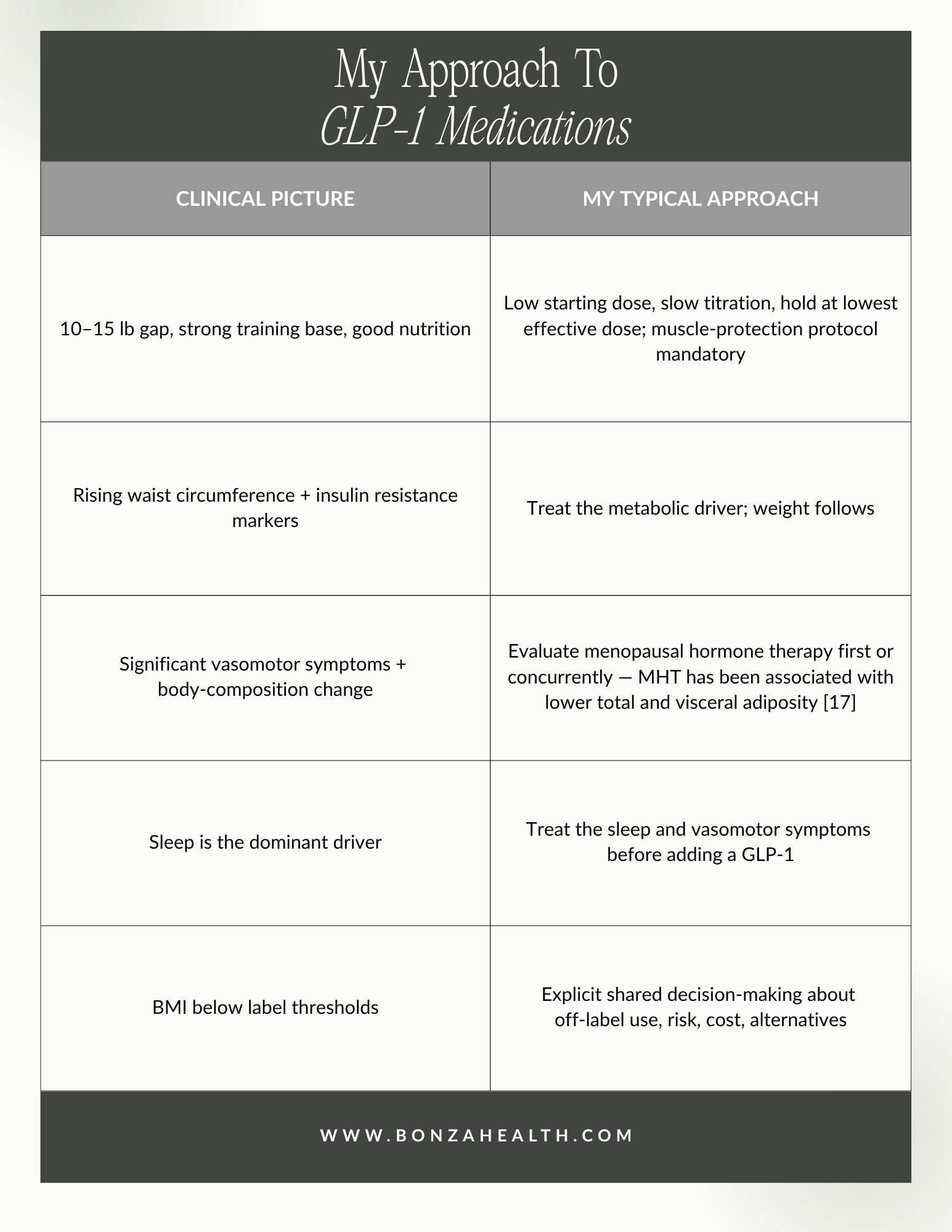
In practice: a low-dose, slowly-titrated strategy is often correct for a woman whose objective is metabolic recalibration rather than large-volume loss.
Protecting muscle and bone — the non-negotiables
This is the part that gets skipped, and the part I care most about.
Any substantial weight loss includes some loss of lean tissue; reviews of GLP-1 receptor agonist therapy suggest a meaningful proportion of total weight lost can come from lean mass, broadly comparable to lifestyle-induced loss [18]. For a woman of fifty, losing muscle and bone during the exact decade she is already losing both is a bad trade — one that arrives twenty-five years later as a fractured hip.

Any substantial weight loss includes some loss of lean tissue.
If a woman on my protocol is losing weight while her grip strength falls and lean mass drops on serial imaging, that is a treatment failure — even if the scale reads exactly what she asked for.
"Within reason" — the line I actually draw
Since I've argued that a woman's standard for herself doesn't require my approval, let me be specific about what I do evaluate. Because I do evaluate something.
I don't assess her motive. I assess the method and the sustainability.
The question is never is your reason good enough? The questions are:
Can she reach this and live there, without perpetual restriction?
Does the plan protect muscle, bone, sleep, and menstrual function?
Is her relationship with the goal one that makes her life larger, or smaller?
If a target requires her to be chronically underfed, to lose bone, to abandon strength, or to organize her entire life around a number — I say so, directly. Not because her wanting was wrong, but because the method will cost her more than it returns. That's a clinical judgment about a plan, not a moral judgment about a woman.
That's the whole distinction. And it's a far more useful line than the one that just asks whether she's being vain.
My stance
I don't get to decide what standard a woman holds for herself.
Some of my patients want to feel like themselves in their clothes. Some are training for athletic compeitions. Some want their waist circumference out of the range that predicts a cardiac event at sixty-five. Some want all three. None of those goals require my approval, and I'm not interested in ranking them.
My job is narrower and more useful than judgment: help her get where she's going without wrecking her metabolism or her bones on the way.
That means naming the physiology honestly. Measuring what actually matters. Using medication when medication is the right tool, at the lowest effective dose, with muscle and bone protected on purpose.
And it means never again letting a competent, disciplined, high-functioning woman sit in my exam room and apologize for holding herself to a standard she has every right to hold.

My job as a physician is to help patients get where they’re going without wrecking their metabolism or their bones on the way.
Frequently Asked Questions
Is it vain to want to lose 10 pounds in perimenopause?
No. Wanting your body to feel like yours is a legitimate reason on its own — it does not require a medical justification, a lab abnormality, or anyone's approval. Separately, the physiologic changes of perimenopause are real and treatable, which is why the effort that used to work may have stopped working.
Why am I gaining weight in perimenopause when nothing about my diet or exercise has changed?
Because the physiology changed. Declining estradiol shifts fat storage toward the visceral compartment, reduces insulin sensitivity, and coincides with lean-mass loss and fragmented sleep. Body-composition changes begin roughly two years before the final menstrual period [1,3].
Is perimenopause weight gain reversible?
The distribution and metabolic consequences are modifiable. That typically requires addressing sleep and vasomotor symptoms, adequate protein, progressive resistance training, and — for some women — hormone therapy or a GLP-1 medication.
Can I take a GLP-1 if I only need to lose 10–15 pounds?
Sometimes, with careful shared decision-making. FDA labeling is tied to BMI thresholds, so use below those thresholds is off-label. Dose-ranging evidence shows lower doses produce meaningful effects [16], supporting a low-dose, slow-titration approach when appropriate.
Will a GLP-1 make me lose muscle?
Some lean-mass loss accompanies most weight loss [18]. That is why a protein floor of at least 1.2 g/kg/day, progressive resistance training 2–4 times weekly, and serial body-composition monitoring are non-negotiable parts of the protocol.
Should I try hormone therapy instead?
For many women with vasomotor symptoms and sleep disruption, menopausal hormone therapy is the more appropriate first conversation; it has been associated with lower total and visceral adiposity [17]. This is an individualized decision.
This article is educational and is not a substitute for individualized medical advice. Treatment decisions, including any use of GLP-1 receptor agonists, should be made with your own physician.
Dr. Sarah Bonza is a board-certified physician and the founder of Bonza Health, where she cares for women navigating perimenopause and midlife metabolic health. To discuss whether this applies to you, visit www.bonzahealth.com.
References
[1] G. A. Greendale, B. Sternfeld, M. Huang, W. Han, C. Karvonen-Gutierrez, K. Ruppert, J. A. Cauley, J. S. Finkelstein, S.-F. Jiang, and A. S. Karlamangla, "Changes in body composition and weight during the menopause transition," JCI Insight, vol. 4, no. 5, e124865, 2019. https://doi.org/10.1172/jci.insight.124865
[2] N. Santoro, C. Roeca, B. A. Peters, and G. Neal-Perry, "The menopause transition: Signs, symptoms, and management options," J. Clin. Endocrinol. Metab., vol. 106, no. 1, pp. 1–15, 2021. https://doi.org/10.1210/clinem/dgaa764
[3] J. C. Lovejoy, C. M. Champagne, L. de Jonge, H. Xie, and S. R. Smith, "Increased visceral fat and decreased energy expenditure during the menopausal transition," Int. J. Obes. (Lond.), vol. 32, no. 6, pp. 949–958, 2008. https://doi.org/10.1038/ijo.2008.25
[4] A. Ambikairajah, E. Walsh, H. Tabatabaei-Jafari, and N. Cherbuin, "Fat mass changes during menopause: A metaanalysis," Am. J. Obstet. Gynecol., vol. 221, no. 5, pp. 393–409.e50, 2019. https://doi.org/10.1016/j.ajog.2019.04.023
[5] M. J. Toth, A. Tchernof, C. K. Sites, and E. T. Poehlman, "Effect of menopausal status on body composition and abdominal fat distribution," Int. J. Obes. Relat. Metab. Disord., vol. 24, no. 2, pp. 226–231, 2000. https://doi.org/10.1038/sj.ijo.0801118
[6] F. Mauvais-Jarvis, D. J. Clegg, and A. L. Hevener, "The role of estrogens in control of energy balance and glucose homeostasis," Endocr. Rev., vol. 34, no. 3, pp. 309–338, 2013. https://doi.org/10.1210/er.2012-1055
[7] C. Karvonen-Gutierrez and C. Kim, "Association of mid-life changes in body size, body composition and obesity status with the menopausal transition," Healthcare (Basel), vol. 4, no. 3, p. 42, 2016. https://doi.org/10.3390/healthcare4030042
[8] F. C. Baker, M. de Zambotti, I. M. Colrain, and B. Bei, "Sleep problems during the menopausal transition: Prevalence, impact, and management challenges," Nat. Sci. Sleep, vol. 10, pp. 73–95, 2018. https://doi.org/10.2147/NSS.S125807
[9] A. V. Nedeltcheva, J. M. Kilkus, J. Imperial, D. A. Schoeller, and P. D. Penev, "Insufficient sleep undermines dietary efforts to reduce adiposity," Ann. Intern. Med., vol. 153, no. 7, pp. 435–441, 2010. https://doi.org/10.7326/0003-4819-153-7-201010050-00006
[10] G. I. Smith, D. N. Reeds, A. M. Hall, K. T. Chambers, B. N. Finck, and B. Mittendorfer, "Sexually dimorphic effect of aging on skeletal muscle protein synthesis," Biol. Sex Differ., vol. 3, no. 1, p. 11, 2012. https://doi.org/10.1186/2042-6410-3-11
[11] M. L. Maltais, J. Desroches, and I. J. Dionne, "Changes in muscle mass and strength after menopause," J. Musculoskelet. Neuronal Interact., vol. 9, no. 4, pp. 186–197, 2009. https://pubmed.ncbi.nlm.nih.gov/19949277/
[12] I. J. Neeland, R. Ross, J.-P. Després, Y. Matsuzawa, S. Yamashita, I. Shai, J. Seidell, P. Magni, R. D. Santos, B. Arsenault, A. Cuevas, F. B. Hu, B. Griffin, A. Zambon, P. Barter, J.-C. Fruchart, and R. H. Eckel, "Visceral and ectopic fat, atherosclerosis, and cardiometabolic disease: A position statement," Lancet Diabetes Endocrinol., vol. 7, no. 9, pp. 715–725, 2019. https://doi.org/10.1016/s2213-8587(19)30084-1
[13] S. R. El Khoudary, B. Aggarwal, T. M. Beckie, H. N. Hodis, A. E. Johnson, R. D. Langer, M. C. Limacher, J. E. Manson, M. L. Stefanick, and M. A. Allison, "Menopause transition and cardiovascular disease risk: Implications for timing of early prevention — A scientific statement from the American Heart Association," Circulation, vol. 142, no. 25, pp. e506–e532, 2020. https://doi.org/10.1161/CIR.0000000000000912
[14] J. P. H. Wilding, R. L. Batterham, S. Calanna, M. Davies, L. F. Van Gaal, I. Lingvay, B. M. McGowan, J. Rosenstock, M. T. D. Tran, T. A. Wadden, S. Wharton, K. Yokote, N. Zeuthen, and R. F. Kushner, "Once-weekly semaglutide in adults with overweight or obesity," N. Engl. J. Med., vol. 384, no. 11, pp. 989–1002, 2021. https://doi.org/10.1056/nejmoa2032183
[15] A. M. Jastreboff, L. J. Aronne, N. N. Ahmad, S. Wharton, L. Connery, B. Alves, A. Kiyosue, S. Zhang, B. Liu, M. C. Bunck, and A. Stefanski, "Tirzepatide once weekly for the treatment of obesity," N. Engl. J. Med., vol. 387, no. 3, pp. 205–216, 2022. https://doi.org/10.1056/nejmoa2206038
[16] P. M. O'Neil, A. L. Birkenfeld, B. McGowan, O. Mosenzon, S. D. Pedersen, S. Wharton, C. G. Carson, C. H. Jepsen, M. Kabisch, and J. P. H. Wilding, "Efficacy and safety of semaglutide compared with liraglutide and placebo for weight loss in patients with obesity: A randomised, double-blind, placebo and active controlled, dose-ranging, phase 2 trial," Lancet, vol. 392, no. 10148, pp. 637–649, 2018. https://doi.org/10.1016/s0140-6736(18)31773-2
[17] G. E. Papadakis, D. Hans, E. Gonzalez Rodriguez, P. Vollenweider, G. Waeber, P. Marques-Vidal, and O. Lamy, "Menopausal hormone therapy is associated with reduced total and visceral adiposity: The OsteoLaus cohort," J. Clin. Endocrinol. Metab., vol. 103, no. 5, pp. 1948–1957, 2018. https://doi.org/10.1210/jc.2017-02449
[18] J. A. Sargeant, J. Henson, J. A. King, T. Yates, K. Khunti, and M. J. Davies, "A review of the effects of glucagon-like peptide-1 receptor agonists and sodium-glucose cotransporter 2 inhibitors on lean body mass in humans," Endocrinol. Metab. (Seoul), vol. 34, no. 3, pp. 247–262, 2019. https://doi.org/10.3803/enm.2019.34.3.247
[19] T. M. Longland, S. Y. Oikawa, C. J. Mitchell, M. C. Devries, and S. M. Phillips, "Higher compared with lower dietary protein during an energy deficit combined with intense exercise promotes greater lean mass retention and fat mass loss," Am. J. Clin. Nutr., vol. 103, no. 3, pp. 738–746, 2016. https://doi.org/10.3945/ajcn.115.119339
[20] J. Bauer, G. Biolo, T. Cederholm, M. Cesari, A. J. Cruz-Jentoft, J. E. Morley, S. Phillips, C. Sieber, P. Stehle, D. Teta, R. Visvanathan, E. Volpi, and Y. Boirie, "Evidence-based recommendations for optimal dietary protein intake in older people: A position paper from the PROT-AGE Study Group," J. Am. Med. Dir. Assoc., vol. 14, no. 8, pp. 542–559, 2013. https://doi.org/10.1016/j.jamda.2013.05.021
[21] D. T. Villareal, L. Aguirre, A. B. Gurney, D. L. Waters, D. R. Sinacore, E. Colombo, R. Armamento-Villareal, and C. Qualls, "Aerobic or resistance exercise, or both, in dieting obese older adults," N. Engl. J. Med., vol. 376, no. 20, pp. 1943–1955, 2017. https://doi.org/10.1056/nejmoa1616338
[22] S. L. Watson, B. K. Weeks, L. J. Weis, A. T. Harding, S. A. Horan, and B. R. Beck, "High-intensity resistance and impact training improves bone mineral density and physical function in postmenopausal women with low bone mass: The LIFTMOR randomized controlled trial," J. Bone Miner. Res., vol. 33, no. 2, pp. 211–220, 2018. https://doi.org/10.1002/jbmr.3284